Category Latin America/Caribbean

US Shifts Stance On Drug Pricing In Pacific Trade Pact Talks, Document Reveals
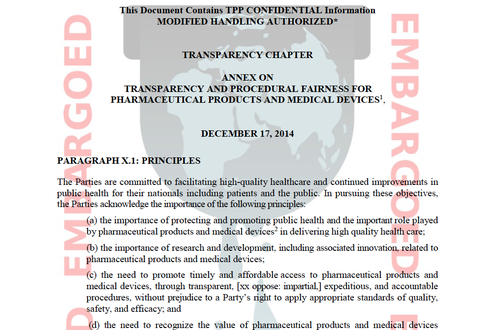
From the New York Times: WASHINGTON — Facing resistance from its Pacific trading partners, the Obama administration is no longer demanding protection for pharmaceutical prices under the 12-nation Trans-Pacific Partnership, according to a newly leaked “transparency” annex of the proposed trade accord.

But American negotiators are still pressing participating governments to open up the process that sets reimbursement rates for drugs and medical devices. Public health professionals, generic drugmakers and activists opposed to the trade deal, which is still being negotiated, contend that it will empower big pharmaceutical firms to command higher reimbursement rates in the United States and abroad, at the expense of consumers.

The Chilean Mining Industry: The Role Of IP In The Innovation Process

The mining industry in Chile offers an interesting case study on the role of intellectual property in the innovation process, according to a discussion at a recent event held at the World Intellectual Property Organization.

Confidential USTR Emails Show Close Industry Involvement In TPP Negotiations

While a full range of stakeholders would be affected by the outcome of the Trans-Pacific Partnership (TPP) agreement under secret negotiation by the United States and a dozen trading partners, corporate representatives have had a special seat at the negotiating table, as shown by hundreds of pages of confidential emails from the US Trade Representative’s office obtained by Intellectual Property Watch. The emails give a rare and fascinating perspective on how policy is developed in the trade office.

Report: Patent Activity At A High But Decline In Scientific Research Could Show Innovation Slowing

Patent activity is currently at an all-time high, with statistics showing large growth across industry sectors in the volume of patents being filed. However, the production of scientific literature is declining, according to a new report from Thomson Reuters.

Lack Of Locally Relevant Online Content Deters Mobile Users In Developing Countries, WSIS Panel Says

Although most people in the world live within reach of a mobile internet signal, a considerable amount of mobile users in developing countries are not using the opportunity to go online. One of the factors, according to a panel today, is the lack of locally relevant content.

Five Challenges Filed Against Gilead Patent Claims For Hepatitis C Drug

Pharmaceutical company Gilead Sciences has been noted first for developing a treatment for hepatitis C, which afflicts tens of millions around the world, and then for pricing it at jaw-dropping prices ($1000 per pill) in the United States and elsewhere. Now a group of health advocates has challenged Gilead's patent applications in five emerging economies.

Divide And Conquer: The New US Strategy To Disentangle The TPP Negotiations

Burcu Kilic & Pablo Viollier write: Political leaders in Washington and other Trans-Pacific Partnership (TPP) negotiating countries have set the end of May as the latest deadline for completion of the talks. The negotiations have already missed several such deadlines, so who really knows? No one. But there is something we all know: TPP raises significant concerns because negotiations are being held behind closed doors with details kept secret even from the legislatures in TPP countries.

Update On Yale/IP-Watch Effort To Open TPP Texts

Intellectual Property Watch has been working for several years to obtain more details about the intellectual property aspects of the Trans-Pacific Partnership (TPP) agreement negotiations through a Freedom of Information Act (FOIA) request, and a subsequent lawsuit to enforce that request, which is being led by a team at the Media Freedom and Information Access Clinic at Yale Law School (MFIA). Today MFIA, a program of Yale's Information Society Project and Abrams Institute, released an update on the case.

Manila Principles On Intermediary Liability Offer Vision For Balance

A new set of principles launched this week by a range of global non-governmental organisations attempts to set out guidelines for internet intermediaries’ liability for content of communications. The six principles, which are seeking endorsement from organisations and individuals worldwide, address freedom of expression, freedom of association, and the right to privacy.

Brazil’s Internet Legal Framework Regulation And Draft Bill For Privacy Law Public Consultation

On 28 January 2015, the Brazilian Ministry of Justice launched public consultations involving two key pieces of legislation, namely: the decree that will regulate the Marco Civil da Internet or the Brazilian Civil Rights Framework for the Internet (the "Internet Legal Framework"); and the Draft Bill for the Protection of Personal Data ("Draft Bill"). A consultation period is being conducted in relation to these two laws via online platforms set up by the government.