

The German Constitutional Court in a fast-track decision today rejected the granting of emergency injunctions against a German signature of the Comprehensive Economic and Trade Agreement (CETA) of Europe with Canada.
Four groups with a total of close to 200,000 people (2 BvR 1368/16, 2 BvR 1444/16, 2 BvR 1823/16, 2 BvR 1482/16, 2 BvE 3/16) (English version here) had appealed to the highest German court to stop their government from signing the free trade deal with Canada at a meeting of the European Council of trade ministers on 18 October.
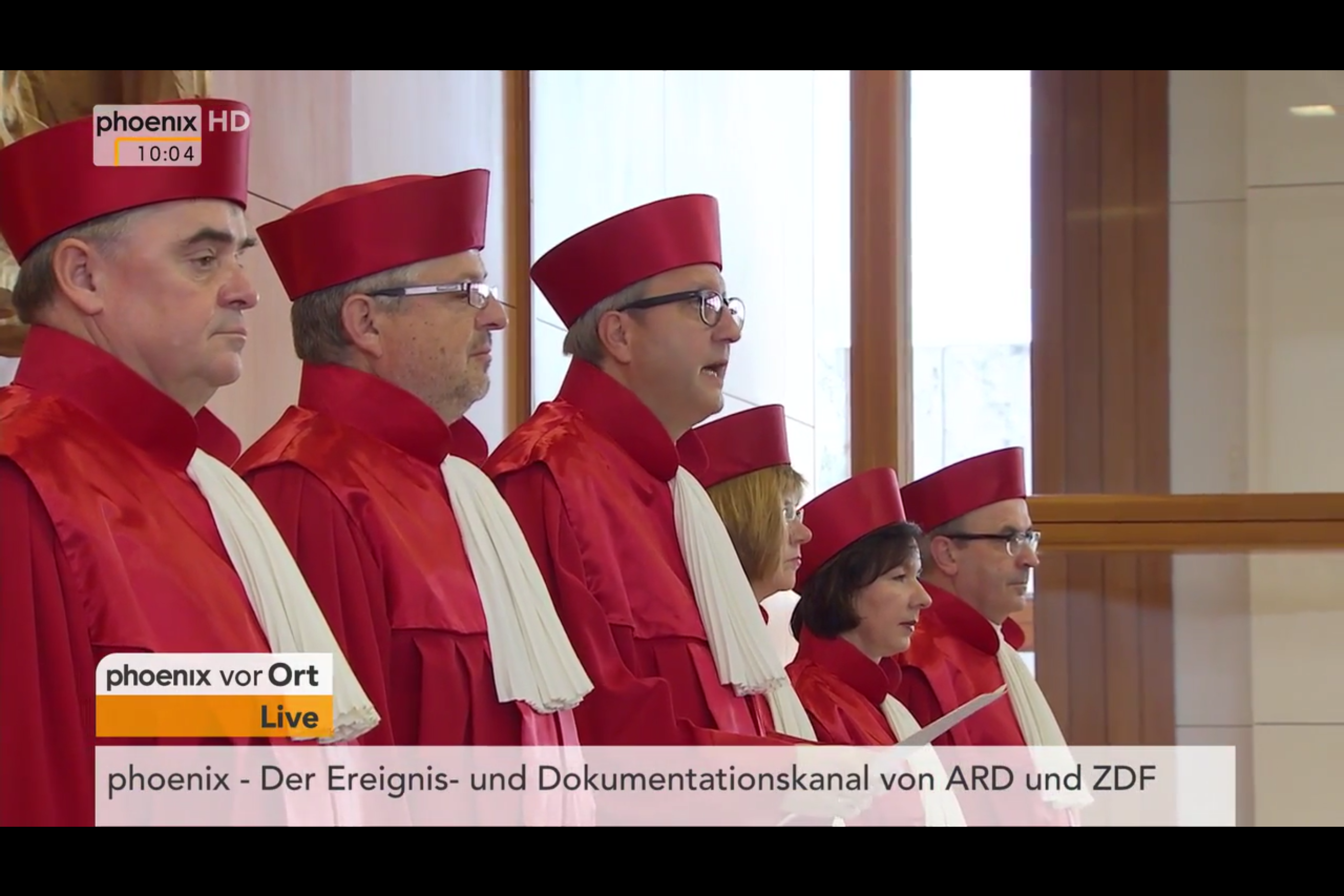
While paving the way for the closure of the deal at the Canada-EU summit end of the month, the German judges also tasked the government with making a binding declaration on its ability to withdraw from CETA unilaterally in case the court ruled CETA unconstitutional in the following principle proceedings.
The German government in a lengthy hearing of the parties on 12 October implored the “red robes” to declare the appeals void as a block of the German vote on the EU level next week could result in the failure of CETA. Acknowledging the potential economic, according to the court even bigger political consequences of a blocking of CETA, the court rejected the emergency injunctions.
“Would the court grant the immediate injunction, but in the principle proceedings rule the government’s signature for the temporary application of CETA to be constitutional, the general public could suffer heavy consequences,” the presiding judge, Andreas Vosskuhle, explained when handing the decision today in Karlsruhe. A potential delay or even failure of CETA, the judges found, could “severely interfere with the government’s ability to act in its European, foreign and foreign trade policy.”
Conditions for German CETA signature, according to the Court
Weighing potential negative effects for the hundreds of thousands of citizens, several NGOs and the party group “The Left” from the German Bundestag, the court nevertheless put some obligations on the government going ahead with its CETA signature.
According to the oral ruling: “The government has to ensure that a EU Council decision about the temporary application only extends to those parts of CETA that unquestionably fall under EU competency.”
According to the court provisions for investment protection, including the investor-state dispute settlement (ISDS) arbitration court system (chapter 8 and 13), international maritime traffic (chapter 14), the recognition of professional qualifications (chapter 11) and labour protection (chapter 23) clearly are not under EU competency.
The general question if the European Commission can sign treaties including free trade agreements or binding international agreements like the Marrakesh Treaty (see IP-Watch) without involvement of the EU member state legislators is before the European Court of Justice. EU Trade Commissioner Malmstroem had always expressed that she was unconvinced about the need to pass CETA as a mixed agreement (see IP-Watch), but saw it as a compromise. The relevant court case for the EU-Singapore trade agreement is pending.
Obligation number two from the Constitutional Court is “that until the final conclusion of the court case all decisions of the planned CETA mixed committee have to be bound by democratic control.” A shift of competencies from democratic bodies in the nation states to a mixed CETA committee made up from EU and Canadian officials is unconstitutional according to the applicants.
Finally, the German judges who did not want to block CETA passage decided that as long as Germany could withdraw from the FTA, a potential ruling in favour of the applicants could still be implemented.
The government during the hearing yesterday explained that according to its interpretation of Article 30.7.3.c, a unilateral withdrawal of one member state remained possible. To hold the government to its statement, Vosshoff, when presenting the oral ruling said, the government had to “immediately and according to international law standards” notify the partners of the treaty about this interpretation.
Opposition, not only in Germany
The conditions laid out by the judges, according to experts, also are a sign that the court sees merit in some of the arguments of the applicants. Judges from other German courts had in the ongoing controversy heavily questioned the system of a parallel investment court system.
Several parliaments of EU member states, including the Netherlands and more recently Ireland, have passed votes against CETA, but it is unclear how the respective governments will vote in the Council, once an additional “declaration” that is supposed to “clarify” the treaty text has been agreed by ministers.
[…] German High Court Paves Way For Government To Sign CETA, Hands Down Conditions […]