

As prospective presidential candidates prepare to plunge voters in the United States into campaign purgatory, it is time for pundits to examine how candidates are branding their political campaigns and crafting their messages to appeal to the electoral audience. With the presidential race beginning to heat up, which candidate will seize the message that resonates most with American voters? And what will that message be?
Will the election message be about stability (like President Reagan’s “stay the course” campaign theme for the 1982 mid-term elections), or about change (like President Obama’s 2008 “change we can believe in” message or President Clinton’s slightly more nuanced “don’t stop thinking about tomorrow”)? Will the election be about “new ideas” (Gary Hart, 1984) or about realizing old ideals (Ronald Reagan’s 1984 “It’s morning again in America”). Are voters eager for “peace and prosperity” (Dwight D. Eisenhower, 1956) or receptive to a message evoking a candidate’s war record (John McCain’s “country first,” 2008).
One thing is clear. An organization that can monopolize a message with broad voter appeal may realize a distinct advantage in an election campaign. Presumably, that is what motivated the conservative organization Concerned Women for America in 1996 to register with the US Trademark Office the service mark PUTTING FAMILIES FIRST for “association services, namely promoting public awareness of the need for Christian family values in our society” (US Registration No. 1922642). When the Democratic Congressional Campaign Committee that year adopted the phrase “Families First” in connection with its legislative agenda, Concerned Women for America sued, charging trademark infringement. US District Judge Thomas Penfield Jackson denied the requested temporary restraining order, citing First Amendment concerns.
Four years later, Republicans cleverly turned the tables. The Children’s Defense Fund adopted the mark LEAVE NO CHILD BEHIND to identify its advocacy services, but George W. Bush’s presidential campaign appropriated the mark to identify elements of the candidate’s platform and legislative agenda. President Bush later denominated his school reform initiative the No Child Left Behind Act.
Politicos also have sought to use trademark protection to monopolize criticism of candidates. Thus, individuals have sought trademark registration for marks like NOBAMA, or BARACK’S JOCKS DRESS TO THE LEFT, or the crass IT’S TIME FOR A DIFFERENT KIND OF BUSH IN OFFICE CLINTON 2016 for bumper stickers and other campaign paraphernalia promoting (or criticizing) a political campaign. The Trademark Office refused these efforts under a law prohibiting a trademark applicant from using a name identifying a particular living individual without that individual’s consent.
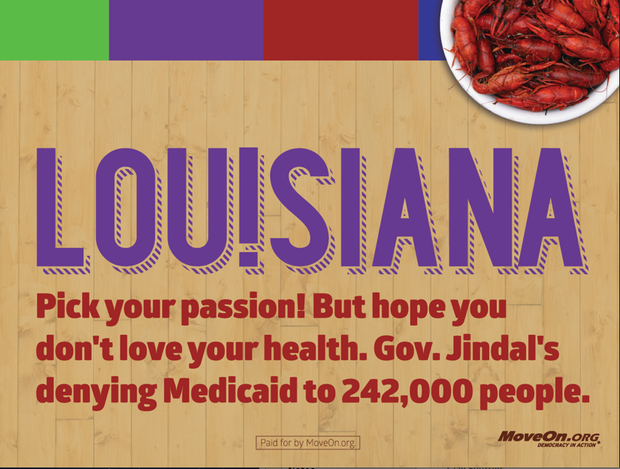
And politicians have sought to use trademark law to stifle political criticism. For example, the administration of Louisiana Governor and presidential hopeful Bobby Jindal conceived the service mark LOUISIANA PICK YOUR PASSION as part of a $69+ million dollar tourism campaign. But the national left-leaning group MoveOn.org mimicked the branding in a satirical billboard it erected near the state capital:
For comparison, here is the original mark:
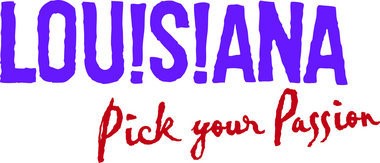
Jindal’s Lieutenant Governor Jay Dardenne brought suit in federal court in Louisiana last year and requested injunctive relief to remove the MoveOn billboard, charging trademark infringement. MoveOn explained that it erected the billboard as part of a campaign aimed at changing the minds of some of the governors and legislative leaders who had resisted allowing their states to take advantage of the federally-funded expansion of Medicaid under the Patient Protection and Affordable Care Act of 2010. The idea was to parody a state’s tourism slogan and logo to make the point that certain jurisdictions seeking to portray themselves as hospitable to tourists were not very good places to live from the viewpoint of offering affordable healthcare. Thus, MoveOn argued that its parodic use of the Louisiana PICK YOUR PASSION mark for this expressive, non-commercial purpose was protected speech and that voters would not be confused by the use. Judge Shelly Dick agreed that the expression at issue involved protected political speech and stated that the state had failed to demonstrate a compelling reason to curtail MoveOn’s political speech and had not shown any permanent damage to the state’s mark resulting from the message on MoveOn’s billboard. [1]/
What marks and taglines are the 2016 presidential candidates using, and what can we deduce about their campaigns?
Perhaps the most notable thing about the design marks for the campaigns of Hillary Clinton and Jeb Bush is that the designs omit altogether any reference to the last names of the candidates:
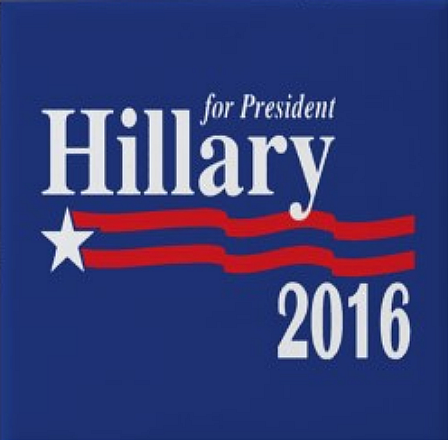
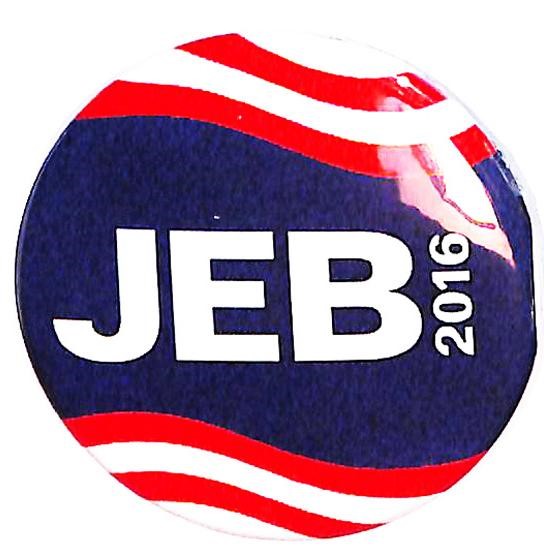
One might deduce that neither candidate wants to be associated with the president (or presidents) of the same name that preceded him or her, and that each is sufficiently well known to use only a first name and still feel confident of achieving high voter recognition.
What about lesser known candidates?
On the Democratic side, neither Vermont Senator Bernie Sanders nor former Maryland Governor Martin O’Malley has anywhere near the name recognition of former Senator and Secretary of State Hillary Clinton, although Senator Sanders seems to be trying to achieve the same casual “you know me” feeling with his BERNIE design mark:
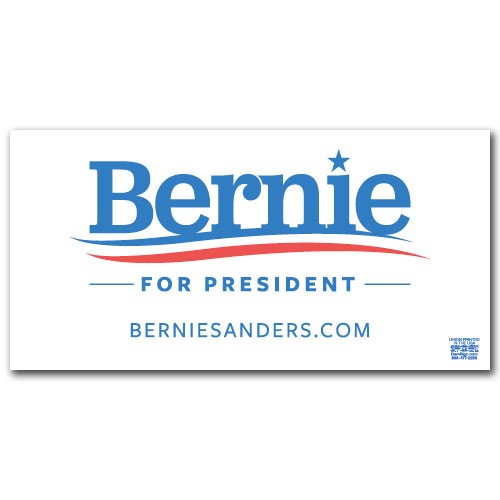 In the case of Sanders, his campaign tagline is more distinctive and remarkable then his design:

Sanders is running as a progressive, left-leaning candidate, and his tagline conveys exactly that message: that he is a major change agent who will shake things up. In contrast, Hillary Clinton, having been a cabinet member in the current administration, cannot as easily adopt a change agent tagline.
Martin O’Malley’s tagline, like the Sanders tagline, evokes change with its focus on “new leadership”:

But whereas the Sanders tagline is outward facing, with its implied question “ARE YOU ready to start a political revolution?,” the O’Malley tagline is not an outward facing question but merely a statement about O’Malley himself (he’s ready to be the new leader), subliminally reinforcing the views of some antagonists that he is a self-absorbed “prettyboy” candidate.
Ironically, the efforts of Hillary Clinton’s potential primary opponents to position themselves to her ideological left may have the effect of pushing her into the role of the centrist candidate. Already, her campaign biography is emphasizing her roots as a small town Republican, which could help her considerably in the general election, presuming she survives the Democratic primary.
On the Republican side, as might be expected, there is a very strong focus on change and the implicit suggestion that the current Democratic administration has dimmed American power and promise. Perhaps the boldest campaign tagline among Republican candidates trumpeting this theme is Kentucky Senator Rand Paul’s, with its focus on “defeating the Washington machine”:
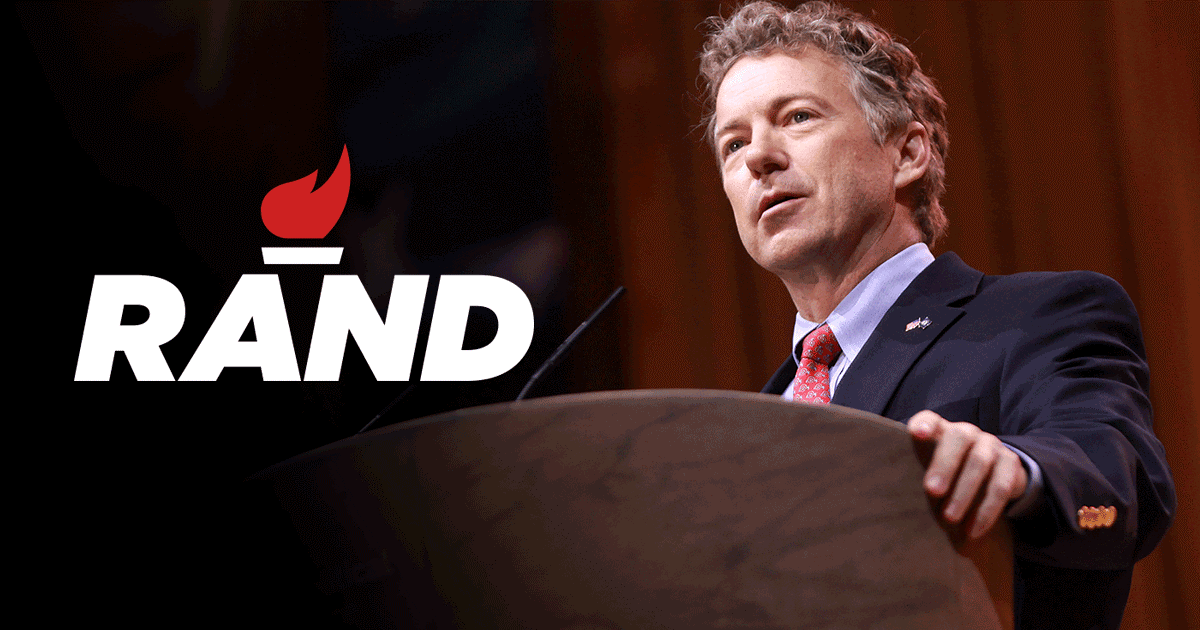
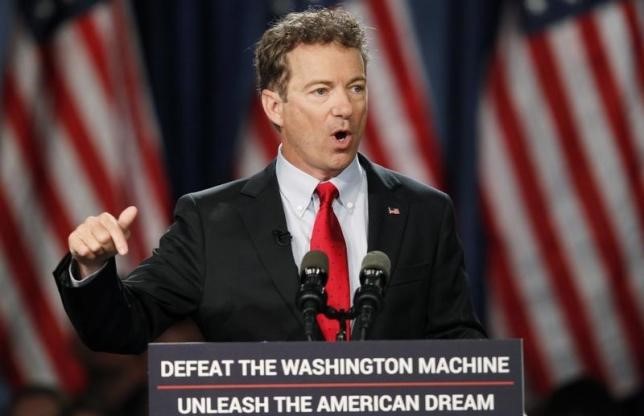
Paul, who refers to himself on some campaign literature as Dr. Rand Paul rather than Senator Rand Paul to emphasize his professional background as an ophthalmologist rather than a US Senator, also uses a second tagline:
By doing so, he dismisses his Republican competition and takes direct aim at the leading Democratic standard-bearer. His Olympic-like torch design mark sitting atop his first name suggests that he carries the torch of liberty.

Among the other Republican candidates, Texas Senator Ted Cruz, Florida Senator Marco Rubio, former Hewlett Packard CEO Carly Fiorina, former Pennsylvania Senator Rick Santorum and New York entrepreneur Donald Trump sound similar themes:
| Candidate’s Design Mark | Candidate’s Tagline |
 |
REIGNITING THE PROMISE OF AMERICA |
 |
ARE YOU READY FOR A NEW AMERICAN CENTURY? |
 |
WE MUST ONCE AGAIN BECOME A NATION OF LIMITLESS POSSIBILITY. |
 |
RESTORE THE AMERICAN DREAM FOR HARDWORKING FAMILIES |
 |
MAKE AMERICA GREAT AGAIN! |
Ted Cruz uses a flag motif in the flame preceding his name to highlight his patriotism. Marco Rubio uses all lower case letters for his name, connoting that he is a populist man of the people, and his use of a cut-out map of America symbolizes his national ambitions, transcending his Florida roots. Carly Fiorina’s first-name only design with a five-pointed star invokes the Hillary design mark. Rick Santorum’s red eagle suggests a vaguely military motif, and his tagline emphasizes American families. Donald Trump, famously known in the trademark world for the unsuccessful efforts of his ex-wife, Ivana, to trademark THE DONALD and his own ill-fated attempt to trademark YOU’RE FIRED! uses a design that trumpets Trump himself.
Hitting a slightly different and unique note is the mark of Dr. Ben Carson, a pediatric neurosurgeon:

Texas Governor Rick Perry’s campaign branding includes a design mark featuring his last name but no tagline, which may make it difficult for him to lay claim to being the candidate of new ideas:
In 2008, President Obama’s transformative rising blue O, emerging like the sun from a prairie field of red and white stripes, became an iconic symbol of that season’s election campaign and marked the candidate as the leading change agent of that election.
It will be interesting to see how the candidates’ branding evolves in the current election season, which featured campaign themes will resonate most with the electorate, and which candidates will emerge as transformative leaders best able to seize the hearts and minds of voters.
Steven P. Hollman is a partner in Hogan Lovells’ Washington DC office. He is a trial lawyer whose practice focuses principally on intellectual property litigation, including trademark and false advertising disputes, and complex commercial litigation. He has been teaching about trademark enforcement for over ten years and writes frequently about political branding. He ran unsuccessfully for the Maryland State Senate in 2002.
[1]/ See Jay Dardenne v. MoveOn, Civil Action 3:14-cv-00150-SDD-SCR (M.D. La. Apr. 7, 2014)(Ruling denying Motion for Preliminary Injunction).
[…] is specifically tailoring their messages in order to with their political party’s nomination. A recent article on the blog Intellectual Property Watch discussed how these candidates tried to set themselves apart from their competitors through […]
How do I send a slogan to Mr. Trump’s campaign?