Category Bilateral/Regional Negotiations

Protecting And Promoting Copyright Balance In NAFTA

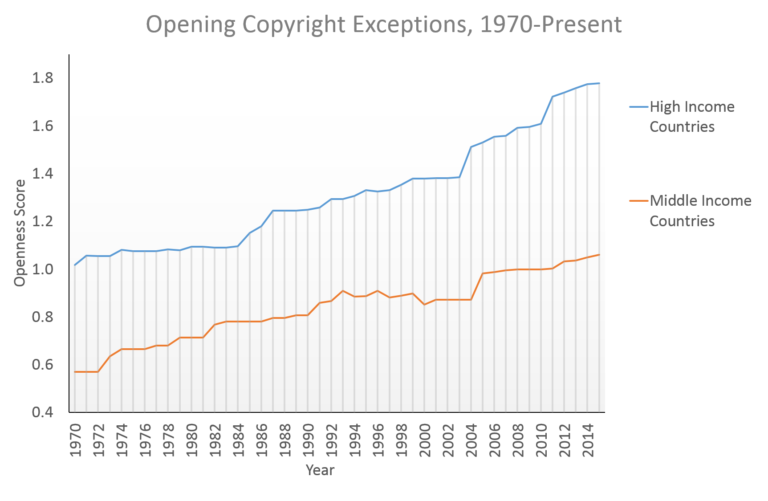
The ongoing NAFTA renegotiation presents a prime opportunity to move the ball on protecting and promoting general public interest copyright exceptions. All three countries have such exceptions to varying degree. And all three are under threat from an agenda to cabin their use through international law. NAFTA negotiators can and should include the best models from prior international agreements that protect and promote the ability of countries to have general exceptions, writes Professor Sean Flynn.

Wellcome Trust Report Recommends UK-EU Agreement On Research & Innovation

The Wellcome Trust, the London-based biomedical research charity, has issued recommendations for improved scientific collaboration after Brexit, including to establish a formal agreement on research and innovation. This includes continued leadership by the UK on open research, and might include expanding the UK patent box scheme, it says.

Copyright For Libraries Around The World In 2018

Copyright laws around the world are constantly changing in an attempt to adapt – or react – to the digital world. These changes can have a major impact on how libraries function and on the public service they provide. While some reforms offer new possibilities and legal certainty, others look backwards and seek to use the law to restrict the ability of libraries to guarantee meaningful information access to their users, IFLA writes.

Year Ahead: Copyright, Unified Patent Court Remain High On EU Priority List

Plans to update European Union copyright rules advanced in 2017 but remain contentious heading into the new year. The proposal for a directive on copyright in the digital single market is the subject of intense debate between the EU Presidency and the European Parliament, with no clear end in sight to the negotiations. Several issues, including a possible “ancillary right” for news publishers and a plan to force online platforms to filter all uploads to combat copyright infringement, remain unresolved.

Other copyright matters, such as a regulation on broadcasting and a review of the EU database directive, are in the works. On the patent side, a pressing question is whether – and when – the EU unified patent and patent court (UPC) might finally launch.

Several EU comprehensive trade agreements, which include provisions on intellectual property rights, are under negotiation.

Cases to watch in the European Court of Justice include a referral from the Netherlands on the issue of whether the taste of cheese can be copyrighted.

How International IP Policy Reconfigured National Politics: An Interview With Prof. Ken Shadlen

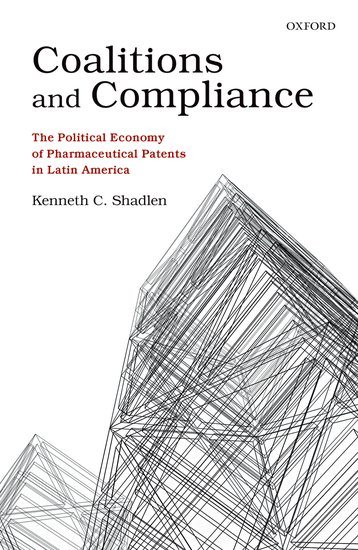
The recently published book Coalitions and Compliance by Professor Ken Shadlen of the London School of Economics examines how international changes can reconfigure domestic politics. Since the late 1980s, developing countries have been subject to intense pressures regarding intellectual property rights. These pressures have been exceptionally controversial in the area of pharmaceuticals. Historically, fearing the economic and social costs of providing private property rights over knowledge, developing countries did not allow drugs to be patented. Now they must do so, an obligation with significant implications for industrial development and public health. This book analyses different forms of compliance with this new imperative in Latin America, comparing the politics of pharmaceutical patenting in Argentina, Brazil, and Mexico. The book focuses on two periods of patent politics: initial conflicts over how to introduce drug patents, and then subsequent conflicts over how these new patent systems function. Intellectual Property Watch recently conducted a Q&A with Prof. Shadlen, which appears below.

Top IP-Watch Stories Of 2017: What Do They Tell Us About Multilateral IP Policy?

What IP-Watch stories were readers reading most in 2017, and what does it say about the state of global intellectual property policy? In this article, we look at the most-trafficked stories of last year, and make a few assumptions. Asia, Europe, trade, health. These were the top targets of interest to readers among our offerings. Interestingly, despite all the sound and fury in Washington, our coverage there was not at the top of the list. Even more interestingly, neither was our extensive and world-leading coverage of the World Intellectual Property Organization.

Internet Governance Forum – An Encyclopaedic Endeavour

The 12th Internet Governance Forum has closed its doors and sent home the last of the more than 2,000 die-hard internet governance adepts from 142 countries who stayed until a mere three days before Christmas in the halls of the United Nations in Geneva. Asking the adepts and the critics about what has changed in the forum that started because governments just could not agree on how critical internet infrastructures should be managed during the 2005 UN World Summit on Information Society, the first answer always is just “big”.

With originally 3,000 registered, it is the biggest international internet politics conference. But “big” is not only the size of the meeting, it is also the number of workshops, panels, best practice forums and bi-, pluri- and (nearly) multi-lateral meetings taking place over the five days. So this year Intellectual Property Watch, having participated substantively all week, decided to make an encyclopaedic endeavour to bring you the first IGF dictionary (or to make a dictionary about that encyclopaedic endeavour) in an effort to give credit to the richness of the forum, but highlight some problems, too.

EU-MERCOSUR FTA Puts At Risk Access To Medicines In Brazil, New Impact Assessment Study Finds

The European Union (EU) is currently negotiating a free trade agreement (FTA) with the four founding members of Mercosur (Argentina, Brazil, Paraguay and Uruguay), which comprises a chapter on intellectual property rights (IPR). A new round of negotiations is taking place from November 29th to December 8th in Brussels[1]. Word is that they aim to announce the closure of the agreement at the next World Trade Organization (WTO) Ministerial Conference that will be held from 10-13 of December in Buenos Aires and the clock is ticking to close all the chapters before that. The authors have conducted a study that shows the adoption of the measures proposed by the EU could put the sustainability of access to health policies in Brazil at risk, as they could sharply increase public expenditures on medicines.