Category Innovation/ R&D

Global Health R&D: Evidence, Priorities, Coordination

World Health Assembly Agenda Item 13.5 is descriptively-yet-uninformatively labelled “Follow-up of the report of the Consultative Expert Working Group on Research and Development: Financing and Coordination (CEWG).” But that anodyne title actually masks an important milestone in the World Health Organization’s long-running efforts to increase R&D around neglected diseases and diseases of poverty.

Antimicrobial Resistance: PPPs The Way Forward, Speakers Say

With global funding for research and development decreasing, and the growing threat of antimicrobial resistance, ways to incentivise research are seen as key to solving the problem. Speakers at a side event to the World Health Assembly this week presented models of public and private partnerships to address the issue.

Expanding Access To Medicines: What Role For Transparency?

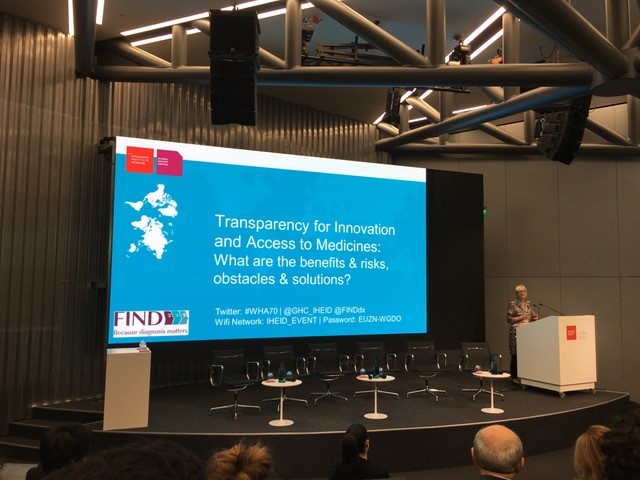
Transparency” and “accountability” are familiar buzzwords. Like salt and pepper, they pop up on nearly every list of ingredients for sound policy and good governance. But, as Ilona Kickbusch and Suerie Moon of the Graduate Institute Global Health Centre in Geneva point out, their details are rarely specified: transparency for what? Accountability to whom? On Tuesday afternoon, those not busy casting a vote for the next World Health Organization director general got the chance to dig into these questions at a panel co-sponsored by the Graduate Institute and FIND. In particular, discussion focused on transparency in terms of public access to two types of information: drug R&D costs and clinical trial data.

Beyond The Obvious – Direct And Indirect Territorial Coverage Of MPP/ViiV Voluntary License For Dolutegravir

Pursuant to a license negotiated by the Medicines Patent Pool (MPP) with ViiV Healthcare (ViiV), an important new antiretroviral medicine, dolutegravir (DTG), will soon be available via generic competition in all low- and lower-middle-income countries, and a significant number of upper-middle-income countries as well. DTG is a highly recommended integrase inhibitor which highly effective, durable, inexpensive to produce, and relatively safe with few side effects. It is already an alternative WHO recommended first-line medicine and will probably become the global standard of care following trials on use of DTG to treat pregnant women and people with TB.[1] But until the MPP can succeed in getting inclusive licensing terms covering all low- and middle-income countries (LMICs), this unique clause in the MPP-ViiV license should be adopted in future licenses, as it is a best practice to date in terms of expansive coverage, writes Brook Baker.

March-in Rights: A Lost Opportunity To Lower US Drug Prices

It appears not just unfair, but absurdly so. The US government paid for research that produced a patented drug, the patents were licensed exclusively to a Japanese firm, and that firm is now committing price discrimination against the US. Astellas Pharma is selling its anti-prostate cancer drug, Xtandi, for over $129,000 per year per patient in the United States – triple the price of the drug in Japan. Alas, this situation is not unusual. Many drugs that were financed by US taxpayers are sold in the US at exorbitant prices, but are much cheaper in other high-income industrialized nations. This differential price problem could be solved easily. However, the US government has consistently refused to exercise its march-in rights in order to lower drug prices.

IFPMA Priorities At WHA: Election, Antibiotics, Cancer, Pandemics

The new head of the International Federation of Pharmaceutical Manufacturers and Associations (IFPMA) has hit the ground running in Geneva, and is weighing in on a variety of policy issues, this week providing a list of priorities for the research-based pharma industry at the upcoming annual World Health Assembly.