Original news and analysis on international IP policy
WHO Members Consider Possible Changes To Pandemic Influenza Framework
A hundred years ago, the influenza pandemic known as the “Spanish flu” infected one-third of the world population, and resulted in an estimated 50 million deaths. Last week, the World Health Organization held a consultation on possible changes to its 2011 agreement to prepare for the next pandemic influenza. Two major questions were on the table: whether to extend its agreement to seasonal influenza, and how to deal with pandemic influenza genetic information, which is increasingly used instead of biological samples of viruses.
A hundred years ago, the influenza pandemic known as the “Spanish flu” infected one-third of the world population, and resulted in an estimated 50 million deaths. Last week, the World Health Organization held a consultation on possible changes to its 2011 agreement to prepare for the next pandemic influenza. Two major questions were on the table: whether to extend its agreement to seasonal influenza, and how to deal with pandemic influenza genetic information, which is increasingly used instead of biological samples of viruses.
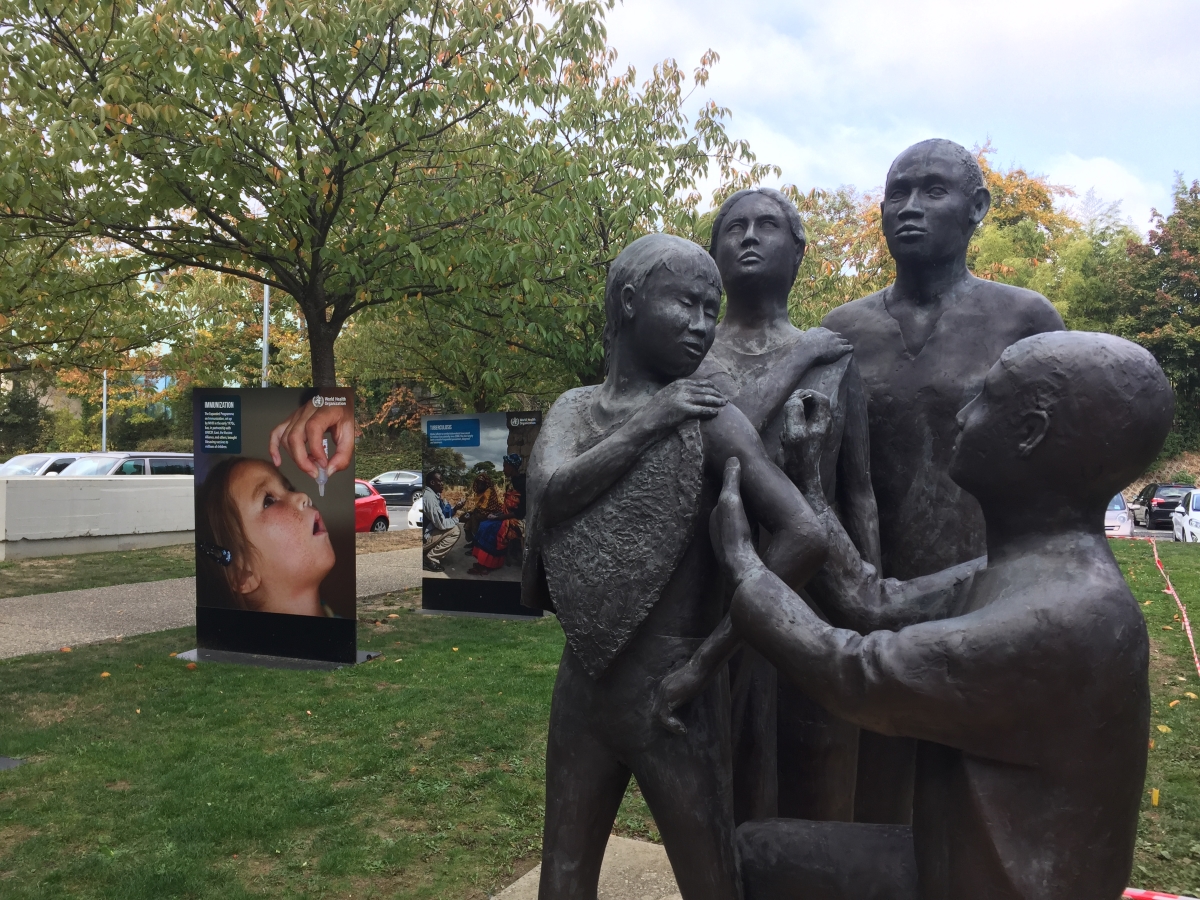
Statue of immunization and displays outside the WHO building
On 15-16 October, WHO member states and other stakeholders met for a closed consultation on a draft analysis [pdf] on approaches to seasonal influenza and genetic sequence data (GSD) under the Pandemic Influenza Preparedness (PIP) Framework.
The PIP Framework allows for better sharing of flu viruses with pandemic potential, and for equitable access to the benefits resulting from this sharing, mainly vaccines and diagnostics.
One of the issues left open in 2011 was how to deal with virus genetic sequence data within the PIP Framework. A set of genetic information allows well-equipped laboratories to recreate a virus from that information, and produce vaccines, thus potentially escaping the rules of access and benefit-sharing of the framework. For the time being, however, access to the biological form of the virus is still necessary for testing purposes, according to sources.
Another question is whether the framework should be expanded to include seasonal viruses. In May 2017, the World Health Assembly asked the WHO to conduct an analysis of both questions. The draft analysis provides options for both issues that attendees to the closed consultation were asked to consider.
According to WHO officials, “the PIP Framework is helping to identify options and helping to think through the implications of those options, bearing in mind that the only driver for the PIP Framework is to advance the best interests of public health. Influenza is one of the biggest public health threats facing the world.”
“The influenza virus is one of the only known pandemic-prone pathogens,” they told Intellectual Property Watch
According to several sources in the room, member states were rather in an information-seeking mode on the different approaches and their possible consequences, rather than providing their views on the different alternatives.
Seasonal Influenza, Four Options
For the expansion of the PIP Framework to seasonal influenza viruses, four different approaches are suggested:
“Approach 1: Maintain the current PIP Framework scope
Approach 2: Expand the scope of the PIP Framework to include seasonal influenza viruses:
o Option A: Amend the definition of PIP biological materials
o Option B: Develop a new section or annex to cover seasonal influenza viruses
Approach 3: Adapt GISRS with a view to its recognition as an SII
Approach 4: Develop a new instrument for all pathogens, including influenza viruses”
The document presents possible advantages and challenges for each approach. For example, maintaining the current scope of the PIP Framework would avoid reopening negotiations. On the other hand, keeping the current scope would force the Global Influenza Surveillance and Response System (GISRS) to deal with a potential 196 different national legislations implementing the Nagoya Protocol on Access to Genetic Resources and the Fair and Equitable Sharing of Benefits Arising from their Utilization to the Convention on Biological Diversity. This could potentially slow or limit the sharing of seasonal viruses and increase the work of GISRS.
Expanding the scope to seasonal viruses by amending the definition of PIP biological material, according to the draft analysis, could address the challenge relating to the implementation of the Nagoya Protocol for seasonal influenza viruses. The PIP Framework, the document says, could be recognised as a Special International Instrument under the Nagoya Protocol.
“This would mean that access and benefit-sharing for viruses covered by the PIP Framework would be managed under the terms of the PIP Framework, rather than those of the Nagoya Protocol,” according to the document. “Were the PIP Framework’s scope to be expanded to include seasonal influenza viruses, the PIP Framework would govern access and benefit-sharing for both seasonal and pandemic influenza viruses.”
The Nagoya Protocol Conference of the Parties is meeting from 17-29 November in Egypt, and the criteria defining “special international instruments” under the protocol are expected to be discussed.
Expanding the scope of the PIP Framework could however potentially increase the work for the GISRS laboratories. “Based on the number of viruses shared in previous years, GISRS estimates that tracing the sharing of seasonal viruses could increase the network’s workload 100-fold as compared with the current system of tracing IVPP [Influenza Viruses with Pandemic Potential] alone,” the analysis remarks.
WHO Officials: International Sharing System Needed
Implementation of the Nagoya Protocol has important implications for public health; those implications have the potential to slow or improve access to genetic resources, including influenza viruses, WHO officials told Intellectual Property Watch. Member states and WHO are working to find ways for the implications of the Nagoya Protocol implementation to facilitate public health objectives and equity, they said.
“Nagoya, essentially, looks towards parties establishing ABS [access and benefit-sharing] systems for pathogens. A bilateral model for ABS for pathogens will not work given the network systems that already exist for pathogens sharing,” they explained.
For example, there is a network system for sharing influenza and for measles, the officials said. “These are existing networked systems, and if you try to develop bilateral pathogen exchanges within those network systems, that could be complicating because of the numbers involved. However, a multilateral system of sharing, as envisioned by Nagoya, can facilitate access and sharing.”
Nagoya is a relatively new instrument, the officials noted. There were a lot of pre-existing public health systems, which grew over decades to adapt to the world as it is now.
“Retrofitting a new regime for these is immensely complicated because there is the risk that it will slow things down,” they said. “Timeliness of sharing of pathogens can be a matter of life and death for many.”
There are specific examples in the seasonal flu where the Nagoya Protocol has affected some of the processes in GISRS, according to the officials. For influenza vaccines, the timeframes for production are very tight, and even a small delay in production becomes an issue when you want to start vaccinating your population, they said.
“There is evidence that there is uncertainty arising out of developments in Nagoya implementation; this is not surprising, however, because it is a relatively new instrument,” said the officials, remarking further that under European Union legislation, the PIP Framework is considered as a special international instrument for influenza viruses with pandemic potential.
Industry Not for Inclusion of Seasonal Flu
Paula Barbosa, manager, Vaccines Policy, at the International Federation of Pharmaceutical Manufacturers & Associations (IFPMA), participating in the consultations said the IFPMA believes that “seasonal influenza should not be included in the PIP Framework, as it would divert the focus on pandemic preparedness and entail reopening the PIP Framework for discussion at WHA level.”
A new ABS instrument focusing on seasonal influenza should not be considered as of now, as the discussions on specialized international instruments (SII) at the CBD level are still in rather early stages, both on criteria as well as process for recognition, she told Intellectual Property Watch.
Barbosa said the IFPMA urged the WHO to consider the urgency behind finding suitable alternatives to the implementation of the Nagoya Protocol and its impact on seasonal influenza vaccine production activities, adding that the sharing of influenza strains is already being affected by it.
According to sources, civil society was in favour of alternatives including seasonal flu viruses into the framework.
GSD: How to Apply Benefit Sharing
Genetic sequence data is not included in the definition of the PIP biological material. As a consequence, receipt of “influenza virus with pandemic potential” (IVPP) genetic information does not trigger the obligation to conclude a contract (SMTA2 – standard material transfer agreement) with the WHO. This create a potential benefit-sharing “loophole,” as explained in the draft analysis.
At stake is the benefit-sharing in terms of benefits to be shared if a vaccine is produced with the biological material obtained through GISRS, but also the partnership contribution, which industry has to pay for using GISRS.
Three approaches are suggested by the draft analysis:
“Approach 1: Maintain the current definition of PIP Biological Material
Approach 2: Amend the definition of Biological Material to include GSD or synthetic materials
Approach 3: Address benefit-sharing for GSD through another mechanism”
Amending the definition of PIP biological material to include GSD would allow a multilateral approach to access and benefit-sharing for GSD, according to the analysis. Should the PIP Framework be considered as a Nagoya Protocol special international instrument, access and benefit-sharing for GSD would be governed by the PIP Framework, it says.
This amendment would also ensure that WHO has access to pandemic influenza products developed using GSD, the document says.
Challenges for this approach would include a rise in cost and resources, as certain PIP Framework requirements that apply to biological material would be cumbersome if applied to GSD, mainly because of the large number of entities/persons accessing GSD for academic, research, and other non-commercial purposes, according to the draft analysis.
“Burdensome requirements on access and use of IVPP GSD could push companies and institutions away from research and development for pandemic influenza,” it further says.
The draft analysis is expected to be edited, taking into account feedback from the consultation, and the second draft submitted to the next WHO Executive Board meeting in January.
GSD Loopholes, Current and Future?
One of the issues with GSD is that it could be used without getting through the ABS system of the PIP Framework. In fact, one threat is far into the future, the other one is happening right now, the WHO officials said.
Well-equipped laboratories can recreate influenza viruses from genetic sequence data, they can then develop and produce vaccines with that virus, the WHO officials told Intellectual Property Watch. However, in order to test those vaccines, to make sure they are safe and efficacious, the regulatory process will require testing them against a real virus, they added.
The issue of a product entering the market without such testing is very theoretical and far into the future, they said.
But there is a current loophole that could be problematic, according to the officials. That would be the case where an SMTA2 is signed by WHO with, for example, a laboratory that does not itself manufacture a flu product. That laboratory might be contacted by a manufacturer asking the laboratory to test the manufacturer’s vaccine (or other product) against the PIP biological material obtained through the SMTA2, they explained. There would be no benefit-sharing from the manufacturer to WHO because the manufacturer never requested the PIP biological material from GISRS, the WHO network which tracks PIP biological material, they said.
“We are seeing some instances but do not yet have full picture of the scale of the issue,” the officials added.
The IFPMA voiced concerns on the inclusion of GSD in the PIP Framework. “Including GSD in the scope of the PIP Framework, by updating the definition of PIP Biological Material, would constitute a barrier to freedom of research and freedom of speech, as GSD is considered as information (intangible) and is materially distinct from a physical sample, by imposing conditions and restrictions on its current open sharing by the broad scientific community,” she told Intellectual Property Watch.
There is no evidence of a “benefit sharing loophole” as manufacturers, both established and cutting-edge science ones, still need to access PIP biological material for testing purposes, and will do so for the long-term, according to Barbosa.
For Alan Hay, GISAID (Global Initiative on Sharing All Influenza Data) scientific liaison officer, and former director of the WHO Collaborating Centre London, “Were a vaccine to be prepared by expression of immunogens using recombinant DNA technology or by reverse genetic manipulation using the genetic sequence (i.e. via synthetic biology), the actual virus, e.g. PIP biological material, is still essential to ensure that the serological properties of the vaccine product match those of the recommended vaccine component.”
“By sharing their genetic sequence data via GISAID, submitters retain the rights to their acknowledged contribution while sharing in the collaborative research and development based on the cumulative analyses of all publicly available influenza virus data, to the benefit of national public health (policy) as well as the global response to disease, independent of any potential indirect monetary provision under the PIP Framework,” he told Intellectual Property Watch.
GISAID: No Notice of Benefit-Sharing
GISAID Epiflu’s database is used by most GISRS laboratories. In its comments provided on the WHO draft analysis, GISAID disapproved of the introduction in paragraph 69 of the document of the concept of a “legal notice” to inform users that if they access or use influenza viruses with pandemic potential GSD, they will be expected to participate in some monetary form of benefit-sharing.
“GISAID questions whether, or how, such a ‘legal notice’ would ascend through national legislation to supersede legally binding licensing agreements that are already in place between a Data Contributor (Licensor, lawfully in possession of virus data) and a User of the Data (Licensee),” it said. “It seems likely that permission will need to be obtained from all Data Contributors to permit a ‘fee’ for access to the Contributor’s Data.”
“Failure to consider fully the potential difficulties with legal notices, ownership of data etc. can result in actions that could jeopardize the progress made in a decade of rapid, responsible sharing of influenza virus GSD, notably via GISAID…,” the comment said.


[…] WHO Members Consider Possible Changes To Pandemic Influenza Framework […]