There are still many unanswered questions about intellectual property rights, speakers said during an academic conference last week in Geneva. Think tank analyst and author Pedro Roffe, who was the focal point of the conference, said at the event that there is “particularly in Geneva” place for dialogue about “very important and emerging” IP questions.
The Global Debate on Intellectual Property, Trade and Development: Past, Present and Future, a conference in honour of Pedro Roffe, took place on 15 June (IPW, IP Law, 20 June 2017). The conference, hosted at the University of Geneva, was jointly organised by the University of Minnesota Law School (US), the Faculty of Law of the University of Geneva and the Centre for International Governance Innovation (CIGI) in Canada.
The So-Called Fourth Industrial Revolution
Several speakers talked about the new challenges for the IP system, what some call the fourth industrial revolution, new boundaries and negotiation topics.
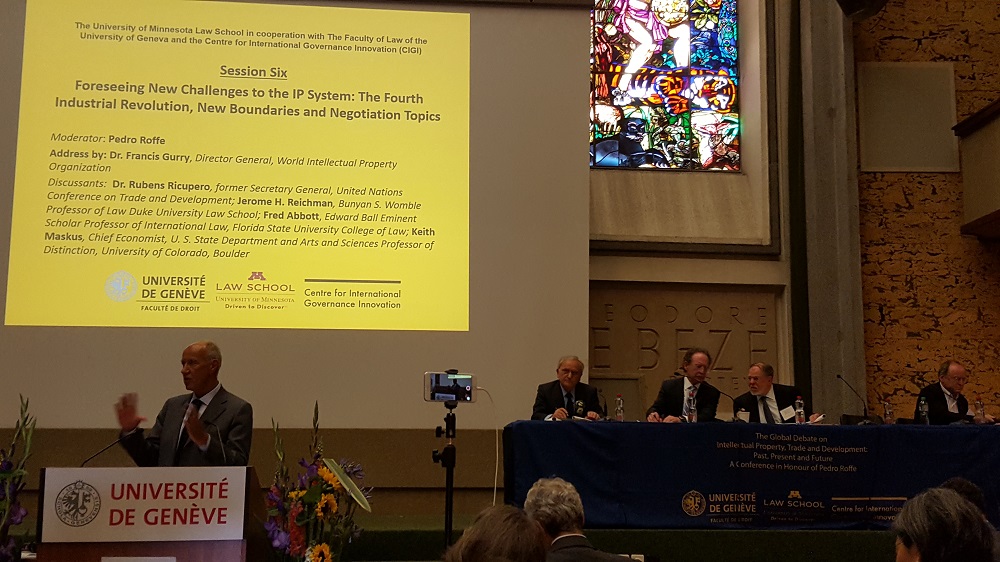
Francis Gurry, director general of the World Intellectual Property Organization, said there has been an “enormous shift of financial and innovative power” from the public to the private sector. The term “industry 4.0” is not a satisfactory way to capture what is happening at the moment, Gurry said, explaining that the term “industry 4.0” emphasises industry, whereas the development is much more significant than in industry alone. He mentioned for instance the Japanese notion of a “Society 5.0” in which we are moving from the information revolution to the kinetic revolution.
Gurry raised awareness of “the extraordinary asymmetries in economic power around the world.” The amount of money the United States spends during one year on R&D is more than the gross domestic product of 167 countries, according to Gurry, who added, “we cannot overestimate these asymmetries that exist in the world.” He also noted that the US Supreme Court now takes more cases related to IP rights than any other field of human endeavour.
Data
The disruption from the speed of technology is “throwing us all into a state of confusion,” Gurry said. Data is, according to Gurry, “a representation of some part of reality that is able to be manipulated by a machine and that can have an impact again on the reality that it represents.” A good concept and understanding of data is essential in order to be able to regulate data, he said. Fundamental developments have occurred in relation to data, Gurry said, adding that many questions related to property rights, security, safety and privacy remain unanswered.
A fundamental question, according to Keith Maskus, chief economist (an assistant secretary-level position) at the US State Department and Arts and Sciences Professor of Distinction and Professor of Economics at the University of Colorado, Boulder (US), is how to define ownership of data in a world where data is generated in “so many different ways.”
Future Risks for IP
The intellectual property system categorises several classes of IP rights based on the way in which the rights should be rewarded and contributed, Gurry said. We are currently in a process of risking the “deformalisation” of the IP system, Gurry said, adding that this will happen in the same way as the shift from the public to the private sector.
A movement is taking place from regulation by a central authority toward regulation by contracts, Gurry said. He added that the cycle has been reversed as policy is formulated by market practices. The block chain illustrates that a registration system may not be needed anymore. This movement towards regulation by contracts forms a challenge for the IP system, Gurry said. With this goes transparency, one of the main items of the IP system, he added. Trade secrets are essentially a contractual right, not a property right, he said.
Fred Abbott, Edward Ball eminent scholar professor of International Law at Florida State University College of Law, said that the transition from the public to the private sector is clear in the area of the domain name settlement. The settlement of domain names is democratised and largely controlled by the private sector, he said.
Maskus said IP rights are losing the ability to do what they are supposed to do, and to control markets. Digital technologies have been transformed so rapidly that IP rights are not going to work for the new contexts of digital technologies, he said. Contracts are more dynamic, he said, adding the question of who owns data. There is reason to doubt the copyright system is equipped to handle that, he said.
Jerome H. Reichman, Bunyan S. Womble Professor of Law at Duke Law School (US), predicted a greater collapse of territoriality in the area of intellectual property rights in the future. The major development which will take place is the expansion of IP rights from new forums, according to Reichman.
IP rights have been used more often as a tool for sharing, Reichman said, calling this “amazing.” The Creative Common licences create an open knowledge environment that goes beyond intellectual property rights, he said. We will have to think about a new type of goods, knowledge goods, Reichman said.
IP and Competition Law
Duncan Matthews, professor of intellectual property law at the Queen Mary University, London, spoke about the intersection between intellectual property rights and competition law.
National authorities have failed to establish a coherence between competition law and IP, according to Matthews.
“Pay-for-delay” agreements, which harm generic competition, only recently have been brought to the attention of the European Commission, according to Matthews. Practices such as product switching and defensive patenting create overlays of protection, he said. This kind of strategy may exclude generic products from entering the market and may block the creation of new products, he added.
Matthews said, replying on a question, that there is a wide recognition of the fact that practices prior to the grant of a patent could also be considered as anti-competitive practices. This was identified by the European Commission in the Pharmaceutical Sector Inquiry in 2009, he added.
Effective use of competition law and policy could facilitate important access to innovation in the future, Matthews said. He proposed a mapping exercise and dissemination by multinational organisations of the best practices in competition law and policy enforcement as guidance for the future.
Patent systems need to be part of the ecosystem of innovation and should not only work in isolation, said Maximiliano Santa Cruz, the national director of Chile’s National Institute of Industrial Property (INAPI).
Concluding Remarks, but Not Concluding a Career
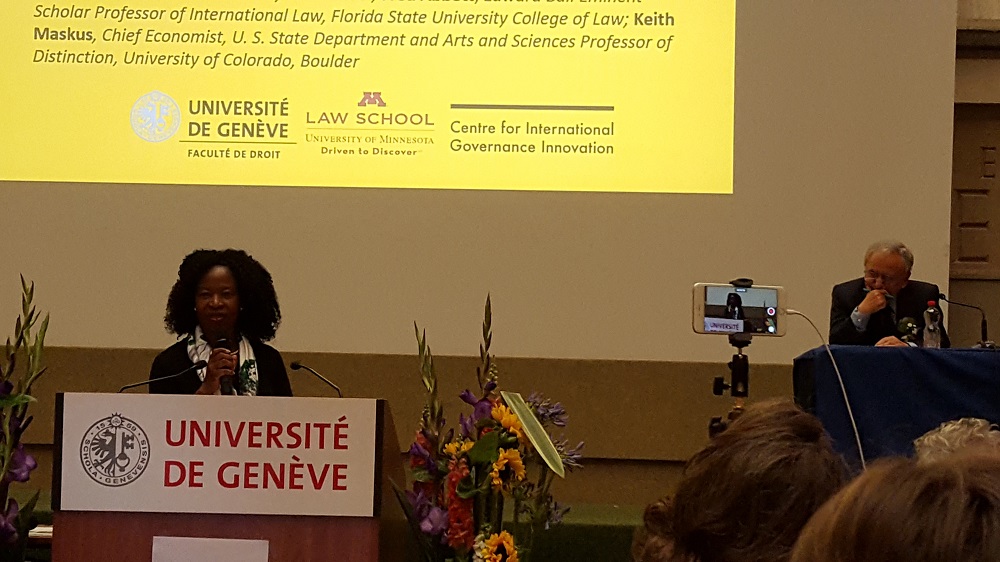
Roffe, who said he will continue to contribute to the field, said that there has been an opening of intellectual property rights to the world, which includes recognition in the last couple of decades that IP is not a world only for experts. The area of IP has become multi-disciplinary as actors from different fields are contributing. An important development is taking place at WIPO, Roffe said. There is for the first time clear recognition that economics has a role to play in the IP system.
Roffe concluded that major changes to the IP system took place in the last decades, but that there is still “a lot to be done.”
William New contributed to this report.
Image Credits: William New