Original news and analysis on international IP policy
On Eve Of WIPO Traditional Knowledge Negotiations, Nations Swap Experiences
A seminar was organised by the World Intellectual Property Organization to provide a discussion platform on the eve of this week’s meeting on the protection of traditional knowledge, and as a way for countries to share systems of protection. Panellists presented views on possible graduated protection for different sorts of traditional knowledge.
A seminar was organised by the World Intellectual Property Organization to provide a discussion platform on the eve of this week’s meeting on the protection of traditional knowledge, and as a way for countries to share systems of protection. Panellists presented views on possible graduated protection for different sorts of traditional knowledge.
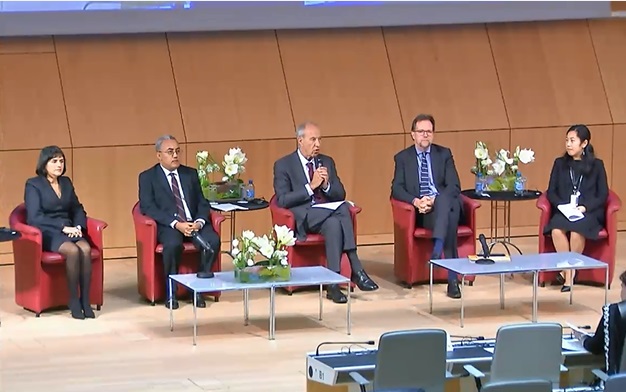
WIPO Director General Francis Gurry speaks at the panel, flanked by WIPO officials
The WIPO Intergovernmental Committee on Intellectual Property and Genetic Resources, Traditional Knowledge and Folklore (IGC) is meeting from 28 November to 2 December.
This week, delegates are expected to discuss a list [pdf] of outstanding and pending issues. This includes the use and meanings of certain terms and concepts, such as terms describing the diffusion of traditional knowledge (TK). Criteria for eligibility of the protection, and whether beneficiaries should include nations and states, are also on the list.
Further items on the list are the scope of protection, and how it should be approached, whether it should be rights-based or measures-based, and the feasibility of a “tiered approach,” which would be based on providing different protection according to different kinds of TK.
On 24-25 November, a seminar on IP and TK was organised by WIPO, with the objective of sharing experiences and deepening the understanding of those outstanding issues.
The programme [pdf] of the seminar included four roundtables: Regional, National and Community Experiences Relevant to Identifying “Protectable Traditional Knowledge” at an International Level; Perspectives on and Experiences with a “Tiered Approach” to the Protection of Traditional Knowledge – Scope of Protection and Exceptions and Limitations; Complementary Measures and Customary Law for the Protection of Traditional Knowledge: Examples and Lessons Learned; and Perspectives on and Experiences with Other Issues: Sanctions and Remedies, Management of Rights, Term of Protection, Formalities, Transitional Measures, Relationship with other International Agreements, National Treatment and Transboundary Cooperation.
During the first roundtable, on 24 November, on regional, national and community experiences, Lilyclaire Bellamy, executive director of the Jamaica Intellectual Property Office, Ministry of Industry, Commerce, Agriculture and Fisheries, said Jamaica and in general the Caribbean tend to have a homogenous way of looking at TK, genetic resources, and traditional cultural expressions. Trying to distinguish between those three subjects is very difficult, she said.
Andrés Valladolid, president of the National Anti-Biopiracy Commission at the Peruvian National Institute for the Defense of Free Competition and the Protection of Intellectual Property (INDECOPI), said in his presentation [pdf] that Peru has 47 indigenous languages, and over 6,000 farmers communities.
Since 2002, he said, Peru has instituted a protection system for the collective knowledge of indigenous people.
Avanti Perera, senior state counsel, Attorney General’s Department, Sri Lanka, said when North Indian Prince Vijaya and his 700 followers arrived on the island in 543 BC, indigenous tribes already inhabited the island: the Yakka, Raksha, Naga, and Deva.
Sri Lanka has subsequently been populated by diverse communities, Indo-Aryan settlers, South Indian and other immigrants, and western colonisers: Portuguese, Dutch and British, but there was a continuity of local traditions, she said in her presentation [pdf]. To date customary laws of various communities co-exist with general laws, she said.
Traditional knowledge in Sri Lanka spans across many sectors, such as architecture, agriculture, environmental management, martial arts, and indigenous medicine.
Perera said Sri Lanka has a 2009 legal framework for the protection of traditional knowledge, and there is an ongoing identification and documentation of TK by various sectors. There is also particular attention given to traditional medical knowledge and efforts to collect information on traditional medical practitioners.
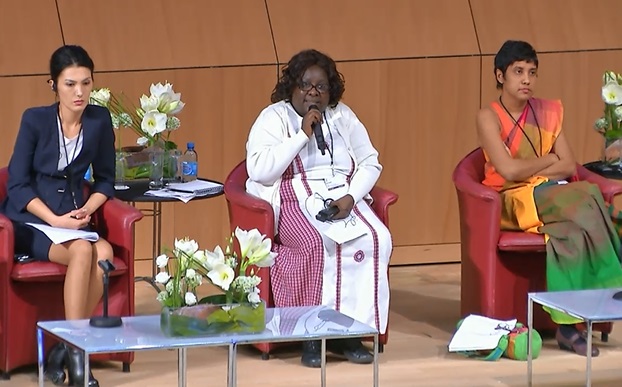
Madina Karmysheva, head of the Section for Selection Achievements and Traditional Knowledge, State Service of Intellectual Property and Innovation under the Government of Kyrgyzstan; Lucy Mulenkei, member of the Maasai People, and executive director of the Indigenous Information Network in Kenya; and Avanti Perera, senior state counsel, Attorney General’s Department, Sri Lanka
Madina Karmysheva, head of the Section for Selection Achievements and Traditional Knowledge, State Service of Intellectual Property and Innovation under the Government of Kyrgyzstan (Kyrgyzpatent), said legal protection is needed for TK, as there is growing commercial interest in this area.
In her presentation [pdf], she said in 2007 Kyrgyzstan adopted a law protecting TK, with the main goal of preventing the illegal patenting of TK.
Kyrgyzstan is establishing a database of its traditional knowledge, gathering information by travelling across the country, meeting with TK holders, and documenting the TK, she said.
Lucy Mulenkei, member of the Maasai People, and executive director of the Indigenous Information Network in Kenya, said TK is disappearing, particularly in Africa. This is due to several factors, she said, including rural migration and land issues, but also because elders are passing away and going with all their knowledge, she said.
It is important to be able to protect the knowledge so that it is not misused. Kenya has a number of policies regarding TK, she said.
Identifying TK is important but it is equally important to see how it can be documented and protected, she said. The documentation of TK has been discussed among indigenous peoples and the recurring question is how to protect the knowledge that has been documented, she added.
In the audience, a representative from the Tulalip Tribe said indigenous people do not want their knowledge to be documented. As much as they do not want to see their knowledge go extinct, they have obligations to fulfil before the knowledge is transmitted and those obligations go with the knowledge in perpetuity. If elders feel that the knowledge will not respect the ancestors and tradition, then they will have to take it to the grave, he said.
Bellamy said she understands the spiritual dimensions of TK but not documenting TK is a real challenge from the point of view of the head of an IP office. If TK is not documented anywhere, protection might be granted if prior art searches are conducted which find nothing, she said.
Tiered Approach: Experiences, Concerns
The second roundtable, on 24 November, focused on the “tiered approach” which has been discussed in the IGC for several sessions, and through which different types of TK would be protected in different ways.
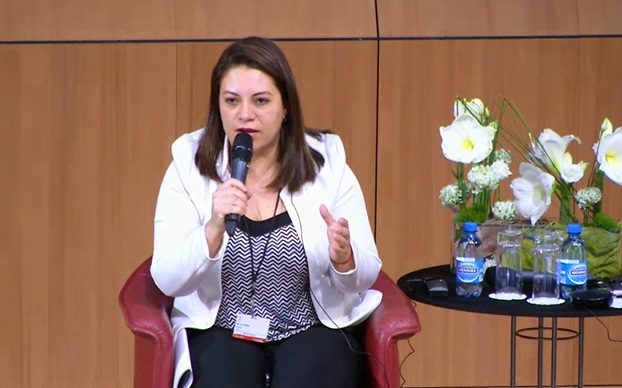
Soledad de la Torre Bossano, national director of Plant Varieties, Ecuadorian Institute of Intellectual Property
Soledad de la Torre Bossano, national director for plant varieties, Ecuadoran Institute of Intellectual Property, said there is a new approach to TK management in Ecuador. New Ecuadoran policies for cultural diversity recognise the free determination of people in communities, and the collective nature of their knowledge, she explained. The principles of free and prior informed consent, the inalienable nature of TK are also acknowledged, as well as the fact that communities are legitimate owners of TK, she added.
Four categories have been determined, she said: sacred, secret, TK with restricted diffusion, and TK with wide diffusion.
Chidi Oguamanam, professor, Centre for Law, Technology and Society, Faculty of Law, University of Ottawa, Canada, said the topic of TK in the context of intellectual property has always been an issue. The tiered approach could be useful but in order to really contribute to protecting TK, it needs to capture the existing reality of TK and associated experiences, he said.
It also needs to focus on the specific character and context of the traditional knowledge, as opposed to a global approach, he said in his presentation [pdf].
Miranda Risang Ayu Paler, law lecturer and researcher at Padjadjaran University, Indonesia, presented the country’s tiered approach, with 5 categories of TK: secret & sacred, sacred, narrowly diffused/closely held, widely diffused, and publicly available. She said Indonesia has over 300 ethnic groups.
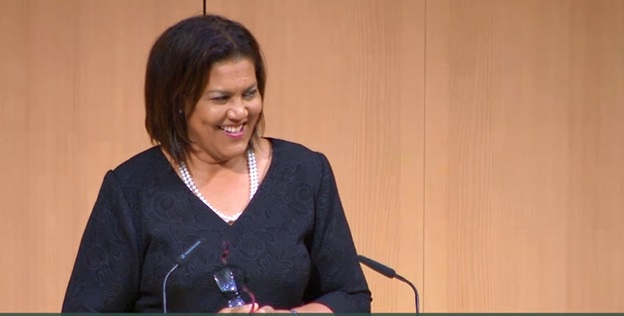
Miranda Risang Ayu Paler, law lecturer and researcher at the Faculty of Law, Padjadjaran University, Indonesia
Indonesia has different legal means to protect TK, she said in her presentation [pdf]. For example, Indonesia uses existing conventional IP protection systems, extending IP protection and/or establishing a sui generis protection system, and also establishes special databases.
She cited an example of an ancestral village in East Nusa Tenggara, where all of the different kinds of TK were found. Secret and sacred TK referred for examples to customary protocols to implement penal sanctions. Sacred TK was found in techniques to build the sacred houses and landscape; techniques to process sacred rice and medicines to cure wounds belong to narrowly diffused TK. Techniques to weave the women clothes in West and East Nusa Tenggara are considered as widely diffused TK. Publicly available TK concerns techniques to roast Sumba coffee.
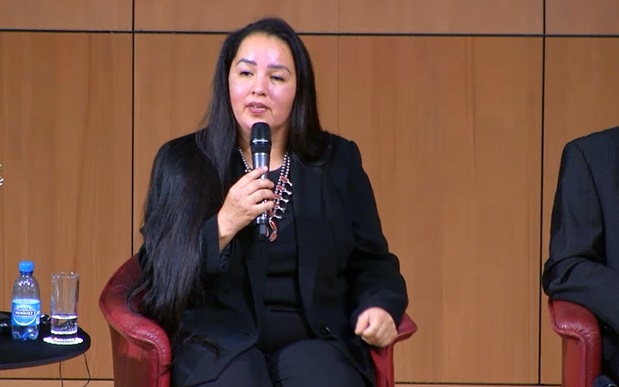
Ann Marie Chischilly, executive director, Institute for Tribal Environmental Professionals at the Northern Arizona University, United States
Ann Marie Chischilly, executive director, Institute for Tribal Environmental Professionals at the Northern Arizona University, United States, said the institute trains tribes on environmental issues. American Indian reservations host some 567 tribes, 229 of which are located in Alaskan Native villages. The tribes are not unified at the national level on their approach to TK, she said. They make up for 1.7 percent of the total US population, she said in her presentation [pdf].
There is some concern with the tiered approach, she said, because even though knowledge is widely known or in the public domain does not mean it is no longer sacred and secret.
She said owners’ expectations should be discussed, which include use of customs and traditions of indigenous peoples, and based on true consultations with them.
Pharma Industry Needs Certainty
Manisha Desai, assistant general patent counsel for Eli Lilly and Company in the US, explained in her presentation [pdf] that pharmaceutical products take many years to develop and much of their patent life is used up when they finally come to the market.
Manisha Desai, assistant general patent counsel for Eli Lilly and Company, United States
As an example, she said Eli Lilly announced on 23 November that after 15 years of research on a new medicine for Alzheimer’s disease, the results of trials were unsuccessful. Patents only provide a finite term of protection, she said. In the case of that unsuccessful Alzheimer’s compound, the application was filed in 2001 with the hope of putting the drug onto the market in 2009, which would have left two years of the patent term for a drug which took 18 years to develop, she said.
Some proposals made in the IGC suggest an infinite term of protection for TK, she said, and in contrast to patents, an automatic worldwide protection.
In her conclusion, she said that the protection of TK must result in legal certainty for holders and potential users, and TK that has fallen into the public domain must remain public. Claims of TK misappropriation must be supported by tangible evidence, said Desai.
After her presentation, answering questions from the audience, she said that if indigenous peoples do not want to disclose their TK, that should be respected. However, when something is more widely diffused, there is a need to know whether it can be used or not. It is unclear with the tiered approach who is going to decide what is widely diffused, she said.
There should be an understanding of what is protected and for the industry to see the line, she said, so as not to cross it.
[…] for NAU’s Institute for Tribal Environmental Professionals, was invited to speak at the United Nations’ World Intellectual Property Organization’s Seminar, “Protection of Traditional Knowledge.” Country representatives from around the world shared […]



[…] for NAU’s Institute for Tribal Environmental Professionals, was invited to speak at the United Nations’ World Intellectual Property Organization’s Seminar, “Protection of Traditional Knowledge.” Country representatives from around the world shared […]