

Patent applications related to blockchain technology are rising at exponential rate, according to a presentation given yesterday by a partner at United States law firm Rimon. Inventors are seeking intellectual property protection, bringing challenges into the blockchain ecosystem, such as infringement and patent trolls. He called for industry collaboration on IP, and the possibility of patent pools.
Marc Kaufman, partner at Rimon, gave the presentation during a webinar on 11 January on the emerging landscape in patent protection in the blockchain ecosystem.
 Patent activity gives the very first public information relating to technology development, Kaufman said, but patent applications are made available 18 months after filing, which gives a shifted image of the current patent landscape.
Blockchain, sometimes more generically referred to as distributed ledger technology, is a mechanism for storing data in a way that provides all the parties with a single shared source of truth, according to Kaufman. Blockchain data cannot be changed, and the system provides mutual trust and transparency, everybody can see the data, and the “same version of the truth.” This technology can be suitable for myriad applications, he added.
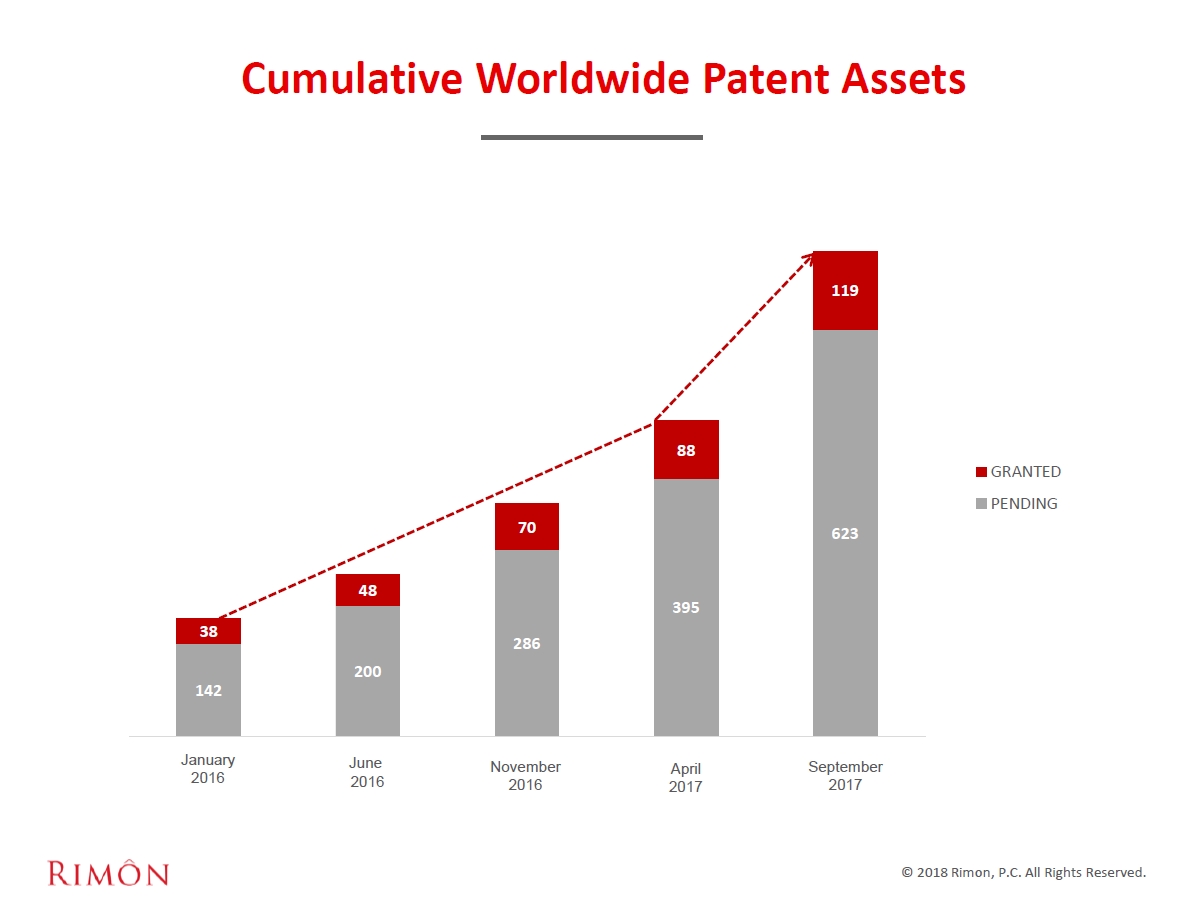
Rimon started watching patent activity related to blockchain technology in late 2015, according to Kaufman. The first search was conducted in January 2016, and the latest in September 2017. Pending applications and granted patents grew from 118 in January 2016 to 742 in September 2017, over a fourfold increase in 20 months.
Although those numbers might seem “minuscule” compared to patent activity in more mature technologies, such as semiconductors, or communications technologies, there is an emerging pattern of proprietary innovations that mirrors the activity observed in the late 1990s related to Web technology, he said.
For the webinar, Kaufman said he performed an informal update of the patent activity up to 9 January. According to this informal update, in the last four months, the number of patent publications having filing dates in 2016 grew from 296 to 491.
China, US, UK Primary Destinations
Patents on blockchain technology are filed primarily in China, the United States and the United Kingdom, followed by patents filed under the World Intellectual Property Organization Patent Cooperation Treaty, which should increase in the coming months and years, he said.
When it comes to patent owners, the top categories, according to Kaufman, are blockchain and crypto-currency companies, followed by financial institutions. Not surprisingly, payments come at the top of patented technologies, followed by encryption, and identity verification.
Payment technology and payment processes are a good place to extract a fee, he said, as that is “where the money is.” He added: “That may very well be why we are seeing so much investment and intellectual property protection in the area of payments using blockchain technology.”
The top patent owners by technology category include large financial institutions, such as the Bank of America, Paypal, academic institutions, and blockchain/crypto-currency companies.
Patent Trolls in the Picture?
Kaufman pointed out that one of the top patent owners is a company called High Tech Private Equity Fund. Their patent holdings originate from a company called nChain Holdings, previously known as EITC holdings, he said. High Tech Private Equity Fund reportedly purchased the assets of nChain Holdings for well over US$100million.
“Interestingly,” he said, “nChain and EITC were founded by a man named Craig Wright, who is the person who once claimed to be Satoshi Nakamoto, the originator of Bitcoin, but was never willing or unable to provide proof of that fact.”
It seems that High Tech Private Equity Fund has no products, and appears to enforce patents as a return of investment, he said, “making them what we sometimes call a non-practicing entity, or what some people more pejoratively refer to as a patent troll.”
Looking Ahead, Patent Pool
According to Kaufman, innovation in blockchain technology will continue to increase at a very high pace, and innovators will continue to seek IP protection, in particular patent protection.
The rise of patent filings will also increase risks for the blockchain ecosystem. One of them will be IP infringement, another one would be the increase of patent assertion entities (another term for patent trolls), he said.
Parties will need to have an IP strategy with a strong defensive position, he said, and industry will need to collaborate on IP issues “in order to provide an ecosystem that fosters innovation.”
Kaufman talked about the Blockchain Intellectual Property Council, (where he sits), which he said is devoted to addressing IP issues generally, but early efforts are focused on increasing patent quality, and encouraging innovation agreements.
A patent pool like the Open Invention Network “may be very effective in the blockchain ecosystem to promote innovation,” he said.
He mentioned the Rimon Blockchain Patent Chronicle, which keeps track of “selected recent published patents and applications” related to Blockchain/Distributed Ledger Technology.
Image Credits: Rimon
[…] URL: https://www.ip-watch.org/2018/01/12/blockchain-related-patents-exponential-rise-lawyer-says-targets-… […]