

Nonprofit group Knowledge Ecology International (KEI) has requested a study by the World Intellectual Property Organization on the case law of the non-voluntary use of patents as a limitation on remedies, Andrew Goldman, counsel for policy and legal affairs at KEI, said at a side event to a WIPO meeting this week.
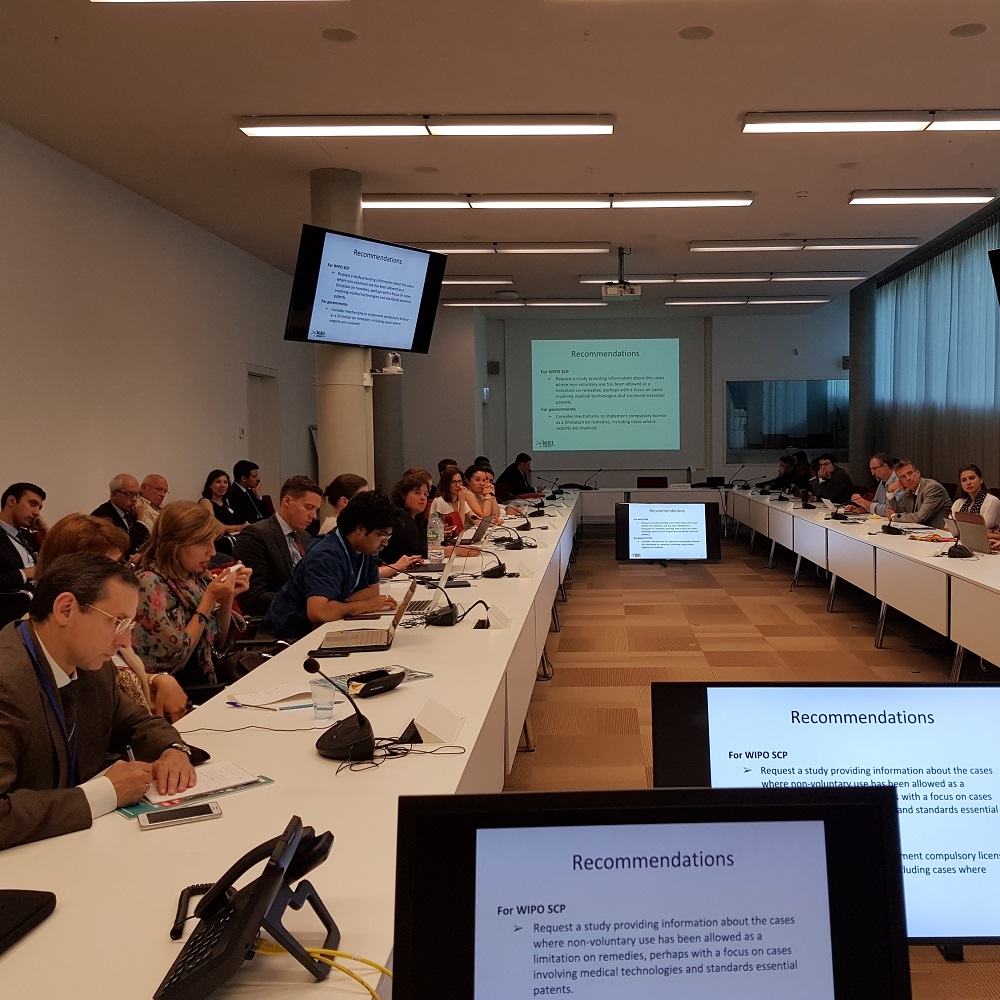 The side event was organised by KEI on 5 July during the WIPO Standing Committee on the Law of Patents (SCP), which is taking place from 3-6 July. The event panel discussed running royalties as a remedy to continued infringement of patents, with a particular emphasis on the United States.
Viviana Muñoz, coordinator of the development, innovation and intellectual property programme at the intergovernmental South Centre, said that an increasing number of patents are granted around the world and that infringement is “not a straightforward question.” Enforcement remains a responsibility of the right holder, she said.
Injunctions under TRIPS
Articles 44 and 45 of the World Trade Organization Agreement on Trade-Related Aspects of Intellectual Property Rights (TRIPS) define the standard for injunction and damages in case of infringement of an intellectual property right, Goldman said. TRIPS Article 44.1 states that governments are required to give judicial authorities the discretion to grant or not to grant injunctions, according to Goldman.
WTO members have the right under Article 44.2 to eliminate the possibility of injunctions, Goldman said. Running royalties, a non-voluntary authorisation to use a patent, are an alternative to an injunction, he said. The limitation on remedies in part 3 of TRIPS, including Article 44, can be used irrespective of whether the requirements of non-voluntary uses in part 2 of TRIPS, such as in articles 30, 31 and 31bis, are met, he added.
Injunctions in the United States
TRIPS Article 44.1 is implemented in the United States in section 35 of the United States Code §283, Goldman said. The section states that courts may “grant injunctions in accordance with the principles of equity to prevent the violation of any right secured by patent, on such terms as the court deems reasonable.”
The practice in the United States patent law prior to the case eBay Inc v. MercExchange, LLC (eBay case) in 2006 was to grant monetary damages in addition to a permanent injunction, according to Goldman. The US Supreme Court decision in the eBay case was significant since it was decided that an injunction is no longer a default remedy for patent infringement, he said. The Supreme Court decided that a denied injunction allows the continued infringing use of the patent in exchange for a running royalty, he added.
The eBay case said a four-factor test for permanent injunctions should apply to patent cases, according to Goldman.
The four factors that the plaintiff must prove in order to get a permanent injunction are: (1) the facts that the injury is irreparable; (2) the remedies available at law are inadequate to compensate for the inquiry; (3) the remedy in equity is warranted after the balance of hardships; and (4) the public interest would not be disserved by a permanent injunction.
Running royalties have been ordered in the United States in relation to different products in the field of medical technologies, including, oral contraceptives, contact lenses, hepatitis C virus diagnostic tests and angioplasty guide catheters, according to Goldman. The eBay test expands also to other cases than patents or trade secrets and outside the sector of medical technology, he said.
Term ‘Compulsory Licence’
Courts have refused to grant injunctions in many cases after the eBay case, Goldman said, adding that instead a payment of a reasonable royalty was ordered for the continued infringement of the patents. The orders are sometimes called “compulsory licences,” he said, adding that the compensation is called “a running royalty.”
Judge Richard Posner used the term “compulsory licence” six times in the case Apple v. Motorola in 2012, according to Goldman. The United States stated during the Trade Policy Review in December 2012 that the US patent law does not contain any compulsory licensing provisions.
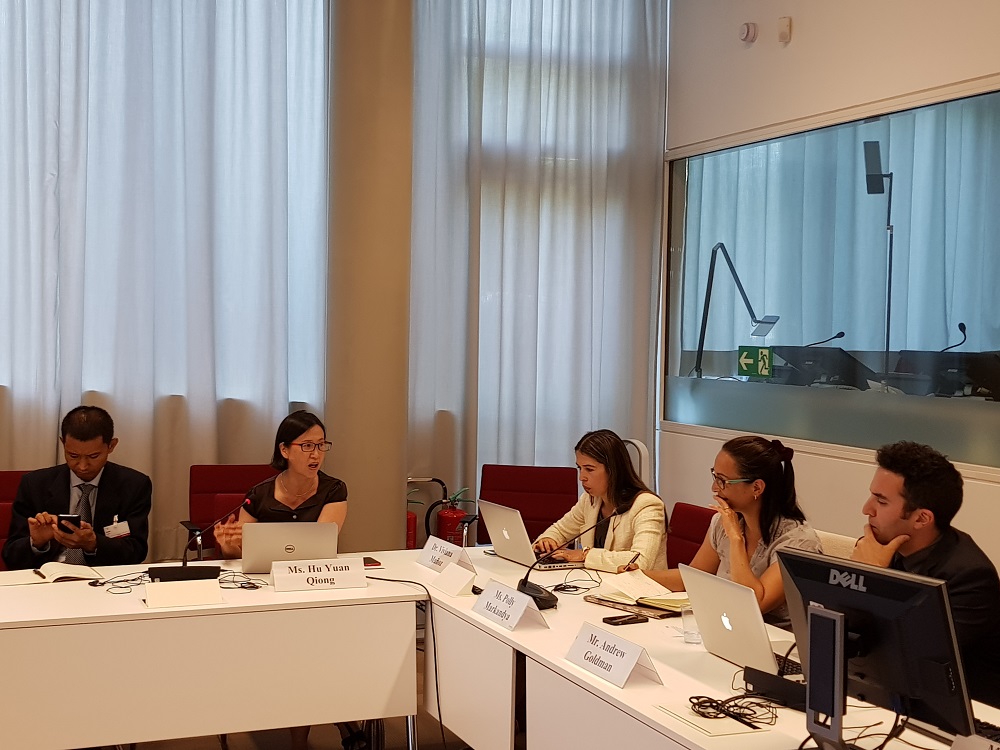
Viviana Muñoz (South Centre); Polly Markandya (MSF); Andrew Goldman (KEI)
Hu Yuan Qiong, senior legal and policy advisor of the Access Campaign of Médecins Sans Frontières (MSF – Doctors Without Borders), said that it does not matter whether the term compulsory licence is used for running royalties as long as the objective is the non-voluntary use of patents. Yuan Qiong told the event that there is a lack of a comprehensive reference about compulsory licences.
Standard Essential Patents
Running royalties’ relation to standard-essential patents in order to prevent that injunctions hinders the interoperability of certain technologies, according to Goldman.
The European Commission stated in a press release of 29 April 2014 that Motorola Mobility infringed the EU Competition Rules because of the misuse of standard-essential patents. A procedure for patent holders and third parties was established in C-170/13 Huawei v. ZTE in 2015 in cases involving requests for injunctions on standard-essential patents.
The US Department of Justice and the US Patent & Trademark Office issued on 8 January 2013 a Policy Statement on Remedies for Standards-Essential Patents Subject to Voluntary F/RAND Commitments, which addressed the limitations on obtaining injunctions.
Recommendations
KEI proposed for the SCP a study that provides information about the cases where the non-voluntary use has been allowed as a limitation on remedies, Goldman said. The focus of this study could be on cases that involve standard-essential patents and medical technologies, he added.
It is very difficult to find out which countries have a law that would allow an authority to grant injunctions, he said. It is important to know which countries have these laws and the how they make use of it, he said. A study by WIPO would be extremely valuable, Goldman added. He concluded that this is an issue which WIPO is “quite uniquely suited to tackle.”
KEI further recommends the governments of the WIPO member states to implement the compulsory licence as a limitation on remedies, including in cases that contain exports, Goldman said.
Yuan Qiong added that these recommendations are “really well needed” in order to have a more updated understanding of the issue in the existing literature.
Elise De Geyter is an intern at Intellectual Property Watch and a candidate for the LLM Intellectual Property and Technology Law at the National University of Singapore (class 2017).
Image Credits: KEI
[…] KEI Recommends WIPO Study On Running Royalties As Limitation On Remedies […]