

Member governments of the World Health Organization are increasingly talking about how to bring about “fair” pricing of medicines. And what’s clear is that it should not be based on how much you would pay to save your life, a senior WHO official said this week.
“The industry has been moving toward this notion of value-based pricing. This is very dangerous,” Marie-Paule Kieny, WHO assistant director-general for health systems and innovation, said in an interview with Intellectual Property Watch. “Getting out of the area of medicine, you can say if an airbag can save my life, why isn’t the cost of an airbag what I would be willing to pay for my life? And that would be a lot.”
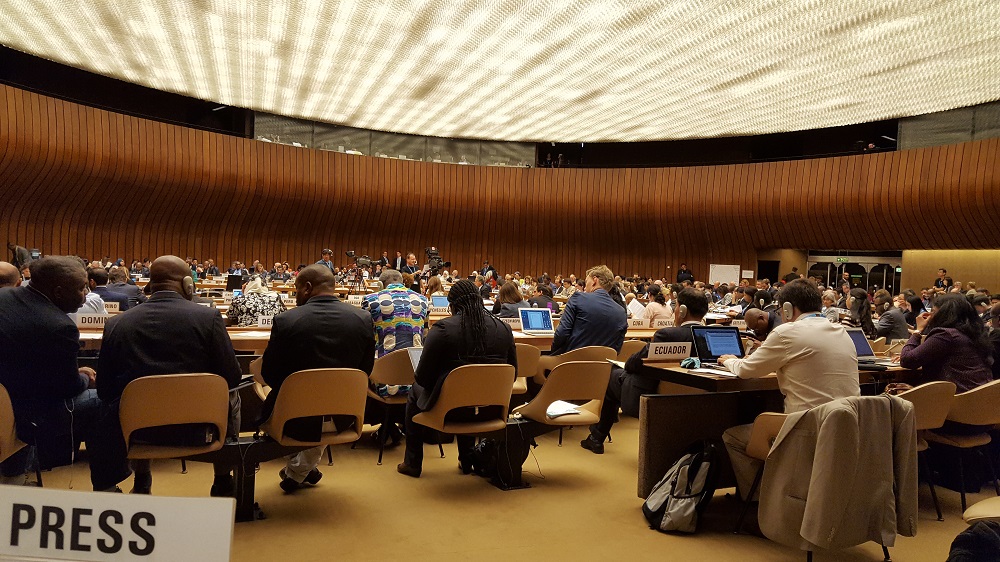
The WHO has begun work on request of member states on improving the global understanding of fair pricing for medical products. The issue is at the edge of the 22-31 May annual World Health Assembly (WHA).
The fair pricing issue is “something new,” said Kieny, and may come up as a continuation. “There could be a request by member states to have it on the agenda next year, but we are just starting,” she said. One agenda item it could be discussed under could be WHA Agenda item 13.3, “Addressing the global shortage of, and access to, medicines and vaccines.” This item came to the floor briefly this morning and was suspended until 4:00 today (note: an update will be available on IP-Watch).
Asked about expanding from vaccines to include other medical products, Kieny said, “This is a contentious issue,” mentioning the comparison with airbags and prices. s
She also asked why it is that sofosbuvir – which she noted is the INN name of a medicine against hepatitis C, is “priced to the price of liver transplant.”
A discussion is needed about “what are the basics for pricing, that’s the idea of fair pricing,” she said. By fair pricing, “it does not always mean low price. There can be justification because of a specific nature of some product why it is very expensive to produce.”
Regarding discussion about delinkage of price from cost of R&D, she said, “I’m not against discussing delinkage of cost of research to price of medicines, but somebody has to pay for the cost of research. I agree there should be a way so the cost of research does not impact the most vulnerable, there’s no doubt about that.” So push funding for research might be one way, for instance.
But still, she said, “a movement toward an agreement, what are the elements behind price of medicines and agreement on that, I think would be something that would help in terms of having affordable medicines.”
“The fair price would be something that at the same time provides access to those who need it, to an affordable medicine, whatever it is, because most of the medicines, in a world where you have universal health coverage, shouldn’t be paid out of pocket, but there’s a payer who pays for it,” Kieny said. “And at the same time bringing reasonable return on investment to the industry. Industry is not a charity, we should also be aware of that.”
She suggested there should be more investigation or surveys on what is the real return on investment in other innovative sectors. Not for food but for example what is considered a fair price by industry in the IT sector.
The WHO held a Fair Pricing Forum hosted by the Netherlands in Amsterdam on 10-11 May. The next step for that will be to publish a database on the cost of production of essential medicines on the WHO Essential Medicines List.
“This will be put for consultation, or scrutiny, by everybody, and we are very happy if industry comes and says, well, you have it wrong, for this disease you underestimate the cost of production, it should be [blank],” she said. “Fine, we are very happy to revise it, but based on data, on transparent data.”
The fair pricing discussion is something that needs to continue, she said. “Look at return on investment, look at the point of view of the payer, of the patient association, of industry.”
There will not be a consensus, Kieny said, “but if we were able already to bring the point of view closer together on what are the different elements that are behind the cost of medicines, taking into consideration on our side that we completely reject this idea of value-based pricing.”
Image Credits: William New
[…] She also mentioned the concept of delinking the price of products and the cost of R&D but said both prices and costs should actually be known. She voiced concerns about a new principle of value-based pricing linking prices to societal value, saying it is not acceptable to patients to put prices at the value of a life (IPW, WHO, 26 May 2017). […]