

NEW YORK — It came as a surprise to some when the United Nations Secretary General’s office announced in November the setting up of a high-level panel to urgently address access to medicines and other health technologies. After all, UN agencies in Geneva, most notably the World Health Organization, have been working on these issues for years.
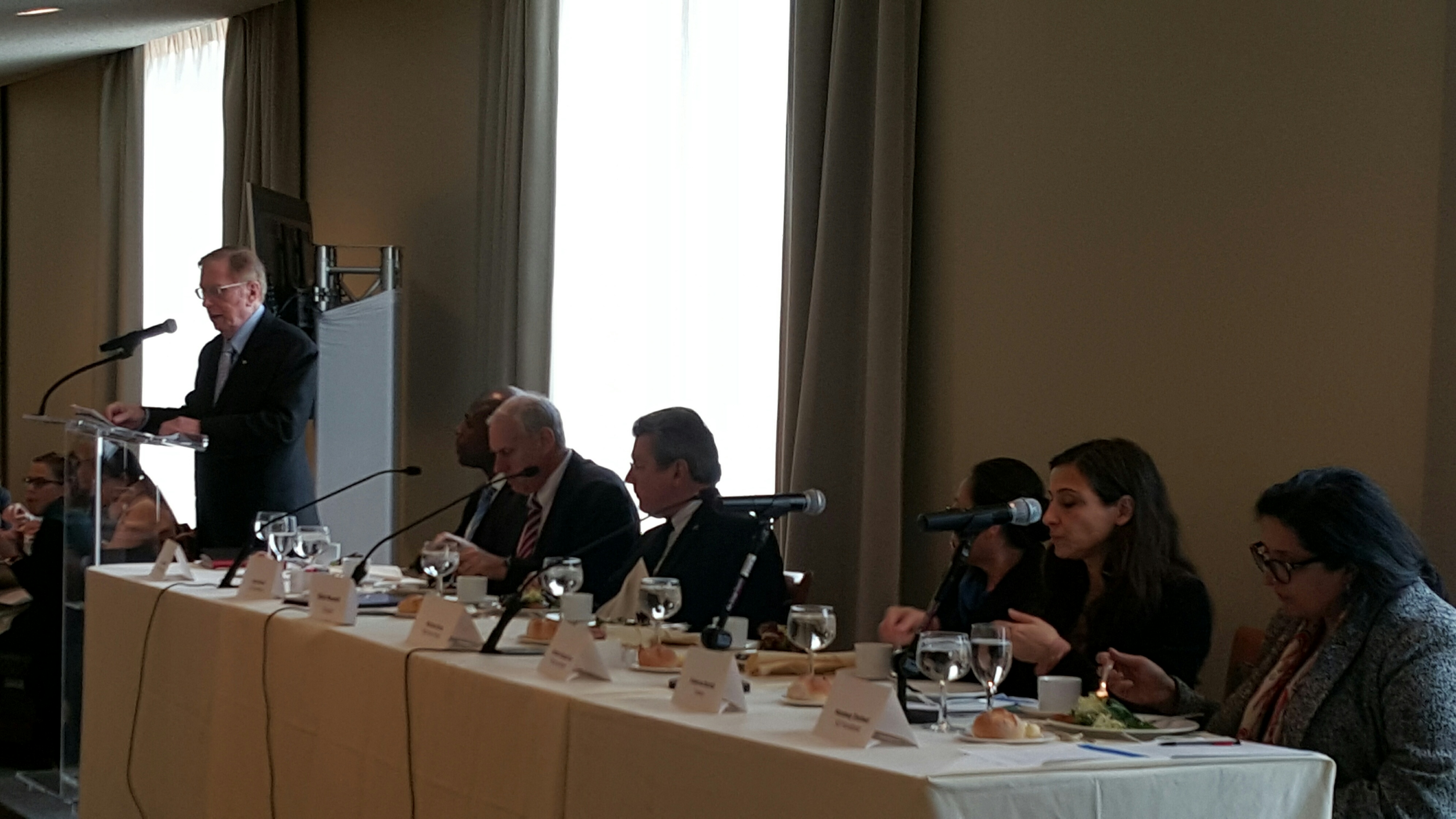
Yesterday at the UN in New York, an event was held to explain some of the vision and urgency behind the setting up of the panel, which includes an expert committee of representatives of some 10 international organisations and others. It also includes an open online call for contributed ideas until 18 February, and two public hearings.
The cross-cutting, 16-member panel was named in December and its report is due in June [corrected]. The High-Level Panel on Access to Medicines website is UNSGAccessMeds.org. The panel shows geographical, racial and gender diversity. It includes representatives from various agencies, nongovernmental organisations, academia and pharmaceutical industry (innovator and generic). It is chaired by former Swiss President Ruth Dreifuss and former Botswana President Festus Gontebanye Mogae.
The luncheon was opened by Simon Bland of UNAIDS and the UN High-Level Panel secretariat, who said that in a consultation they were told the questions the panel is asking are the right kinds of questions and that it is “absolutely the right time to be asking these questions.”
Panellist and chair of the expert advisory group Michael Kirby, a retired Justice of the High Court of Australia who has served on many UN expert or reference groups, yesterday painted some of the vision and history that led to the panel’s formation. But while he was optimistic and firm about the panel’s purpose, he also found himself defending its independence and legitimacy after “grave” concerns were raised at the lunch by a delegate of the United States mission.
“There is no reason why we should not succeed,” said Kirby, “except the challenges are enormous and the time is brief.”
“These are not just issues of the United States,” he said. “These are issues of the world.”
If one were to look for the “trigger” that led to establishing the panel, he said, it would be the approval by UN member states last autumn of the 2030 Sustainable Development Goals, especially the third one, which is on health.
Panellists were appointed in November to carry out a review and look at solutions to “remedy policy coherence” in delivering access to medicines. This big-picture initiative cuts across numerous fields such as innovation, international trade law, public health, human rights and more.
It was noted that while the name of the panel refers to access to medicines, its work also refers to vaccines, diagnostics, and other health technologies.
Kirby noted the short time-frame, but said, “Six months is short but not impossible.” He pointed to a secretary general’s report on human rights abuses in North Korea on which he worked that also was done in six months and has become the “gold standard” in that area.
The panel wants “to get as many proposals as we can,” he said, and will address the preparation of the report in a “transparent and open-minded way.”
But addressing some questions that have begun to surface about the panel, Kirby said if anyone thinks the group is coming having “already written the report,” that is not the case. “We are approaching our task with an open mind,” he said.
Kirby and others were coming from a morning meeting with industry. There, he said, GlaxoSmithKline CEO Andrew Witty called it a “well-timed investigation” and that “the time is now.”
Seeking Sustainable Solutions
Panel member Sakiko Fukuda-Parr of Japan, a development economist and professor at the New School in New York, and director and lead author of the UNDP Human Development Reports, discussed the Sustainable Development Goals (SDGs). She said she has been focusing on goal-setting, social and economic sustainability, and the ability to harness knowledge.
Several speakers noted the different nature of the SDGs from the preceding Millennium Development Goals (MDGs). Bland said they are not just the MDGs 2.0. Fukuda-Parr said the SDGs are “not an aid agenda for donors,” and are not North-South, but rather about leaving no one behind and creating a sustainable world for all. Health is important for inclusive and sustainable growth, she said.
Fukuda-Parr said it is particularly important that the panel is starting with a call for proposals, and noted that “this is not a process where are saying we don’t know enough.”
She and others emphasised that the initiative specifically draws on all the past work done on this issue. What is needed is “agreement on priority actions that are implementable.” They are addressing two categories of issues: quick fixes and long-term, incremental changes, she said.
Tenu Avafia, team leader: Human Rights, Law and Treatment Access, HIV, Health and Development Group at the the UN Development Programme (UNDP), which along with UNAIDS is organising the panel initiative, spoke on the modalities of the panel’s work, and the secretariat to the panel. He recalled that the panel was called for in the 2012 report of the Global Commission on HIV and Law, which included recommendations on intellectual property and its role in boosting innovation and access to medicines. This included a recommendation (6.1) for the secretary general to set up the high level panel.
Also tied to creation of the panel was the Synthesis Report of the Secretary General on the Post-2015 Development Agenda.
And the third pillar leading to the panel was the September 2015 adoption of the UN SDGs.
Avafia said there is an emphasis on the panel not recreating previous work but rather building on it. The expert committee includes as many as 10 institutions, and experts named for a range of particular expertise.
Authors of contributions will be invited to the two “global dialogues” on the day before each public hearing, being held in March in London and Johannesburg. Then comes the process of forging the key elements of the report, he said, with the aim of handing it to the secretary general in June.
The panel may also request contributions from key organisations, such as the World Health Organization, World Trade Organization and World Intellectual Property Organization.
A WIPO representative said “nothing is more important to us” than maintaining innovation, and that there has been progress, with product development partnerships such as WIPO Re:Search, which shows that the existing IP system can deliver health benefits to the world. She said WIPO is “sensitive” to any suggestion of incoherence in innovation, echoing the statement of the WIPO representative to the expert committee, speaking at the 1 February member state briefing. “Without innovation you have nothing to have access to,” she said.
A German mission representative from the audience said the country is concerned about health systems, and encouraged the inclusion of the private sector.
An Indian mission representative said a lot of work has already been done, and noted that the “very high” level of expertise on the panel. India has the view that measures that prevent access to medicines are a human rights violation, he said. He also said WHO has been relegated a little behind in this process and India would like to see how it could be a leader in this initiative.
From the audience, Judit Rius from Médicins Sans Frontières (MSF, Doctors Without Borders), said the NGO delivers medicines on the ground and welcomed the balance of the panel and the narrow focus. MSF encourages the panel to show “focus, braveness, and your humanity,” and to find solutions that are “not ‘anti-anything'” but rather pro-something.
US Opposition
In the questions and answers, Laurie Phipps of the US mission to the UN let loose a volley of concerns about the secretary-general’s panel, going so far as to raise a question of its legitimacy.
“The United States has grave concerns about the lack of transparency and consultation with stakeholders and governments in the process thus far, the short time-frame established for soliciting input and producing a final report, the lack of clarity on its intent, the narrow focus of the panel, the apparent prejudice in the panel’s assumptions, and the risk of overlap or incoherence in the UN system,” she said. “The issue of access to medicines is important for all countries, thus such a high-level effort should have full legitimacy and provide real and practical solutions.”
She said the US was “surprised” to learn of the November announcement, and said it was “our understanding” that “many member states were also unaware of this initiative” and further that the US has “heard repeatedly of concerns for a narrow approach around the issue.” She did not name any other countries or the sources of concerns, however.
Phipps specifically charged that “appropriate protocol was not followed in this instance” for consultation or information prior to the panel’s formation. In addition, she said the US has “been told” that the WHO, WTO and WIPO were not consulted prior to the panel’s formation, and were only belatedly added, which “does not compensate for their lack of involvement in the development of the focus of the panel or the panel’s composition.” Those three Geneva-based institutions did not appear to raise these concerns in their presentations to the panel on Monday in Geneva, however (IPW, Public Health, 1 February 2016).
In addition, the US said it has “learned” that two panel members and one “prominent” member of the expert group have expressed concerns to the panel co-chairs that the intent of the panel is not consistent with what was originally communicated to them, as it has been significantly narrowed and is “based on a number of assumptions not shared by all panel members.”
Furthermore, the US argued that the panel is a duplication of effort as the WHO is working on an evaluation of its Global Strategy and Plan of Action on Public Health, Innovation, and Intellectual Property. That slow-moving strategy and plan of action dates back to 2008 and before, and it is unclear whether it has made any significant progress on the problem. As Phipps pointed, the WHO is just now beginning to collect data on it and then will go through the member-state driven process of a “policy analysis” of it.
She also raised concern about narrowness of focus, where the panel seems to be focused only on promoting access to innovative medicines without looking at the “systems that have been established to promote innovation.”
“Access to medicines is about more than price, profits, or intellectual property. Governments deal with the multi-faceted challenges by making choices on procurement, taxes, tariffs, health systems and service delivery, rational use, and more,” she said.
Initial Response
Kirby responded by first saying that member states must take any complaints to the secretary general’s office, not to the appointees. He also said the statement had not been sent ahead of time so he had not had time to consider the concerns before now. He asked that it be submitted and a more formal response would be offered.
But in general, he said that regardless, the panellists were appointed and will carry out their duty. He also said the issue has been known since the 2012 Global Commission report, on which he was a commissioner, and said that the panel process is transparent, including public hearings.
Kirby further said the panel is not member-state driven, and is not about one country. He added that the issue is in fact the subject of “lively debate” in the United States itself, as he noticed large news articles even in his two days in the country (he came from Australia). At the time of the panel, for instance, the US Congress was holding a high-intensity debate on the very issue of pricing of medicines.
“Nobody can say they were not on notice about this,” said Kirby. “The fact is it has been created, with a number of people of integrity and ability.” He added that he thought “the secretary-general is to be congratulated” for the urgency he has placed on the issue.
Kirby assured the gathering that the panel has the “greatest respect” for WHO, and said the panel will sit down with the relevant agencies like WHO, WTO and WIPO.
The panel will go through the submissions received in late February, he said.
France, Uruguay Hosts
The lunch event was co-hosted by France and Uruguay. Fabienne Bartoli of the French mission said France is “very proud” to be a part of the initiative. She said they hope that new ideas for innovative medicine and innovative health solutions will come out of it, praising the quality of the panellists. She noted the success of prior initiatives such as GAVI, the vaccine alliance, but noted the short time-frame for this report.
Uruguay Amb. Elbio Rosselli described the reform of the healthcare system in his country with the setting up of a new health system to achieve uniform levels of coverage and quality, including the financing model, with a fund. This included new model for social insurance as well as a change in the management model in which the National Board of Health was created to agree and sign the contracts with providers.
Uruguay has considered introducing generic drugs and replacing brands in the national health system, with mechanisms for ensuring the bioequivalence and biosimilarity of medicines, he said. Ways to handle intellectual property are handled alongside.
Image Credits: William New
[…] Vision, Urgency Of UN High-Level Panel On Access To Medicines Begins To Take Shape […]
[…] A representative of the United States applauded the panel, a turnaround from doubts cast on the panel at its inception in New York a couple of months ago (IPW, United Nations, 5 February 2016). […]
[…] Reporting on US opposition to the UN High-Level Panel: http://www.ip-watch.org/2016/02/05/vision-urgency-of-un-high-level-panel-on-access-to-medicines-begi… […]
[…] Reporting on US opposition to the UN High–Level Panel: http://www.ip-watch.org/2016/02/05/vision-urgency-of-un-high-level-panel-on-access-to-medicines-beg… […]