

World Intellectual Property Organization delegates this week have underlined the positive mood which governed the discussions on a potential treaty protecting broadcasting organisations. The topic has been on the agenda of WIPO’s committee on copyright for some 17 years. This week some convergence emerged notably on what the treaty should protect.
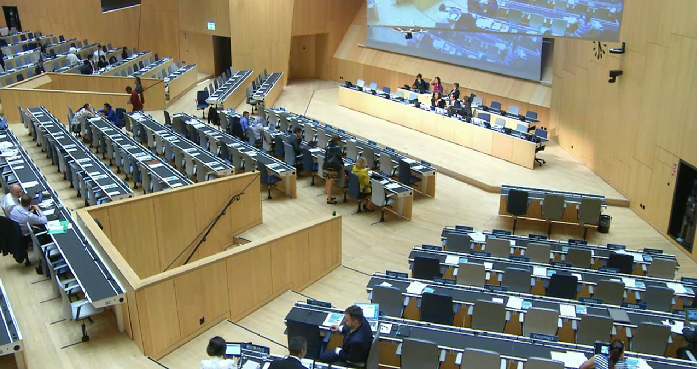
The WIPO Standing Committee on Copyright and Related Rights is taking place from 29 June to 3 July. The first part of the week was devoted to discussions on the potential treaty protecting broadcasting organisations.
Although delegates did not undertake any text-based work, broad consensus on some basic principles emerged, according to several sources. The shared objective of all delegations taking the floor was to stop piracy of broadcast signals.
For example, the previous divide between countries supporting a narrow protection treaty protecting only signal-based transmission and excluding internet originated content, and countries favouring the inclusion of internet transmission seem to be narrowing.
According to several sources, the protection now being envisaged is closer to the 2007 General Assembly mandate, providing protection to a signal over any platform as long as it is not stored and retransmitted, such as over the internet.
Definitions also were discussed, and whether a definition of broadcasting should be crafted along the same lines as what can already been found in existing international treaties, such as the WIPO Performances and Phonograms Treaty (WPPT), the Rome Convention for the Protection of Performers, Producers of Phonograms and Broadcasting Organizations, and the Beijing Treaty on Audiovisual Performances.
It was also pondered whether a definition of broadcasting organisations is necessary or not. Both definitions would clarify the beneficiaries of the treaty, some said, as broadcasting is defined in different ways in different domestic legislations.
Diplomatic Conference in Next Biennium?
Romania, on behalf of the Central European and Baltic States (CEBS), said it is now essential to move to text-based discussions and would support a clear roadmap towards a diplomatic conference (high-level negotiating meeting) in the next biennium.
This was supported by a number of countries, such as Russia, Serbia, Japan, Nigeria, Kenya, South Africa, and Iran. The United States, which said no one had committed to anything, expressed nonetheless satisfaction with progress made during the week, and agreed to move to text-based discussions.
The European Union also supported the CEBS group for a clear roadmap towards a diplomatic conference in the next biennium and expressed satisfaction although they said the results of the week’s discussions were coming short of their initial expectations. The EU as well as the US said a number of provisions of the treaty had not been tackled yet.
Rationale of Both Viewpoints
At the outset of the session, several developing countries advocated the need for the treaty to be in conformity with the 2007 General Assembly mandate.
The European Union in its opening statement [pdf] underlined the “great importance” of the discussions, and in a later statement [pdf] said that both transmissions made by traditional means and internet should be protected against piracy.
Broadcasting organisations use new technologies, the EU delegate remarked, and they should be provided with adequate and effective protection, in view of the technological realities of the 21st century.
Iran in its statement remarked that the SCCR should not establish a second layer of protection for broadcasts and should not restrict society’s free access to knowledge and information. The issue of expanding the protection to content of the signal and transmission over computer and internet is of concern because it would be granting stronger rights which may increase costs and affect access to broadcasts in developing countries, the delegate said.
“The new possible ways to deliver content via computer networks and mobile devices hold great promise to bridge the knowledge and digital divide,” he said. “Therefore, it is paramount to determine whether and how intellectual property rights should apply with respect to broadcasting.”
India explained that “the provisions of this treaty need to provide protection to the broadcasting organizations for their broadcasts on traditional broadcasting and cablecasting media to enable them to enjoy the rights to the extent owned or acquired by them from the owners of copyrights or related right.”
“No extra layer of rights should be awarded to broadcasters on the content which they have got licence to broadcast only,” the Indian delegate said. “They should not be given rights in other platforms without a contract from the right owner.”
IP-Watch interns Ani Mamikon and Rishi Dhir contributed to this story.
[…] first part of the week was devoted to a potential treaty protecting broadcasting organisations (IPW, WIPO, 3 July 2015). The proposed recommendation to the General Assembly was that the SCCR continue discussions on the […]
[…] Broadcasting Treaty Discussions Open Way To New Convergence On Broad Principles […]
[…] Countries generally agree on the notion of stopping piracy of broadcast signals, but the subject of protection and what constitutes a broadcasting organisations is heavily debated. Still, at the last session of the SCCR in July, sources said positions were getting closer (IPW, WIPO, 3 July 2015). […]