Year 2014

Hard Bargaining In IP Chapter Of Trans-Pacific Partnership, Trade Ministers Say

Intellectual property is still one of the most complex and challenging areas of the Trans-Pacific Partnership (TPP), as some countries are holding fast to high levels of IP protection to promote innovation and creativity, while others continue to seek a greater emphasis on access to ideas. This appears to be the message of today's statement from trade ministers of countries negotiating the TPP.

WIPO Committee On Development And IP Opens With Overloaded Agenda

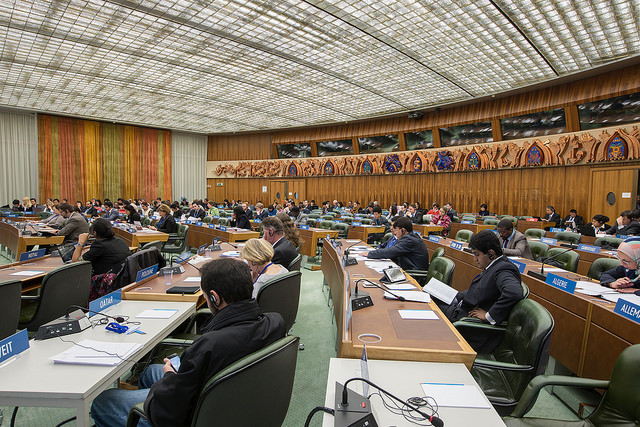
The World Intellectual Property Organization Committee on Development and Intellectual Property (CDIP) opened today with a heavy agenda and open issues that carried over from past sessions. In particular, delegates are expected to find agreement on a list of speakers, which would unlock the convening of an international conference on IP and development. They also must agree on the terms of reference of an independent review of WIPO’s implementation of the 45 Recommendations of the 2007 Development Agenda.

Global Differences On Patents Lead WIPO Patent Law Committee To Stumble On Future Work

Once again, differences over the role of a World Intellectual Property Organization committee last week came in the way of consensus and prevented delegates from agreeing on future work. At the heart of the discontent was the perceived imbalance of the proposed programme of work, which some said disregarded the interests of developing countries. A speaker for the African region gave a striking speech on the Ebola crisis as an example of the failure of the patent system.

ITU Plenipotentiary Outcome Limiting UN Agency Role In Internet Governance Deemed “Success”

US Ambassador Daniel Sepulveda on the eve of the final celebration of the International Telecommunication Union (ITU) Plenipotentiary Conference last week said he was "happy" about the results. Asked what he thought was the most important resolution of the three week conference, he told Intellectual Property Watch he would not name one resolution, but rather considered the achievement of overall consensus by the ITU member states on the final documents "a success."

Expect Strong IP Push From Global Pharma Industry Next Year; WHO Prescribes Dose Of Reality

NEW YORK - Strong intellectual property rights will be a top priority for the pharmaceutical industry internationally in the coming year and arguments over IPRs versus medicines access are false, a top representative said at a high-level industry event this week. But views at the event differed on expectations of industry in light of the Ebola crisis, hepatitis C drug costs or other medicines access questions.

WTO, WHO, WIPO Examine IPRs And Middle-Income Countries

The current income-based grouping of countries needs to be changed or access to medicines in middle-income countries will worsen, several speakers said yesterday at a joint meeting between three international organisations on health, trade, and intellectual property. But middle-income countries should step up their engagement in organisations such as the World Health Organization, according to WHO and civil society.

US: WIPO Plan To Negotiate Higher GI Protection Sets “Deeply Troubling Precedent”

The United States is accustomed to having a strong say in multilateral negotiations, but in the case of a move by a small number of World Intellectual Property Organization members to negotiate higher protection for geographical indications without the full participation of the US and others, the US government is particularly fuming. Now it has questioned the very validity of the move.

World Customs Organization Adds To Anti-Counterfeiting System

The Brussels-based World Customs Organization has updated its online tool for field customs officers to communicate in real time with rights holders on counterfeiting of their brands. The WCO announced its partnership with another company providing authentication and traceability technologies, bringing over 30 additional top brands on board.

ITU Plenipotentiary Conference: Internet Governance Diplomacy On Display

The much belaboured takeover of the internet by the United Nations International Telecommunication Union again has not taken place. Instead, ITU member states gathered at the Plenipotentiary Conference in Busan, South Korea, this week rather smoothly passed a set of internet-related resolutions that will, once the closing plenary adopts them, preserve the limited status quo of involvement of the UN organisation responsible for telecommunication and radio frequencies in internet-related public policy issues.

What Is Happening At The ITU Plenipotentiary Conference?

Consultant Richard Hill writes: There is lots going on at the ITU Plenipotentiary Conference, in particular a typical North/South clash regarding who should do what. The global South would like to see a greater role for the International Telecommunication Union in some areas, or a least a smaller role for institutions based in or dominated by the global North, whereas the global North favors the status quo. But there are many nuances, some very significant, within this overall picture.