
Original news and analysis on international IP policy
Category Regional Policy

Many Hepatitis C Patients Do Not Have Access To Medicines In India, Group Says
Despite being the global leader of generic drug manufacturing, access to hepatitis C treatment in India remains out of reach for a large portion of the population, a civil society group has said in a new paper. The authors call for India to work on a national programme of prevention and treatment of hepatitis, and warn against voluntary licences developed by multinational pharmaceutical companies.
South African Government Staves Off Critics With IP Consultative Framework
South Africa’s Department of Trade and Industry (DTI) appears to be meeting its detractors halfway with a new intellectual property consultative framework it says will help pave the way for consultative engagement with IP stakeholders both inside and outside of government.

Google Anti-Piracy Report Criticised By Content Owners
Google is doing more to counter online copyright infringement than ever before, it said in its “How Google Fights Piracy 2016 Update,” claiming takedowns of over 500 million webpages in response to rights holder requests. Yet the music industry and an academic said the company needs to up its game.

Infojustice: NGO And Academics Letter To US Secretary Of State On Access To Medicines
From Infojustice.org: Letter from 56 Non-profit Organizations and Academic Experts to Secretary Kerry Regarding State Department Pressure Against Access to Medicines Efforts

US High Court Restores Treble Damages For Patent Infringement
Pulse Electronics was guilty of patent infringement. That had been decided long ago. The only remaining issue was how much Pulse must pay for its wrongdoing. The company could be liable for treble damages, provided its infringement was willful. Fortunately for Pulse, willful infringement was almost impossible to prove, thanks to a standard established by the Federal Circuit. Unfortunately for Pulse, its lawsuit reached the US Supreme Court. And in its recent ruling on the case, the high court threw out the Federal Circuit’s standard, making it far easier to prove willful infringement. The decision is likely to have an important impact on patent litigation, the courts, and companies doing business in the US.
MSF International Access Campaign Recruiting Executive Director Of Access Campaign
The Médecins Sans Frontières (MSF) International Access Campaign is recruiting an Executive Director (ED) of the Access Campaign.
New French Law Opens Market For Non-Profits Selling Public Domain Seeds
New legislation on biodiversity has been adopted by the French National Assembly, opening doors for the sharing and selling of seeds in the public domain to amateur gardeners. For some associations that had been illegally trading public domain seeds, this is seen as a major victory.
The “Denial Playbook”: An Original Product Of The Oil Industry
New documents reveal that the oil and tobacco industries took pages from the same book to engineer their decade long campaigns on denying the existence of climate change and smoking-related cancer. The playbook also appears to have originated not with tobacco, but with the oil industry itself, and the two even appeared to share patents.

Civil Society Calls On India To Backtrack On Policy Threatening Global HIV Response
The International AIDS Society made a statement today at the International AIDS Conference in Durban, South Africa, voicing concerns about India's recent policy which, according to the group, is threatening access to HIV treatment in India and around the world.
The Significance Of Uruguay’s Win Over Philip Morris International
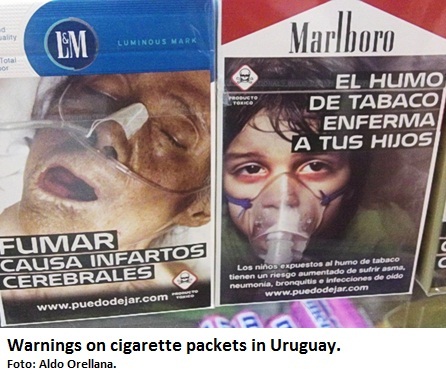
The tobacco industry’s global efforts to use bilateral and multilateral agreements to challenge the spread of tobacco control measures such as trademark-minimising plain packages were dealt a significant blow last week when the World Bank dispute settlement body dismissed a case brought by Philip Morris against the government of Uruguay.
The decision is seen a landmark for those who view the company as using test cases to continually challenge and delay public health protection measures and discourage other countries, particularly those with fewer resources, from strengthening their health regulations. Additionally, the case reasserted that trademarks are subject to government regulations and also illustrated the role that international organisations and actors can play in support of national governments defending their health measures.

Blockstream’s New Patent Strategy: Trust Us, We Won’t Sue You
Blockstream, which developed the blockchain technology and bitcoin, has announced a defensive patent strategy. The crux of it: assurance that users of its technology won't be sued.