Category Themes

A Look Back: Challenges Of Open Access In 2017 (An Industry Perspective)

Suzanne Kavanagh writes: Over the course of the year, three issues repeatedly reared their heads as barriers to the successful implementation of Open Access: the burden of expected author OA expertise; the underutilization of metadata in the publication lifecycle, and the challenges posed to authors and institutions by one-off solutions. As the tenth Open Access Week draws to a close, with its focus on the concrete benefits of making scholarly research openly available, where have we gotten to in solving these problems and realizing the potential of OA?

Reaping The Benefits Of Artificial Intelligence

Your brand is everything in the global marketplace. It is no exaggeration to say that a business now lives and dies by both its offline, online and social reputation. Because of this, searching a trademark is more vital than ever before. It is important for trademark professionals to work faster and more effectively in searching, clearing and registering strong marks to ensure clients have a competitive advantage. To do so requires the merging of the old and new: the specific knowledge that only highly experienced trademark experts can provide, with the advantages of the latest wave of artificial intelligence (AI) technology, writes Ronda Majure.

WHO Draft 5-Year Plan Would Focus On Impact & Innovation, Be Discreet On Medicines Access

After the new head of the World Health Organization provided his vision for his tenure of the global health institution this summer, the organisation is working on its next programme of work for the period 2019-2023. A preliminary concept note has been issued for public consideration. The note lays out priorities and new orientations and describes a financially sober, more efficient organisation, focused on measurable impact, set on aligning with the United Nations Sustainable Development Goals, and affirming its role as a multi-stakeholder platform of global governance on health, but stays clear of controversial issues, such as the affordability of medicines.

Qatar WTO Dispute Case: An Issue Of IP Or National Security?

The United Arab Emirates (UAE) this week blocked the first request by Qatar for a World Trade Organization dispute settlement panel to rule on measures by UAE that Qatar alleges interfere with trade in goods and services and with protection of Qatar's intellectual property rights. Neighbouring countries say they have taken actions out of concern that Qatar is providing financial support for terrorist groups.

CARB-X Makes Award For First Topical Antimicrobial; Could Be Used In Emergency Settings

CARB-X, an initiative aimed at accelerating innovation in antibacterial treatment, today announced an award to a company to accelerate development of a new bioengineered antimicrobial intended to be applied directly to affected tissues. This follows an announcement earlier this month of funding another firm to develop a new antibiotic class to treat drug-resistant Gram-negative bacterial infections.

Consultation On Future Of WHO Pandemic Flu Programme To Look At Seasonal Viruses, Genetic Information

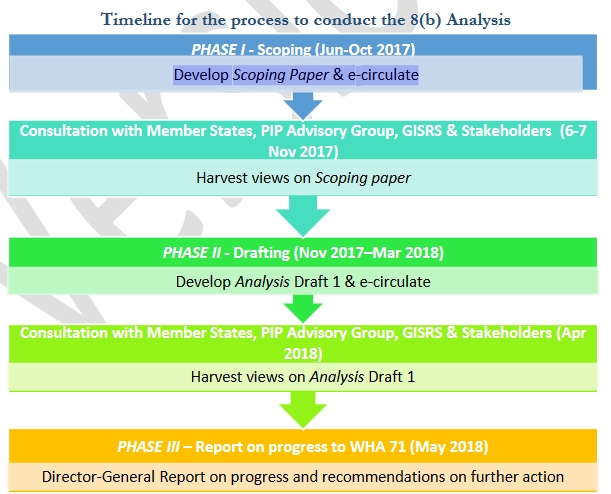
The World Health Organization mechanism to prepare the world for the next influenza pandemic is pondering its future and possible improvements. Among them are its extension to seasonal influenza, and the inclusion of genetic virus information along with biological samples to keep pace with technological developments. Member states and stakeholders (except the media) have been invited by the WHO to a consultation next month to discuss an analysis showing the potential beneficial or deleterious effects of the suggested changes to the system.

Staff Union Welcomes Next EPO President, Hopes For Dialogue

In a letter to its members, the Staff Union of the European Patent Office (SUEPO) in The Hague, Netherlands has welcomed the election of Antonio Campinos as new President of the EPO a week ago, expressed hope for a change in EPO management-workforce relations and has some recommendations for next steps.

TRIPS Council Serves As Ground For Discussion Of Compulsory Licensing

The escalating prices of medicines has become a growing global concern. Among many issues, intellectual property has been pointed to as providing monopolies that allow for unaffordable prices, in particular in developing countries. Though there is consensus among countries that IP is but one of the issues, the extent of the IP influence is not agreed. The use of compulsory licences as a way for developing countries to grant access to medicines to their populations was discussed during the World Trade Organization committee on intellectual property last week, with divergent opinions.