Category Innovation/ R&D

Number Of Unique Patent Assertions Declined Over Years, Patexia Finds
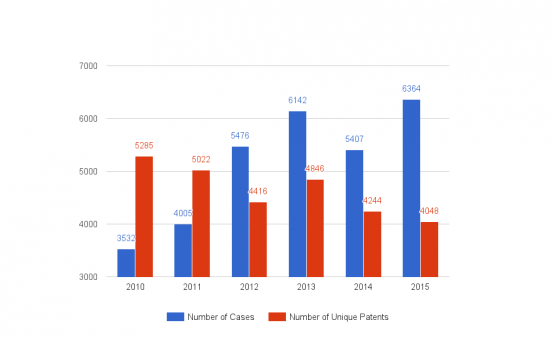
Pedram Sameni of Patexia writes: We recently studied the PTAB data and suggested that although the rise and fall in litigation indirectly affected the rise and fall in IPR challenges, the true driver of IPR challenges is the number of unique patents asserted each year. To learn more, we decided to look at the number of unique patents asserted against different defendants since 2010. We made several interesting discoveries, including the surprising fact that even though the number of cases has been rising, the number of unique patents asserted each year has been declining.

US Agencies Seek Comment On Updated Antitrust Guidelines For IP Licensing

In an age when licensing of intellectual property plays a critical role in business strategy, the United States Department of Justice and Federal Trade Commission are seeking public comment on a proposed update of the antitrust guidelines for IP licensing.

Switzerland Stars, China In Top 25, Innovation Rating Finds

A global innovation rating has found Switzerland to be the most innovative nation in the world for the sixth consecutive year even if some other countries are on its heels. The lead group of countries continued to be mainly composed of most economically advanced nations, while innovation is lagging in many developing countries, but China and India made notable leaps up the list this year. The rankings stirred a broader discussion today of the shifting global economy and the role of innovation, including a call for a new approach to global innovation governance.

US High Court Restores Treble Damages For Patent Infringement

Pulse Electronics was guilty of patent infringement. That had been decided long ago. The only remaining issue was how much Pulse must pay for its wrongdoing. The company could be liable for treble damages, provided its infringement was willful. Fortunately for Pulse, willful infringement was almost impossible to prove, thanks to a standard established by the Federal Circuit. Unfortunately for Pulse, its lawsuit reached the US Supreme Court. And in its recent ruling on the case, the high court threw out the Federal Circuit’s standard, making it far easier to prove willful infringement. The decision is likely to have an important impact on patent litigation, the courts, and companies doing business in the US.

UNCTAD’s Work On IP To Continue In Strengthened Four-Year Mandate

NAIROBI, Kenya (IP-Watch) – Intellectual property rights related to trade and development will continue to be part of the United Nations Conference on Trade and Development (UNCTAD)’s programme work, according to an agreement on the organisation’s four-year mandate reached at the agency’s 14th session in Nairobi.

UNDP Initiative Seeks Impact-Driven Entrepreneurs From 10 Developing Countries

The United Nations Development Programme (UNDP) has launched a joint initiative with Impact Hub, an international community of social entrepreneurs. The initiative is a platform named "#Accelerate2030," aiming at supporting and promoting the most promising impact-driven ventures focusing on the UN Sustainable Developments Goals (SDGs).

AIDS Conference: Will The UN High-Level Panel Report Deliver R&D And Access To Medicines?

DURBAN, South Africa - The lessons derived from the history of AIDS treatment have become a rallying call for civil society organisations globally. Not being able to afford AIDS medicines should not be repeated for people with other diseases, including HIV co-infections, treatment activists told world leaders here.

Patenting By Universities Unhelpful, Paper Says; WIPO Programme To Be Reviewed

A new publication analysing the relationship between intellectual property and access to science explores ways countries have developed to counter the potential barriers created by IP rights, and says patenting by universities is counterproductive.