Category Trademarks/Geographical Indications/Domains

Brexit Threatens Legal Uncertainty, Higher Costs For Trademarks, Lawyers Say

Two weeks after the United Kingdom voted to leave the European Union, the potential impact of “Brexit” on patents and trademarks is becoming marginally clearer, intellectual property lawyers said in interviews and a 7 July webinar. Among other things, Brexit would delay the EU unitary patent and unified patent court (UPC) and result in great uncertainty –and higher costs -- for trademark owners, they said.

US Industry Airs Hopes, Frustrations On IP Rights In India

What do global innovators make of India’s new National Intellectual Property Rights Policy? A recent discussion on “India’s National IPR Strategy: A View from Global Innovators” in Washington DC attempted to assess the opportunities and challenges ahead from the perspective of American companies.

US Sees Weak African IP Protection, But Not Enough To Lose Unilateral Trade Benefits

The Office of the United States Trade Representative (USTR) today (29 June) released its annual report on the eligibility of African nations for unilateral trade benefits offered by the US. While some countries were praised for progress on intellectual property protection, others were found to be weak in this area, but none were removed from eligibility for that reason. Overall, reporting on IP rights varied widely in the report.

Clinton Lays Out Presidential Tech & Innovation Plans

US presidential candidate Hillary Clinton has issued highlights of her plan to boost the nation's competitiveness in and attention to technology, internet and innovation if elected. The platform hits many of the latest issues and buzzwords in those fields, continuing existing programs but also pushing further in some areas. Among the plans: appoint a chief innovation advisor, reduce frivolous patent litigation, support allowing the US Patent and Trademark Office to keep its fees, boost access to orphan copyrighted works and open licensing, support multi-stakeholder internet governance, and keep the internet open worldwide. Clinton also gave a nod to personal privacy online and took a jab at the SOPA bill that was defeated for over-reaching on behalf of IP rightsholders.

National Parliaments Not Needed For CETA Approval, European Commission President Juncker Says

European Commission President Jean-Claude Juncker said today that the European Union would not include national parliaments of EU member states in the final decision on the Canada-EU Trade Agreement (CETA). Juncker's CETA statement was made during the post-Brexit meeting of EU heads of state in Brussels today (28 June), several German newspapers reported quoting the German News Agency (DPA).

Russia Centralizes State Power In The Field Of IP Rights

The Russian government has officially adopted a package of measures aimed at tightening state control for the observance of intellectual property rights in the country. This will take place through the introduction of a new system of IP management and implementation of other measures, according to recent statements of Oleg Fomichev, Russia’s deputy minister for economic development.

OECD Ministerial On Internet Wraps Up: Openness A Concern

The Organization for Economic Cooperation and Development (OECD) should not wait 8 or 10 years before its next Internet Ministerial, said OECD Secretary General Angel Gurria at the closing session in Cancun Mexico yesterday. Gurria called for a faster pace for government and regulators to adapt to the digital markets. Better data on the data economy will help, as reflected in the new Cancun Declaration.

OECD Ministerial On Internet: Trust, But Whom?

Beware “digital protectionism.” That was one of the key messages of United States Commerce Secretary Penny Pritzker, speaking at the official opening of the Organisation for Economic Cooperation and Development (OECD) Ministerial on the digital economy in Cancun, Mexico.

As OECD Gathers, Call For New Internet Social Compact – With Some Open Questions

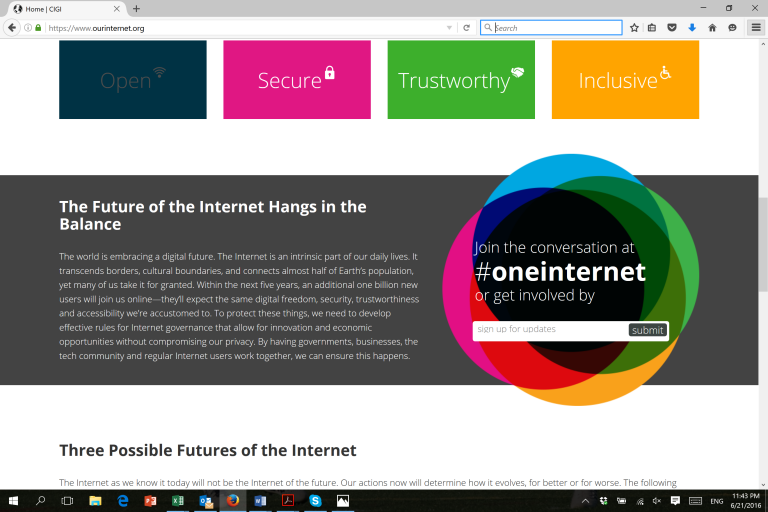
On the eve of the third internet-related Ministerial Meeting of the Organisation for Economic Development and Cooperation (OECD) starting on 22 June in Cancun, Mexico, the Global Commission on Internet Governance (GCIG) published a think report on “One Internet.” Calling for a new “social compact” for the internet, the 140-page report that was fed by 50 research studies has a number of well-known recommendations, some surprisingly technical and some interesting ones.