Category Copyright Policy

Clinton Lays Out Presidential Tech & Innovation Plans

US presidential candidate Hillary Clinton has issued highlights of her plan to boost the nation's competitiveness in and attention to technology, internet and innovation if elected. The platform hits many of the latest issues and buzzwords in those fields, continuing existing programs but also pushing further in some areas. Among the plans: appoint a chief innovation advisor, reduce frivolous patent litigation, support allowing the US Patent and Trademark Office to keep its fees, boost access to orphan copyrighted works and open licensing, support multi-stakeholder internet governance, and keep the internet open worldwide. Clinton also gave a nod to personal privacy online and took a jab at the SOPA bill that was defeated for over-reaching on behalf of IP rightsholders.

National Parliaments Not Needed For CETA Approval, European Commission President Juncker Says

European Commission President Jean-Claude Juncker said today that the European Union would not include national parliaments of EU member states in the final decision on the Canada-EU Trade Agreement (CETA). Juncker's CETA statement was made during the post-Brexit meeting of EU heads of state in Brussels today (28 June), several German newspapers reported quoting the German News Agency (DPA).

US Courts Split On Legality Of Music Sampling

De minimis non curat lex – the law does not concern itself with trifles. This venerable legal principle is applied throughout the world, but not in one part of US copyright law. Copying any part of a sound recording, no matter how tiny, is actionable copyright infringement, according to an eleven year-old US appellate court ruling. Following that ruling, pop star Madonna found herself sued because her hit song, Vogue, allegedly copied a fraction of a second of another song. That copyright infringement suit was thrown out on 2 June, however, when a different appellate court ruled that de minimis infringements of sound recordings do not create any liability. Now US copyright law is in a muddle.

Russia Centralizes State Power In The Field Of IP Rights

The Russian government has officially adopted a package of measures aimed at tightening state control for the observance of intellectual property rights in the country. This will take place through the introduction of a new system of IP management and implementation of other measures, according to recent statements of Oleg Fomichev, Russia’s deputy minister for economic development.

OECD Ministerial On Internet Wraps Up: Openness A Concern

The Organization for Economic Cooperation and Development (OECD) should not wait 8 or 10 years before its next Internet Ministerial, said OECD Secretary General Angel Gurria at the closing session in Cancun Mexico yesterday. Gurria called for a faster pace for government and regulators to adapt to the digital markets. Better data on the data economy will help, as reflected in the new Cancun Declaration.

UK “Brexit” Leaves IP Community With Many Questions

Britons' 23 June decision to pull out of the European Union has caused shock waves in the UK and Europe, and the vote is still being digested. Early reactions from members of the intellectual property community show that the impact of Brexit on IP policies and issues in Britain and Europe is far from clear.

LinkedIn’s Patent Portfolio; Looking For Hidden Gems

John Sullivan writes: It's obvious that this acquisition isn’t necessarily about the IP assets of LinkedIn. However, let’s have a closer look at LinkedIn’s portfolio to see if there are any hidden gems inside that would represent a nice fringe benefit to what already looks like a mutually beneficial acquisition.

OECD Ministerial On Internet: Trust, But Whom?

Beware “digital protectionism.” That was one of the key messages of United States Commerce Secretary Penny Pritzker, speaking at the official opening of the Organisation for Economic Cooperation and Development (OECD) Ministerial on the digital economy in Cancun, Mexico.

As OECD Gathers, Call For New Internet Social Compact – With Some Open Questions

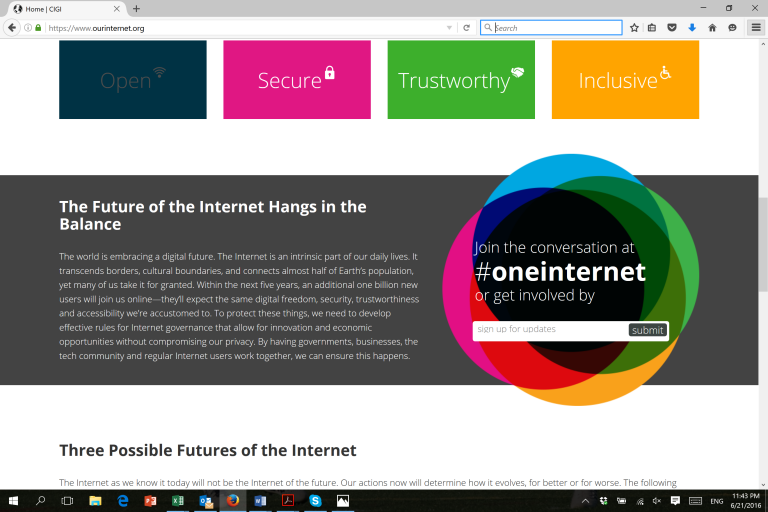
On the eve of the third internet-related Ministerial Meeting of the Organisation for Economic Development and Cooperation (OECD) starting on 22 June in Cancun, Mexico, the Global Commission on Internet Governance (GCIG) published a think report on “One Internet.” Calling for a new “social compact” for the internet, the 140-page report that was fed by 50 research studies has a number of well-known recommendations, some surprisingly technical and some interesting ones.