Original news and analysis on international IP policy
UN Technology Bank To Build IP Infrastructure In LDCs; Private Sector Funds Needed
NEW YORK -- A new United Nations Technology Bank for least-developed countries aimed at growing technology transfer and intellectual property infrastructure across the 48 poorest nations became operational at last week’s annual UN General Assembly in New York. The bank’s creation represents the first target of the 2030 UN Sustainable Development Goals to be achieved.
NEW YORK — A new United Nations Technology Bank for least-developed countries aimed at growing technology transfer and intellectual property infrastructure across the 48 poorest nations became operational at last week’s annual UN General Assembly in New York. The bank’s creation represents the first target of the 2030 UN Sustainable Development Goals to be achieved.
Host nation Turkey signed an agreement with the UN on 22 September, committing to provide US$2 million per year for five years plus staff and offices. LDCs were lining up to make token contributions as well, but the real need is to tap resources in the developed world to make it sustainable, sources said.
The Technology Bank effort is organised by the UN Office of the High Representative for the Least Developed Countries, Landlocked Developing Countries and Small Island Developing States (UN-OHRLLS). More information about the bank is available here.
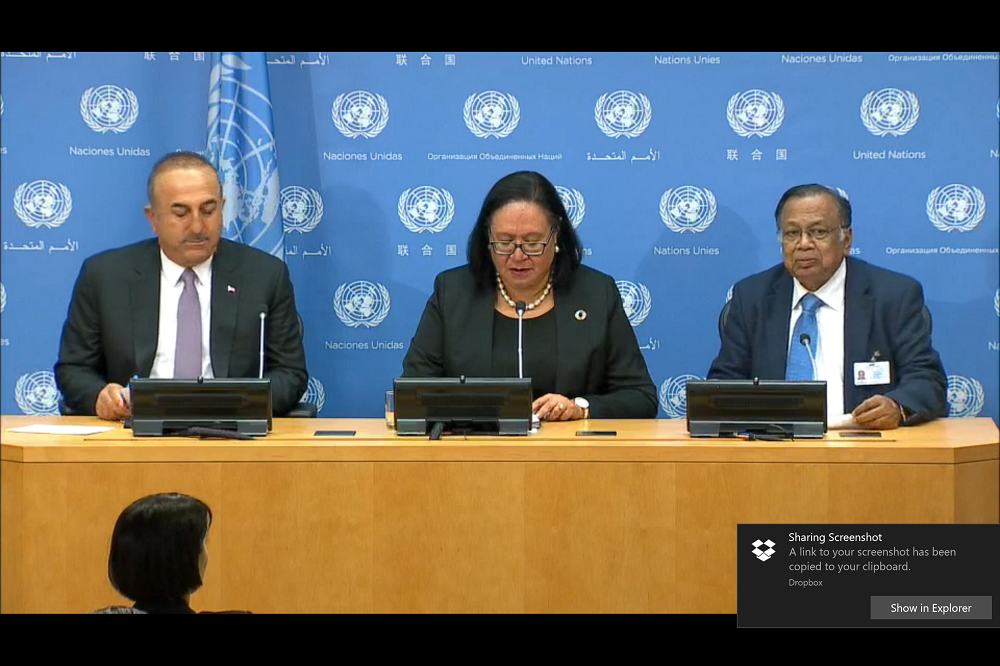
Several officials announced the signing at a 22 September press briefing at UN headquarters. The video of the press briefing is here.
Speaking at the briefing was Fekitamoeloa ‘Utoikamanu of Tonga, the under-secretary-general and high representative for the Least Developed Countries, Landlocked Developing Countries and Small Island Developing States. She also served on the International Telecommunication Union (ITU) Broadband Commission.
Also speaking was Turkish Foreign Affairs Minister Mevlüt Çavuşoğlu, and Abul Hassan Ali, minister of foreign affairs of Bangladesh and chair of LDC Group).
Asked whether the bank is foreseen to function as a pool for patent rights, ‘Utoikamanu said there are two components to the bank: technology transfer and strengthening the IP infrastructure of LDC countries, as well as support IP rights acquisition and capacity building. For example in 2015, across the LDC countries there were only 2400 patents registered compared with 800 in neighbouring countries and about 100,000 in bigger countries. You’re talking in comparison to 47 countries. So there’s big potential for supporting IP and technology transfer.
They did a costing over 5 years of the Bank and it is foreseen to cost $35 million annually.
‘Utoikamanu said the signing on 22 September with Turkey was the formal operating agreement for the Technology Bank, and marked the achievement of the first SDG, target 17.8. The bank has been a longstanding priority for LDCs, called for in the 2011 Istanbul Programme of Action. The 2016 UN General Assembly officially established the bank as a new UN institution and subsidiary organ of the General Assembly, to be located in Gebze, Turkey.
“Finally we are there,” said ‘Utoikamanu.
“This achievement is not only highly symbolic, but also of great strategic importance to the LDCs in the overall achievement of the Sustainable Development Goals,” said ‘Utoikamanu. “This bank is all about leaving no one behind.”
She added that officials heard “over and over” during the week of the General Assembly high-level meetings that “the great divide of our time is in access to science, technology and capacity to innovate. We must ensure that the LDCs are not yet again left behind.”
The Technology Bank is expected to broaden the application of science, technology and innovation in the world’s poorest countries, ‘Utoikamanu said. It will improve technology-related policies, facilitate technology transfer and enhance the integration of the LDCs into the global knowledge-based economy. It will also serve as a knowledge hub, connecting needs, resources and actors, facilitating LDC access to existing technology-related projects and fostering joint initiatives with relevant organisations and the private sector.
For example, she said, healthcare is key to enabling a productive life. The bank will help make advances in healthcare available in a form adjusted to the conditions of the LDCs and broaden access.
Turkish government provided financial and in-kind resources to host it. OHRLLS will organise UN capacities. But more voluntary support is needed from other sources to make it sustainable.
The aim is to tap the “great minds with great ideas” across developing countries. “This potential is currently held back by lack of access to funds, market access and patent protection.”
Çavuşoğlu said: “This Technology Bank is dedicated exclusively to least-developed countries. We strongly believe this bank will fill the technology gap, and will speed up structural transformation in LDCs.”
By signing the agreement, Turkish government commits to provide the secretariat US$2 million annually for 5 years. The government also will provide personnel and the offices in Gebze, in a technopark near Istanbul. Turkey will engage in joint projects with the bank, he said.
Hassan Ali called operationalisation of the Technology Bank is “a major milestone” toward the SDGs and the Istanbul action programme for LDCs. He said it should contribute to all LDCs. Bangladesh made a token contribution of $50,000 to the trust fund, and it is his understanding that other LDCs will make symbolic pledges to the bank as well.
According to a fact sheet, the bank will:
“Strengthen the STI capacity of LDCs including the capacity to: identify, absorb, develop, integrate and scale-up the deployment of technologies and innovations – including indigenous ones – as well as the capacity to address and manage intellectual property rights issues.”
“Promote the development and implementation of national and regional STI strategies, strengthen partnerships among STI-related public entities and with the private sector, and promote cooperation among all stakeholders involved in STI including researchers, research institutions, public entities within and between LDCs, as well as with their counterparts in other countries.”
“Promote and facilitate the identification, utilization and access of appropriate technologies by LDCs, as well as their transfer to the LDCs, while respecting intellectual property rights and fostering the national and regional capacity of LDCs for the effective utilization of technology to bring about transformative change.”
Governance
On governance, the Technology Bank “will be guided by a Council composed of 13 independent experts in STI and development cooperation, appointed by the Secretary-General for a period of three years. The Technology Bank will report annually to the General Assembly.”
The finances of the bank will be kept in a trust fund overseen by the UN auditors.
Private sector, governments, foundations and other stakeholders were urged to contribute to make it sustainable.
[…] Unidas ha establecido como objetivo prioritario de su 2030 UN Sustainable Development Goals, la creación de un banco tecnológico, destinado a la dotación de infraestructuras en materia de PI y transferencia de tecnología para […]

 Host nation Turkey signed an agreement with the UN on 22 September, committing to provide US$2 million per year for five years plus staff and offices. LDCs were lining up to make token contributions as well, but the real need is to tap resources in the developed world to make it sustainable, sources said.

[…] Unidas ha establecido como objetivo prioritario de su 2030 UN Sustainable Development Goals, la creación de un banco tecnológico, destinado a la dotación de infraestructuras en materia de PI y transferencia de tecnología para […]