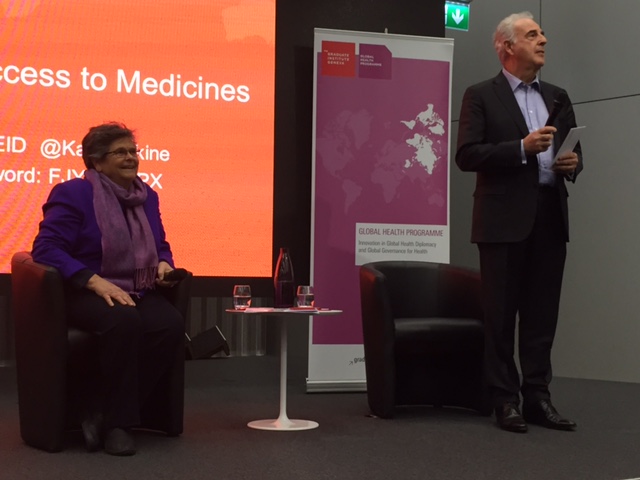
Former Swiss President Ruth Dreifuss, co-chair of the United Nations Secretary General’s High-Level Panel on Access to Medicines, participated in a Geneva event on rare diseases earlier this month. She agreed to answer Intellectual Property Watch’s Catherine Saez about the High-Level Panel report, in particular how it was received by the international community, her take on criticisms that have been voiced, and the importance that the report be discussed at the international level such as the World Health Assembly.
INTELLECTUAL PROPERTY WATCH (IPW): How would you say the report of the High Level Panel, issued in September 2016, has been received by the international community?
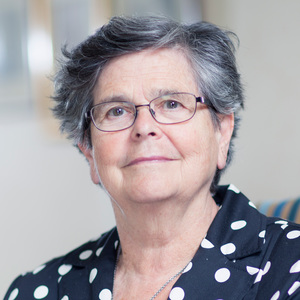
RUTH DREIFUSS: I was happy to hear that the NGO community found the report is a useful toolbox, and that they would like to use this toolbox both for awareness purposes, but also to push and support new models in the international governance, and inter-governmental arena.
The reception of the report by this particular public has been very important to me.
On the part of international organisations, I think the report served to launch a discussion. At this level, my hope was that the momentum could be rekindled on the issue of access to medicines.
I chaired the Commission on Intellectual Property Rights, Innovation and Public Health, which delivered a report to the World Health Organization in 2006. At that time I saw real momentum on the issue of access to medicines, an awareness, and a will to go further.
However this momentum had been diminishing over the last years and the report of the High Level Panel acted as a strong push to put the issue back on the international agenda. This is the case at the World Health Organization, it cannot be ignored. We will have an opportunity to discuss the report at a side event at the World Trade Organization, and will present it at the United Nations Human Rights Council. It is very important that others take ownership of the report now.
Some countries are doing it and also some organisations which are not directly involved in the tension between the right to health and trade.
IPW: What would you say to countries such as the European Union members, the United States, and Switzerland that are saying that the focus of the panel was too narrow and only addresses a part of the problem?
DREIFUSS: It is true that the panel did not address the big picture of the issue of innovation and access to medicines. It was our mandate to focus on one aspect of the issue. It is silly to say that issues should only be considered through a big picture perspective. Being too broad would not have allowed us to be precise, and focus is an advantage.
IPW: Some developed countries have also said that the process of the panel was not member-driven.
DREIFUSS: Some countries, pushed by their own pharmaceutical industries, tried to say that our report is set against intellectual property rights. It is not. It clearly shows that the IP incentive might work in some cases, and does not in others, such as in the case of rare diseases. When the IP incentive works, it leads to high prices.
Pharmaceutical industries know that many innovations are not affordable at the level of prices they are put on the market, not only for poor populations, or for people paying for medicines out of their pocket, but also in countries trying to achieve universal coverage. However, compassionate donations and voluntary licensing are mostly insufficient to guarantee access for those in need.
Our report is about the tensions existing between intellectual property and health. We had to underline that negotiations carried out at the WTO leading to the Doha Declaration [on TRIPS and Public Health] tried to overcome this tension and provide means to overcome them. It is a pity that in so many trade agreements progress made at the beginning of the millennium is now challenged by priority given to trade over health.
IPW: Why is it important that the High-Level Panel report be discussed at the World Health Assembly in May?
DREIFUSS: It is very important because the WHO has many tools on the table to make progress in this field. Progress is not going far enough, swiftly enough. It is stranded so it is very important that with the help of our report, governments at the WHO can recreate the wish and the will to go further.
IPW: What is your best wish for your report? Its best outcome?
DREIFUSS: It is a very difficult question because it is a multi-faceted problem. Progress is scarce on research for new medicines, in particular for neglected diseases, and on availability and affordability. Countries fighting to have early generic market entry is a good example of a push for progress in the area of availability and affordability.
I have millions of wishes, and if some of them are realised, it is good.
What is important for me is really to make use of these tools that are now on the table at the WHO, that there is discussion and progress toward the idea of a binding research and development treaty. We cannot rely solely on the tools we have now.
Image Credits: High Level Panel on Access to Medicines