Original news and analysis on international IP policy
UN Works Through Issues Of A Changed Internet
Most nations in the world agree that all aspects of society now depend on the internet. But this year’s process of reviewing the 2005 World Summit on the Information Society (WSIS) is showing how many challenges to the internet have arisen and how far apart nations are on the ways to address them.
Most nations in the world agree that all aspects of society now depend on the internet. But this year’s process of reviewing the 2005 World Summit on the Information Society (WSIS) is showing how many challenges to the internet have arisen and how far apart nations are on the ways to address them.
On 15-16 December at the United Nations, a General Assembly High-Level Meeting will be held to allow “in-depth discussions on important issues in the implementation of the WSIS outcomes, including the progress, gaps and challenges, as well as areas for future actions.”
But despite the increased importance of the internet worldwide – or perhaps because of it – it seems increasingly unlikely that the event will lead to major new decisions or have the importance of its predecessor two-part WSIS of a decade ago.
The WSIS+10 review is now working on the basis of a “zero draft” outcome document [pdf] compiled by the co-facilitators of the process, Latvian Amb. Janis Mazeiks and United Arab Emirates Amb. Lana Nusseibeh. The co-facilitators’ letter accompanying the zero draft is available here [pdf].
Following the stakeholder consultations and preparatory committee at the UN in New York from 19-22 October, the co-facilitators said they expect to make changes to the draft and recirculate it.
A central issue dividing nations for several years now has been how much of a role to give to governments and the United Nations in global internet governance.
A week ago stakeholder consultations and the preparatory committee on the WSIS+10 review were held at the UN headquarters in New York. Governments were generally divided along lines of emerging economies and developing countries that want more government and UN control over internet governance, and developed, largely western economies that favour a continued multi-stakeholder model that keeps governments on par with other stakeholders. Some, such as Russia, called for a new summit to be held, but this was roundly opposed by some such as the United States.
The multi-stakeholder issue was heavily discussed during the week, and will continue to be a key issue, but there are differentiated views, making agreement unlikely.
“I think that’s a debate that will not get resolved in this review process,” said Nusseibeh. It is one that “we will see go on for many years to come.”
A look at an exchange that took place during the preparatory meeting over the need for a third summit reveals differences in perspectives between developed countries seeking to preserve the status quo and emerging economies seeing a need to reopen the process.
India said it supports a review of WSIS and would “very strongly” support a high level meeting. “We don’t understand this position of not being able to change anything,” the delegate told the meeting. “We are talking about a dynamic internet. More is yet to come.” He mentioned cybersecurity, ICT for development, and human rights as areas that have arisen since the last WSIS meeting.
The US delegate then retorted that a review is ongoing every year, and that the US is “not opposed to taking on new issues,” but that all three issues mentioned by India are being discussed already. The US and other western countries repeatedly said that a compelling case has not been for high level meeting.
Russia then weighed in to say it thinks it is “very important to make a new agenda with a summit in 2020.”
India came back and said the ongoing review system should continue, however this platform is a different platform. “If the ongoing system was sufficient we shouldn’t be sitting here,” he said, calling for reconsideration of the approach that a review is not needed.
“Economies that are growing very rapidly like India see massive growth in the next five years, four times the growth in internet penetration in the country by 2020, which will throw up new challenges,” such as security, cultural, and social issue. “We are an open democracy, voices are expressed and encouraged in our system,” and it is necessary to have ongoing process, “but in the UN context we need to have a review in 2020.”
To which the US gave a little ground. The US could see a UN General Assembly review, he said, but a new high level summit “would undermine our work here and the WSIS.” At the WSIS, he said, “they said we should come together in 10 years and see if it is working well. We have and it is.” Still, the US could see sitting down and discussing, he said.
Earlier, South Africa made the comment that the WSIS outcomes have demonstrated “the need for new processes to fill gaps in ways for governments to address their responsibilities.”
To which the US, which appeared to play a de facto arbiter role in the discussion, noted that the ICANN Government Advisory Committee (GAC) and NetMundial in Brazil had been added to the process. And, the US, said, there have been no specifics about the “responsibilities” of governments that are not being addressed. The US supported a Brazil proposal to work with governments on identifying needs.
Reflecting the state of the internet itself in 2015, there are many seeming contradictions from all sides. In general, governments seem driven by a desire to control and track behaviour online, some likely in undemocratic ways. And western countries, led by the US, known to rely on surveillance to monitor users, push for openness and transparency. It it not clear where public concerns about surveillance or other control enter into the government-led UN process.
Next Steps to December Assembly
Summing up the weeklong meetings, Nusseibeh said overall, they had seen “reaffirmation of WSIS principles.” Members stressed that ICT for development should be at the heart of the outcome document. Financing, bridging the digital divide, especially with women, education, culture, diversity all seem likely to be emphasised in the document. Aligning the WSIS and 2030 SDGs, she said, “I think this can be done.”
Nusseibeh also said there appeared to be an emerging compromise on having nongovermental stakeholders at the table, she said, and it appears IGF will be renewed, probably for 10 years. Developing country participation is needed. The issues of enhanced cooperation and internet neutrality appear to need more discussion. On human rights, there was not consensus on the location of it in the document, but there is consensus on the importance of it. This is also true for cybersecurity, where the gap is on whether it should be included as a section or mentioned elsewhere. On WSIS action lines, it is to be decided whether to mention or build on them. And there was openness to consider the rationale for a high level event, and how to link to the SDGs.
Member states “may be closer to compromise than it may have seemed at the outset of these three days,” she said.
Mazeiks said in conclusion that were was a “clear desire” among member states to negotiate on on the zero draft text. He said they are now “extremely tight on time,” and urged comments by 30 October. By 10 November the co-facilitators will issue the next text. Consultations are expected during the week of 16 November, after the 10-13 November Internet Governance Forum (IGF) where both co-facilitators will be present. “Informal informal” consultations will result in a document at the end of the week of 16 November, he said, ahead of the 15-16 high-level General Assembly.
Panel: Politics of Internet Governance
On 30 October, a panel of the UN co-facilitators, academics and former US WSIS negotiators (now industry lobbyists) discussed the political side of global internet governance. They addressed internet governance, security, freedom and the ongoing effort to transition oversight of the internet away from the United States.
The panel at Columbia University’s School of International and Public Affairs was called “The High Politics of Internet Governance: Global Policy Conflicts a Decade after the World Summit on the Information Society.”
The Columbia event included the two co-facilitators of the WSIS+10 process. Panellists were: Moderator: Merit Janow, Dean, School of International and Public Affairs (SIPA), Columbia University. Panel: Laura DeNardis, Professor, American University, and Senior Research Scholar, Columbia SIPA; Gordon Goldstein, Managing Director and Head of External Affairs, Silver Lake Group; Amb. David Gross, Partner, Wiley Rein; Veni Markovski, Vice President, ICANN; Amb. Janis Mazeiks, Ambassador, Permanent Mission of Latvia to the UN; and Amb. Lana Nusseibeh, Ambassador, Permanent Mission of the United Arab Emirates to the UN.
On the panel, WSIS review co-facilitator Nusseibeh said three themes emerged from the stakeholder consultations: ICT for development (ICT4D), human rights and building confidence and security, and internet governance.
“We are in the middle of a process,” co-facilitator Mazeiks said. There is a consultation track with stakeholders and a negotiation track with governments.
On ICT4D, according to Nusseibeh, the broader goal is to harness internet for social good. She cited statistics showing the dramatic growth in mobile phones and other ICTs, to the extent that some take the view that “it ain’t broke,” so we don’t need to fix it, and more government interference is not needed.
But despite this progress, she said, other countries say the digital divide remains too large. More than half the world remains offline. Only 37 percent of women worldwide are online, and the gender issue has come up in this round of discussions under WSIS, she said. Another concern is that an estimated 80 percent of content online is available in only one of ten languages.
And most importantly, now 10 years since WSIS, it has become clear that mere access to ICTs is not a sufficient measure for developing countries. The new emphasis is the quality of that access, how relevant and how accessible content is for users in developing countries, how does it impact their daily lives.
She said there is strong potential for synergies between the WSIS process and the recently adopted 2030 UN Sustainable Development Goals (SDGs). Stakeholders agreed that WSIS should capture the cross-cutting role ICTs can play in the SDGs, and calls for the WSIS process to feed into the larger SDG review process that will look back in 15 years, as it would ensure a larger relationship between internet, an important driver and tool for development, and the global development agenda.
Also noted was that cybersecurity is bigger than in the past, and the human rights aspect has increased. Cybersecurity is related to ensuring national security considerations, and there is now concern about balancing privacy/freedom of expression and security/anti-terrorism.
On internet governance, the internet has evolved into a global infrastructure, and for many this has to be reflected in its governance structure. The Internet Governance Forum (IGF) was created at the original WSIS as a non-negotiating body, a platform for discussion of issues of the day. The next IGF meeting is taking place from 10-13 November in Brazil.
At the recent preparatory committee meetings, many governments voiced support for extending the IGF’s mandate, perhaps for 5, 10 or 15 more years (15 would put it on the same timeline with the SDGs). It has been noted that the IGF does not represent a substitute for an actual negotiating venue, however.
And on a key issue of the review, the WSIS+10 process relies on multi-stakeholder involvement, but there are differing views on the extent of multi-stakeholder engagement. Some, especially the G77+China countries, prefer that governments lead, while others, notably the large developed economies, insist on retaining the multi-stakeholder model making all equal.
Rise of State Control
On the panel, Prof. DeNardis talked about what has changed in 10 years. Now, every aspect of society depends on the internet, she said, and the function of the internet has changed.
The internet is no longer a communications network. It is now a control network. – Prof. Laura DeNardis
“The internet is no longer a communications network,” she said. “It is now a control network,” with many more things connected than just communications devices.
A big question now is how to account for human rights and also have security, she said, as users have data collected on them, and are subject to censorship.
“Internet governance has become a proxy for state power,” said DeNardis.
Goldstein, a former US negotiator, discussed the terms “multi-stakeholder” and “multilateral.”
The internet was unregulated, but increasingly states favour a multilateral system, which means an elevated role for government. The China+G77 submission explicitly calls for a multilateral model, he said.
This issue came to a head at the World Conference on International Telecommunications (WCIT), held in Dubai in December 2012. There, said Goldstein, the meeting broke down when the UN International Telecommunication Union (ITU), which organised the original WSIS, was elevated to be the body in control of internet governance. Some 89 countries signed the treaty at the WCIT, while others, including the United States, walked out.
The tension between those two blocs and types of mentality established three years ago continues today, in the background of the WSIS+10.
It is “quite unlikely” that the upcoming WSIS+10 conference will resolve those issues, said Goldstein.
David Gross was the lead US delegate for the WSIS, long since back in the private sector. His message on the panel was one of caution. “We need to be careful not to go on in the way we have,” he said. Rather, we need to ask a core question: what ought to be the role of the UN?
For him, the role should be taking technology and using it for the betterment of humanity. But for issues of where discussions should take place it is not the right place. Internet governance encompasses a whole host of different issues, and “the world does not lack for places to discuss these.”
“I do not believe [the UN headquarters in New York] is the right place to have serious … discussions about internet governance,” said Gross. This is consistent with his position at the WSIS in 2005, when he was influential in making the IGF a non-negotiating “talk shop” rather than a place for serious discussions.
Gross also said we need to be careful not to “hide the ball” – making it hard for all to participate – by holding too many forums that small countries cannot attend or participate in.
Jeni Markovski of the Internet Corporation for Assigned Names and Numbers (ICANN), who formerly was a negotiator for Bulgaria, said he recalled that the word “governance” did not translate well into some languages, as it literally meant “government”.
He also recalled earlier discussions that sought to separate governance OF the internet (such as the technology of moving packets around) from governance ON the internet. He said there are “so many places” addressing these issues, that the UN is “yet another place.” ICANN, despite being a California non-profit corporation that plays a technical role, is sometimes seen as a competitor to the UN on internet management. It is considered to be multi-stakeholder with a government advisory committee and range of business committees.
Markovski noted that “the reality is the majority of people are not online.” He also promoted ICANN as a “very open” organisation.
He further downplayed the issue of moving away from US control over the Internet Assigned Numbers Authority (IANA), which is responsible for making changes to the underlying internet. All the US does is check that ICANN is doing what it is supposed to be doing, he said, so the change would just mean a single government is no longer doing that.
Latvian Amb. Mazeiks, the WSIS+10 co-facilitator, promoted the UN, saying there is “not one UN,” but rather many specialisations, and there is an understanding of shared interest. There are differences on how much of a role governments should play in internet governance, he said. But the UN in New York is “where small countries send their best diplomats.” The internet involves much more difficult security issues now. “The discussion should happen at the UN,” he said.
DeNardis said now there is governance OF, ON and BY governments, via surveillance. This is leading to lack of trust in the internet.
“Don’t take the internet for granted, or the multi-lateral governance of the internet for granted,” she said. The goal should be keeping it open.
Gross suggested that it is necessary to find ways for people to gather in virtual ways rather than getting together in person.
“This is not diplomatic or academic,” he said. “The world really depends on how this comes out.” He noted reports that show that freedom on the internet continues to go downward.
Mazeiks said separately that there was support during the recent WSIS+10 meetings for moving cybersecurity and human rights issues to other places within the zero draft text.
DeNardis noted that there are a lot of barriers to participation, and that the multi-stakeholder model is somewhat of an answer to these.
Stakeholder Voices
On 19 October, a range of stakeholders, seemingly most from larger economies, took the floor at the UN to voice support or concern for various issues in the WSIS+10 process.
Many mentioned areas they feel are missing or insufficiently addressed in the draft, such as: culture and cultural diversity, the needs of people with disabilities, the high cost and low availability of broadband internet, the need for peaceful cyberspace, recognition of IT professionals, people with chronic diseases, regional/community-based development, including women in internet policymaking, and multilingualism.
One participant noted that the words “information society” are not mentioned once in the 2030 SDGs.
I am obliged to point out that the comment “There, said Goldstein, the meeting broke down when the UN International Telecommunication Union (ITU), which organised the original WSIS, was elevated to be the body in control of internet governance. Some 89 countries signed the treaty at the WCIT, while others, including the United States, walked out.” is factually incorrect on several counts. First of all, nobody “walked out” of the WCIT: some countries did not sign the treaty. More importantly, the treaty in question, the ITRs, do not “elevate” the ITU to “be in control of Internet governance”. Additional information on WCIT and the ITRs can be found in the IP Watch article:

 On 15-16 December at the United Nations, a General Assembly High-Level Meeting will be held to allow “in-depth discussions on important issues in the implementation of the WSIS outcomes, including the progress, gaps and challenges, as well as areas for future actions.”
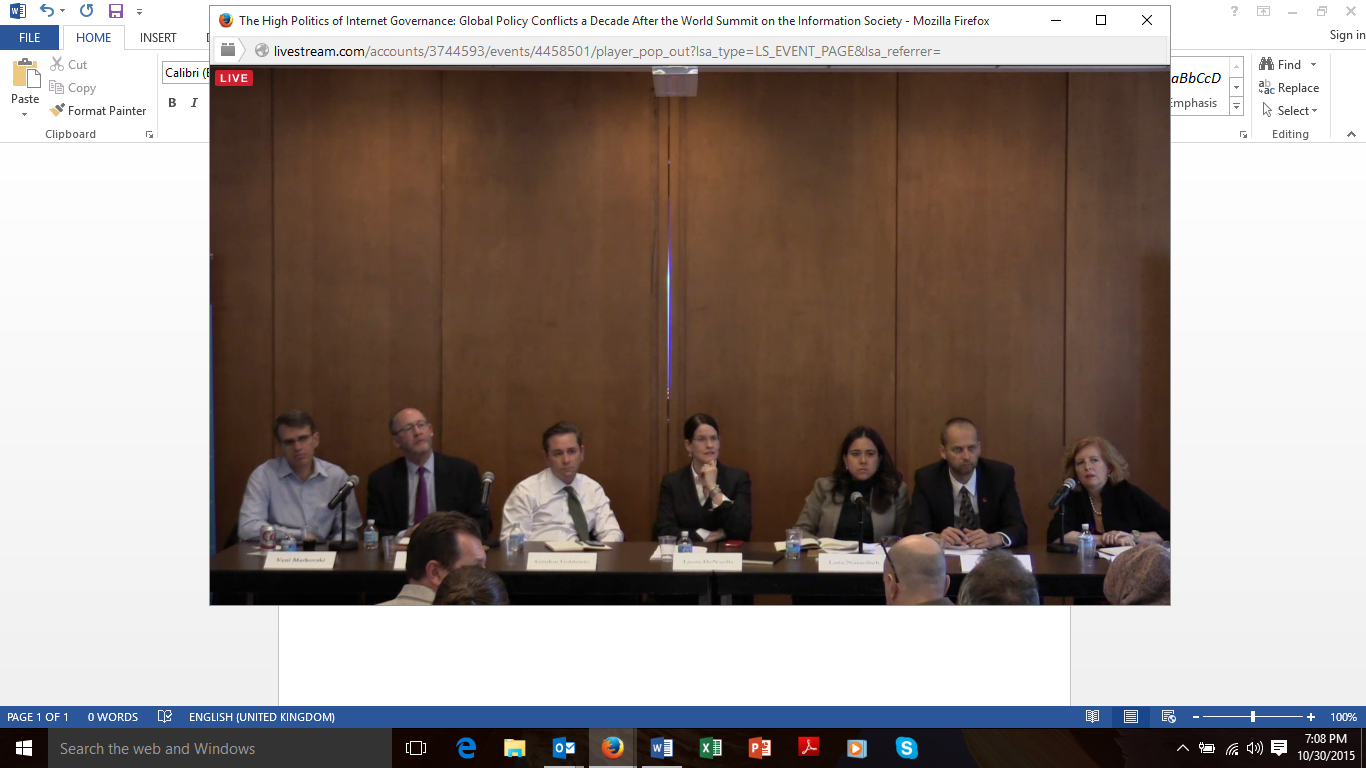 The panel at Columbia University’s School of International and Public Affairs was called “The High Politics of Internet Governance: Global Policy Conflicts a Decade after the World Summit on the Information Society.”


I am obliged to point out that the comment “There, said Goldstein, the meeting broke down when the UN International Telecommunication Union (ITU), which organised the original WSIS, was elevated to be the body in control of internet governance. Some 89 countries signed the treaty at the WCIT, while others, including the United States, walked out.” is factually incorrect on several counts. First of all, nobody “walked out” of the WCIT: some countries did not sign the treaty. More importantly, the treaty in question, the ITRs, do not “elevate” the ITU to “be in control of Internet governance”. Additional information on WCIT and the ITRs can be found in the IP Watch article:
http://www.ip-watch.org/2014/01/17/interview-richard-hill-on-the-new-international-telecommunications-and-the-internet/
And at:
http://www.hill-a.ch/wcit
Richard Hill