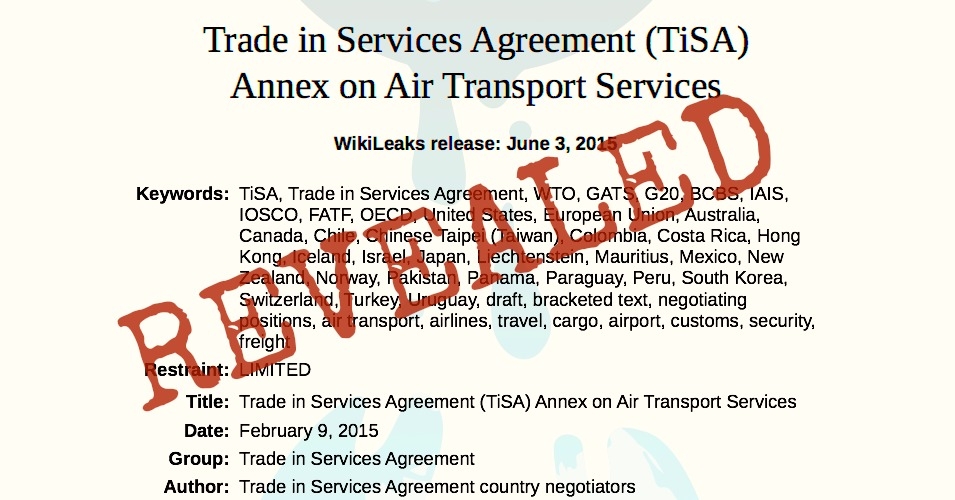
The ambassadors for the Trade in Services Agreement (TISA) have endorsed a deadline of notifying any additional new annexes by 31 July, and submitting completed offers by 15 September. This is the result of the most recent meeting of negotiators of the 25 TISA parties, according to a spokesperson for the Australian Department of Foreign Affairs and Trade. Australia hosted the TISA round from July 6-10 in Geneva.
TISA negotiations have been ongoing for several years in an effort to create a trade agreement to push cross-border trade.
Currently, 24 parties are parties to the TISA negotiations: Australia, Canada, Chile, Taiwan, Colombia, Costa Rica, European Union, Hong Kong, Iceland, Israel, Japan, Liechtenstein, New Zealand, Norway, Mexico, Pakistan, Panama, Paraguay, Peru, South Korea, Switzerland, Turkey, and the United States. Uruguay and Mauritius recently joined the club of the so-called “very best friends.”
Parties met last week to take stock of how far advanced the negotiations are. The DFAT spokesperson in a written statement summarized: “We made useful progress at the 12th round of TISA negotiations. The parties agreed to time frames for ongoing negotiations. There is appetite for intensified discussions in some areas, including market access.”
The spokesperson added that “large elements of the core text are stabilised,” and “good progress was made on a number of annexes at the 12th round and we expect to stabilise a number by the end of the year.”
Currently, there are 17 horizontal and sectoral annexes in addition to the core text, including chapters on e-commerce, telecommunications, financial services, public procurement and domestic regulation.
Sources at the European Commission in Brussels, busy this week with the next round of negotiations of the Transatlantic Trade and Investment Partnership (TTIP), offered caution on a deadline for TISA as a whole. Negotiations might come to a close perhaps at the end of 2016, a source told Intellectual Property Watch.
Some rather controversial topics are yet to be discussed, for example the institutional arrangement for a TISA committee. During the negotiations on the failed Anti-Counterfeiting Trade Agreement (ACTA) a couple of years ago, considerable public controversy erupted over the competencies for such a body.
According to the sources in Brussel a point difficult to compromise in the core text is the question about the most favored nation clause for market access. For the time being there was no agreement over awarding all TISA parties the same market access conditions that would be granted in bilateral agreements to third party countries. Experts at the EU Commission would prefer to be able to have more integration with selected trade partners.
Criticism of potential limits for governments to legislate and regulate once they commit to the TISA agenda is rejected by the trade parties, but discussions on the “right to regulate” clarification in TISA are not yet finalised. The same is true when it comes to the hot-button issue of data protection, for which the EU Commission has reiterated time and again that it would defend what it calls the EU red lines.
Given that transfer of data to a TISA partner according to the leaked proposal must not be prevented, including the transfer of personal data, concerns remain by data protection activists. Commission negotiators do point out that there are proposals from different parties. The data transfer formulation is part of a proposal by the United States that has fought over years with the EU over a General Data Protection agreement.
Another red line for the EU, according to the Commission, is a limitation to grant TISA parties the ability to decide for themselves on public services. With so many free trade agreements already negotiated, public services have never been a problem, so they ask why it should be now, the Commission source said.
TISA parties will continue to negotiate for the rest of the year and another stocktaking meeting can be expected a year from now, sources said.