
Experts at last week’s meeting of the Internet Corporation for Assigned Names and Numbers (ICANN) in Buenos Aires reached a milestone with a final proposal from the ICANN working group for the transition of internet control away from the United States. But global governance without oversight remains difficult, as the ongoing review of the introduction of new generic top-level domains aptly illustrates.
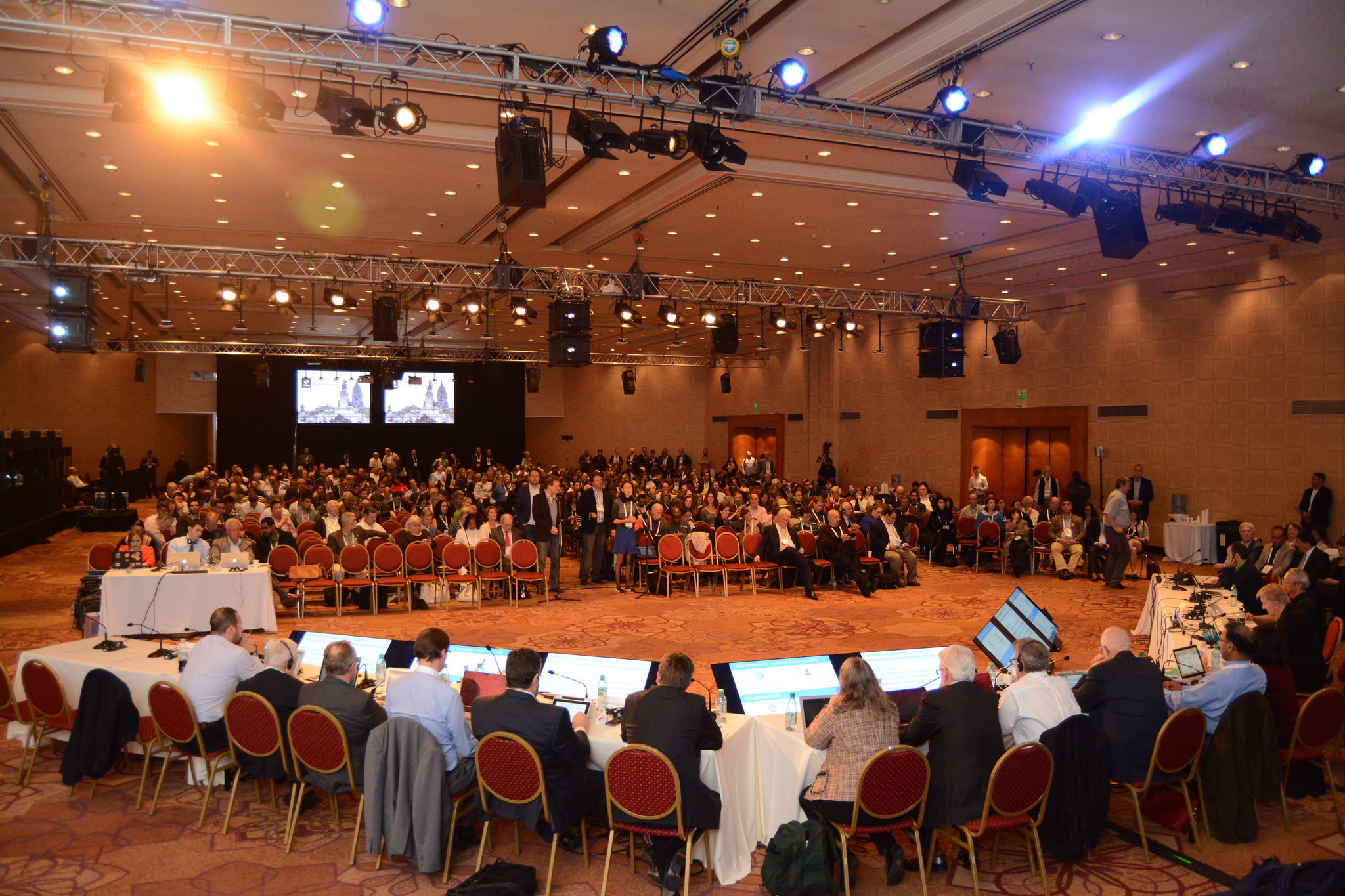
The 53rd meeting of the Internet Corporation for Assigned Names and Numbers (ICANN) was held in Buenos Aires from 21-25 June.
At the meeting, the ICANN Cross-Community Working Group on IANA transition (CWG) finalised its proposal for a future self-governance model. Instead of being overseen by US administrators, core assets of the net like the central root zone of the domain name system of the internet would be governed by ICANN’s stakeholders. How the stakeholders try to govern was demonstrated in Buenos Aires, where ICANN participants took stock of the process for creating new top-level domains.
At issue is the transition of the Internet Assigned Numbers Authority (IANA), as well as the application process for new generic top-level domains (gTLDs, such as .com). The IANA transition is hotly discussed because it manages central databases of core internet identifiers, names, internet protocol addresses and protocol numbers for the three respective communities.
Some members of the community would like to push ICANN to at least announce a timeline for a next round of new domains. But there are also many calls for a thorough review and rewrite of applications procedure.
Domain name system (DNS) technology expert Suzanne Woolf, ICANN Board liaison to the Internet Engineering Task Force (IETF), in a packed public session on 25 June, congratulated the ICANN community on the filing of the names proposal.
IANA Transition
After 17 years of oversight by the US National Telecommunications and Information Administration (NTIA), the IANA functions will now be overseen by the communities themselves, based on their multi-stakeholder governance models.
ICANN’s so-called five “chartering organizations” which include domain industry and users, country-code top level managers, civil society, security experts and governments – support the names proposal. Now it is up to the IANA Stewardship Transition Coordination Group (ICG) to mould the names, the numbers and the protocol proposals into one single proposal.
But the ICANN community still has work to do on its proposal as, “the CWG-Stewardship proposal is significantly dependent and expressly conditioned on the implementation of ICANN-level accountability mechanisms proposed by the Cross Community Working Group on Enhancing ICANN Accountability (CCWG-Accountability),” the proposal states.
The CCWG will meet on 17-18 July in Paris again. The new deadline given for the ICG is the meeting in Dublin in October. Woolf added a qualifier to her congratulations for the names community completing its proposal: “It is very important milestone, but it is only one milestone.”
The milestone results from a mammoth effort of voluntary work, but ICANN also spent over half a million US dollars for external legal counsel in the month of March alone with bigger bills to be expected for the remainder of the work, ICANN Chair Fadi Chehadé noted.
New TLD Process Close to Finish Line
The Buenos Aires meeting also saw considerable discussions on the success of the new gTLD program, certainly another milestone project of the ICANN. ICANN Global Domain Division Vice President Akram Atallah reported that of 1277 strings applied for, 660 now have been delegated. An additional 318 have already been contracted and 259 are in contracting negotiations. “We’re very close to finishing the programme,” Atallah said.
ICANN’s New gTLD Program Committee (NGPC) also finally completed its answer to the Governmental Advisory Committee’s (GAC) request to avoid an exclusive use of generic TLDs.
Applicants for TLDs like .phone, .food or .grocery – the latter applied for by Wal-Mart – are now expected to either allow for open registration in the TLD, withdraw the application, or wait for the next round which will have to consider a policy for generic words. This is suggested in the resolution by the NGPC. Several applicants in their answers to the GAC requests pointed out that the limitation for generics had not been in the applicant guidebook.
,Africa Stuck in Independent Review Process
Another stuck TLD application was brought up in various sessions during the ICANN meeting: the .africa domain, supported by the Africa Union.
Due to a competing application, the TLD for the African continent is before an independent review panel (IRP) that has taken its time. The vice-chair of the At-large Advisory Committee, Tijani Ben Jeema, complained during the public forum about the length of the IRP procedure. Africa and Latin America have seen very few applications (7 and 5 respectively, compared to 300 from North America).
Alice Munyua, lead at the African Union initiative for .africa also warned of shortcomings of the IRP processes when making these processes a core ICANN accountability mechanism after the IANA transition.
“We need to have a panel who does understand not only the ICANN processes and mechanisms and policies, but also can contextualize everything with regard to the area,” Munyua said.
Consideration about competent and effective panels are all the more necessary because in the future the decision could be even “binding the board”. An Indian participant called on ICANN to consider that IRPs remain too expensive for developing country applicants, a fact that awards ICANN with “relative immunity” for many decisions.
At the same time, independent dispute resolution that could be challenged before local courts in the end was presented as one way to get ICANN more globalised jurisdiction-wise, ICANN Board Member Bruce Tonkin, from Melbourne IT, argued.
He made the point during one of the discussions with governments unhappy about the fact that ICANN’s headquarters will remain in the US even after the IANA transition.
.amazon Saga; GAC Preparing List on Country Name Use
Another big dispute from the current TLD round still simmering is US retailer Amazon’s application for .amazon that had been stalled due to complaints by Latin American countries that it is a geographical name. The US Congressional Trademark Caucus just before the Buenos Aires meeting added fuel to the fire with a letter to ICANN calling it to answer the retailer’s renewed request to find a “mutually acceptable solution”.
Caucus Co-Chairs Randy Forbes and Suzan DelBene wrote: “At this critical stage in which the United States Government prepares to transition stewardship of the IANA functions we believe it is incumbent upon ICANN to resolve this issue, demonstrating that all stakeholders and trademark owners can be treated fairly, according to ICANN’s multi-stakeholder developed rules and existing international law.”
Eric Iriarte, general manager of the Latin America and Caribbean TLD Association LACTLD during the public forum of ICANN asked acrimoniously, he was “curious to understand how the Congress of the United States linked .amazon to the IANA transition with something that we may call in some cultures blackmailing.”
ICANN Board Member Mike Silber, a South African attorney and head, Legal and Commercial, at Liquid Telecom, said the .amazon and .africa cases are illustrations of how “we’ve ended up with a number of issues which have been possibly a little more complex than at the time the applicant guidebook was discussed and agreed and finalized. And hopefully in a second or third or however many rounds we go through, we’ll be able to refine and improve the process each time.” It was not so much a case of right and wrong that was at issue, rather “predictability, certainty and fairness.”
Topic of Contention: Community TLDs
More requests to re-consider the application policies came from community TLD applicants.
Thomas Lowenhaupt, one of the original pioneers for a .nyc TLD, criticised the failure of city TLDs to engage the public in the ventures. The .nyc domain is currently operating with close to 80,000 names issued. But he was not delighted, as “in New York in all these years there has not been a meaningful public hearing about our city’s TLD.”
The same was true for other city TLDs like .paris, he said, and called on ICANN, when it began accepting another round of applications for cities, it should make “meaningful opportunity to participate in consensus based planning processes” an obligatory feature.
The handling of community TLDs is also on the to-do list of the ICANN Governmental Advisory Committee, “noting” in its communiqué, “that it does not appear to have met applicant expectations.”
How to Spend TLD Auction Funds
Support for TLD applications from developing countries, funding awareness campaigns on new TLDs, or investing in the technical problems that new TLDs face – a lot of ideas are floating around about how to spend the US$ 58 million ICANN received via auctioning off TLDs that were applied for by several applicants.
The amount could be quickly go up another $60 million with the upcoming auction of .web, Elliot Noss, CEO of Tucows calculated. On top of that is another $100 million that ICANN had reserved for legal complaints during the first round and has not spent so far.
ICANN management constantly underlines that the auction money is clearly separated and if and how it will be distributed will be up to the community. Another cross-community working group could be set up to develop a plan.
Board members during the public forum were less enthusiastic about the idea to help new gTLD operators in marketing the new names – registration numbers of the new names still are low.
Google Domain Specialist Jordyn Buchanan argued that ICANN has a responsibility “to help people understand that these things have arrived.” Google has started to market the .how TLD via its Google Registry services.
Also for internationalised domain names there still is a lot of work needed, Buchanan said. “There are a lot of IDNs, people can now get email addresses in their own language, but they basically don’t work anywhere,” she said. ICANN should help to make the technology work instead of “leaving it on the floor.”



[…] Intellectual Property Watch […]
FYI
>#OMG! Africans want ICANN insiders on Independent Review Panels (IRPs)
http://domainnewsafrica.com/omg-africans-want-icann-insiders-on-independent-review-panels-irps/
>ICANN wants total control of DNS while breaking its own bylaws to block .africa probe: Board member ordered to appear at hearing
http://www.theregister.co.uk/2015/04/28/internet_bylaws_dot_africa/?utm
FYI,
Unredacted: ICANN’s hidden role in fierce battle over .Africa rights
http://www.theregister.co.uk/2015/07/15/icann_dot_africa_review/
Domain-name overseer ICANN’s pivotal role in a controversial fight over .africa is today revealed in full for the first time.
An independent review into the .africa saga, which was two years in the making, concluded that ICANN had broken its own bylaws: the organization had failed to properly investigate claims made by one of the two applicants battling for the rights to own the top-level domain.
But before the 63-page final report [PDF] was published last week, repeated references to ICANN’s own involvement in favor of one of the applicants were systematically removed by the organization itself.
[…] to the IANA Stewardship Transition Coordination Group (ICG).ICG is now finalizing its proposal molding the names, the numbers and the protocol proposals into one. While this process will most likely […]