Original news and analysis on international IP policy
UN Review Of WSIS Intensifies; Questions About ICANN Board Role In IANA Handover
This year’s United Nations review of implementation of the 2005 World Summit on the Information Society (WSIS) is picking up pace. Meanwhile, intensive efforts continue to meet a September target for the handover from the United States of key underlying functions of the internet.
This year’s United Nations review of implementation of the 2005 World Summit on the Information Society (WSIS) is picking up pace. Meanwhile, intensive efforts continue to meet a September target for the handover from the United States of key underlying functions of the internet.
The WSIS took place in two parts, 2003 in Geneva and 2005 in Tunis, Tunisia, and resulted in a series of outcomes, mandating a review this year. The UN General Assembly is scheduled to hold a high-level review meeting in mid-December in New York, and is following a process leading up to that. The Internet Society has provided guidance on the WSIS+10 review process, here.
The UN General Assembly passed a resolution, A/RES/68/302, in July 2014 that laid out the process. This included the appointment of two co-facilitators by the General Assembly president in June 2015, and an intergovernmental negotiation process including preparatory meetings and information interactive consultations with stakeholders from June to December.
This is a big year for the UN General Assembly as it is expected to adopt a new post-2015 development agenda at its September summit.
Leading up to June, the UN system has organised a WSIS+10 review, including the International Telecommunication Union (ITU), UN Economic, Scientific and Cultural Organization (UNESCO), and UN Conference on Trade and Development (UNCTAD), as well as numerous stakeholder contributions.
The UN Commission on Science and Technology for Development (CSTD) also has a key role, according to the Internet Society (a key stakeholder), having been tasked with assisting the UN Economic and Social Council (ECOSOC) as the focal point for the system-wide follow-up of WSIS.
ECOSOC, based in the New York headquarters, is expected to review the CSTD report [pdf] in July.
And last week, the WSIS+10 Forum was held in Geneva, giving an opportunity to discuss many aspects of the WSIS+10 review. It also was an opportunity to discuss the transition of the Internet Assigned Numbers Authority (IANA) away from US control (see below).
Though not a policymaking event, the 25-29 May WSIS Forum resulted in a set of outcomes that will be sent on to the CSTD.
In a “bottom-up multi-stakeholder” process, stakeholder groups have been holding intensive consultations amongst themselves in order to come up with contributions to the process.
IANA Transition
In a related track, the US Commerce Department National Telecommunication and Information Administration (NTIA), which has managed oversight of aspects of the internet since the 1998 creation of the Internet Corporation for Assigned Names and Numbers (ICANN), has designed a process for handing over the last of its unilateral control of the global internet.
The US last year proposed to hand over its oversight of the Internet Assigned Numbers Authority (IANA), which is responsible for the global coordination of the domain name system root, internet protocol addressing, and other internet protocol resources.
But NTIA has set conditions that it cannot be put into the hands of an intergovernmental organisation or government, and it must give its approval. And before the proposal comes to the NTIA, it must pass through the ICANN Board.
IANA has three main functions, as shown below (source: IANA.org):
The transition planning process has been divided between these three components (names, numbers, protocols), with each coming up with plans to be joined together and sent on.
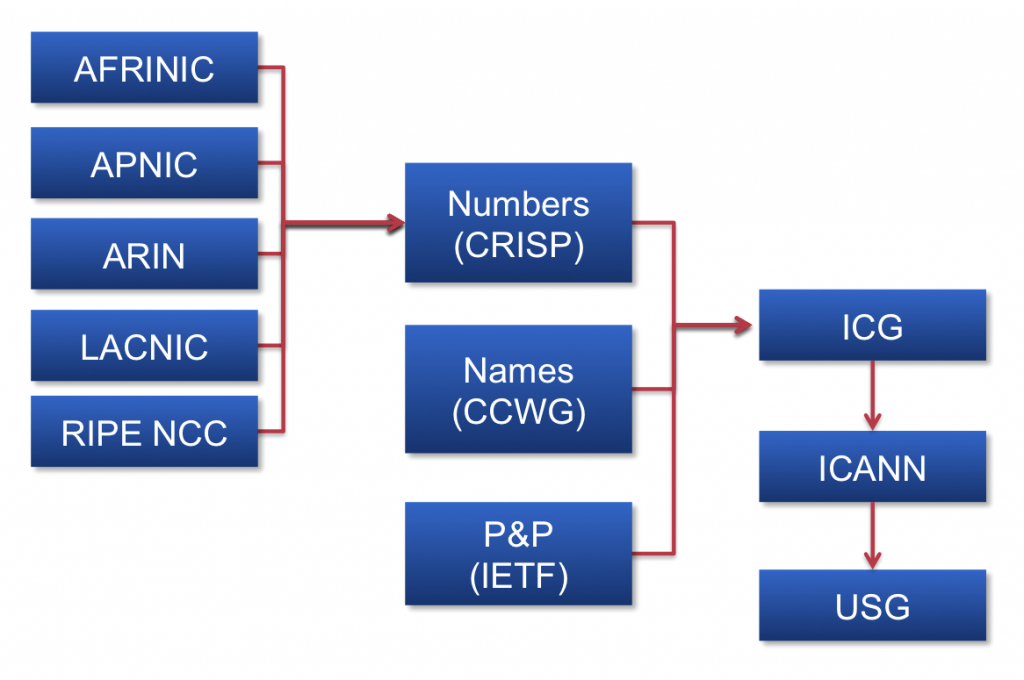
On the numbers side, there are five regional internet registries, which have been coordinating the IANA stewardship process transition along with other groups. The five RIRs are coordinated by the Number Resource Organization (NRO) and are: African Network Information Center (AFRINIC), Asia-Pacific Network Information Centre (APNIC), American Registry for Internet Numbers (ARIN), Latin America and Caribbean Network Information Centre (LACNIC), and Regional Internet Registry for Europe, the Middle East and parts of Central Asia (RIPE NCC). The Address Supporting Organization (ASO) also contributes to this track.
The numbers processes were fed into the Consolidated Regional IANA Stewardship transition Proposal (CRISP). The CRISP proposal on numbers will be joined with those of the names community (from the Cross-Community Working Group on accountability, CCWG) and the protocol proposal from the Internet Engineering Task Force (IETF) and Internet Architecture Board (IAB).
All of these will then feed into the IANA Stewardship Transition Coordination Group (ICG), then to ICANN and finally to the US government. It has been noted that the September 2015 deadline for NTIA handover is not a fixed deadline but more of a target.
Olivier Crepin-Leblond of the ICANN At-Large Community (ALAC), which represents users, spoke about the process, describing the numerous groups and many stakeholders involved. He said another group, the Cross Community Working Group on the IANA stewardship transition (CWG), had already involved some 94 meetings and calls, some 4,600 hours of work and nearly 4,000 mailing list exchanges. The CCWG (on accountability) had had 75 meetings and calls with some 4,300 working hours and over 4,000 mailing list exchanges.
Speakers also described progress toward agreement, such as development of draft service agreements and proposals for replacing the role of NTIA. An example might be for instance replacing the relationship between RIRs and NTIA with a relationship of RIRs and the IANA operator.
In addition, Crepin-Leblond and other speakers discussed efforts to boost the accountability of ICANN, which has over the years become larger, better-funded, and, in some people’s eyes, less publicly accountable.
Eliot Lear of Cisco Systems, an IETF regular, discussed the process from the protocol standpoint. Protocol parameters relate to when the IP packet is shipped across the Web whenever a user does an action, and the destination port shows what application will be used. There is a parameter registry for that, and ICANN administers that for the IETF as the IANA operator.
He described the process of a group of like-minded technical people coming up with a draft amongst themselves last year and then subjecting it to heavy commenting from the community that led to 10 revisions before it was agreed and sent to a steering group, which made additional changes before sending it to the ICG. Even then, the decision was appealed, so a further process could happen.
Markus Kummer, an ICANN Board member and Swiss former head of the Internet Governance Forum, said the US contract with IANA has been at the heart of the internet governance discussion for over a decade, and was seen by many governments as inappropriate. Now the historic moment has arrived when the US is ready for transition. He noted that the US has played a “very light” role on control, just checking for accuracy to ensure tasks have been performed accurately. But even though it does little in this role, the US has a big stake, he said, and noted how far the US stake can reach by pointing to the recent FIFA scandal.
On the role of the ICANN Board, he said some panellists overlooked it. Will the Board say no, make changes or just pass it on, he asked. The Board has already made comments and has said in general that the transition in workable, but details need to be worked on. The same goes for the accountability question, he said. His personal hope is that the Board will pass the proposal on and that it will not be problematic.
The worst outcome, said Kummer, could be if the ICANN Board says for whatever reason that the result is not good. Hopefully they will remain involved, he said. Kummer noted that there is considerable expertise on Board, and that they may have questions, such as to confirm to the community, ‘Are you sure you want this, or that?’
From the floor, consultant Richard Hill questioned the process, saying that everybody is “not exactly” equal. People named by ICANN constituencies have higher status, he said, and there are preconditions to the process put forward unilaterally by the US, which will have the final decision in the end.
“I would dispute that this is democratic by any meaning of the word, unless you are a US citizen,” Hill said. He further raised the question of ICANN’s role as both convenor and participant. And he said the process is difficult to follow, technical with a lot of material, and a lot of time needed.
A panellist defended the process, saying agreements have been based on consensus and that the process itself has been working in an open, democratic, inclusive manner.
An audience member from Delhi asked why the ICANN Board should play an intervening role after the process is completed, as it will already have had a chance to give its say. He asked whether the Board has a veto on the process.
A panellist explained that there are members designated by their group and there are participants, who are anyone that wants to follow. If there is no consensus, then it could come to a vote restricted to members. But, the panellist said, it is an inclusive process, so he does not anticipate a vote in the end.
Meanwhile, another audience member asked if there is a risk they are creating a “subsidiary structure” to ICANN here rather than a fully independent structure for the IANA.
Tracy Hackshaw of the Ministry of Science and Technology, Trinidad and Tobago, a member of the ICANN Government Advisory Committee (GAC), said governments are different than other stakeholders. They represent the views of their country and need to consult back home on issues before providing input to the process. So for governments, the speed at which the process is moving is “a challenge,” he said.
“Issues of the root of the internet are not the issues of the day in small island nations,” he said, so government has to do extra work in regional bodies to formulate positions. Governments look at internet governance from the standpoint of critical infrastructure and stability, he said, adding that issues such as how the root and the domain name system remain stable need to be raised in the transition process.
Marilyn Cade, a veteran representative of US business interests on the internet, said businesses are most concerned about security, stability and resiliency, and “how the internet can help them reach the next 100 or 1000 customers.”
Bill Drake of the University of Zurich and member of the Noncommercial Users Constiuency, another veteran of the internet governance debates from the US perspective, noted that there were no ICANN representatives on the panel, but rather representatives of the internet community. He and others noted that participation in the process is completely open to anyone to get involved, and praised ICANN as “quite extraordinary” in the way it deals with civil society.
Background: RIRs
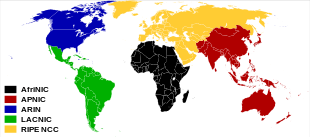
A regional internet registry (RIR) is an organization that manages the allocation and registration of internet number resources within a particular region of the world. Internet number resources include IP addresses and autonomous system (AS) numbers.
Map of Regional Internet Registries:
The Regional Internet Registry system evolved over time, eventually dividing the world into five RIRs: