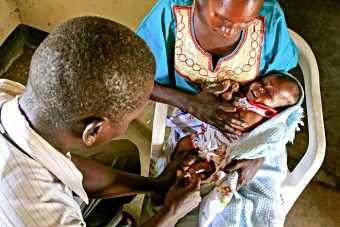
LYON, France – At the Biovision life science forum looking into translating innovation into health-related solutions last week, a panel of speakers shared their experience about the global access to vaccines. Although vaccination coverage is on the rise and intellectual property has not been a major concern in the past decade for vaccines, patents may well become a barrier in the future, panellists said.
A plenary session at Biovision, held on 5-6 June, focused on new access approaches for vaccines.
Seth Berkley, CEO of the GAVI Alliance said the “power of vaccines is extraordinary” and has led to the world lifting out of poverty. No other interventions in the world touch so many lives, he insisted.
Global vaccination coverage is increasing, however, only 5 percent of all children are fully immunised with the 11 vaccines recommended by the World Health Organization, Berkley said. GAVI hopes to raise that number to 50 percent, he said.
What holds us back on access today, he asked, answering, “People tend to think about the cost of vaccines and other issues” but it is mostly system issues. Those can be the quality of the data, the supply chain, reaching isolated places, rural areas and urban slums alike.
The GAVI model is unique, he said, but “there is no free lunch,” and “everybody pays.” Poor countries pay a very small amount, US$ 0.20 a dose for vaccines, but as countries move from low to lower-middle income, they begin to pay more, and when they cross a threshold, they graduate, he explained.
It is important at that time, that graduating countries are able to afford vaccines. He mentioned the recent GlaxoSmithKline’s commitment to retain GAVI prices for graduating countries for five years.
The model of middle-income country graduation from international support is a recurring concern of public health advocates because it does not account for the high number of very poor in those countries who will not afford the new, higher prices.
Patents: Growing Concern for Vaccines
The production of vaccines relies on very sophisticated methods and the level of knowhow required to manufacture them makes the infringement of vaccine patents unlikely, according to several sources.
However, this situation is changing, according to Martin Friede, programme leader for the Technology Transfer Initiative of the World Health Organization. For most vaccines, intellectual property has not been a challenge he said, but during the last 20 years some 10,000 patent applications for vaccines have been submitted.
The main owners of these patents are not big industries, but rather national institutes of health and universities, he said. The patents mainly concern vaccines against tuberculosis, malaria and HIV. The bulk of the funding comes from the public sector because there is no market force driving this, he said.
“In the old days,” he said, companies would go to universities for the products they wanted, negotiate and pay an upfront cash fee on four or five patents. Now a large number of patents on tuberculosis, malaria and HIV are being “held by many different people.” However, “it is not the patents that are causing the damage, it is the patent management,” he said.
The university technology transfer offices “are saying, you want to use this technology, we want to see cash on the table,” he said. “We believe that there is a massive amount of patents out there on these three areas, owned almost exclusively by the public sector, paid for by taxpayers’ money,” he said, and “they are being used as commercial leverage,” he said.
“There are so many [patents] out there, the industry is saying since there is no market, we are not prepared to make the investment to procure these licences,” he said.
He called for a mechanism to be set up so that when patents have been paid for by the public sector, there should be easier access to those patents, and they are managed “in a socially responsible manner.”
Another phenomenon, he said, is that some academics are now doing vaccine development. However, vaccine development is a highly skilled activity, which requires access to a broad range of knowhow and a broad range of platform technologies.
“We see an enormous waste of resources,” he said, “as academics are taking the product development on themselves.” Then they are trying to sell this to industry, which has to do the work all over again, he said.
He called for a much closer interaction between academia and industry, and for the funders to drive socially responsible licensing practices.
In response to an audience question, Friede confirmed that knowhow is the primary barrier to vaccine manufacturing but for some new vaccines, patents can constitute a barrier, adding as an example the recent patenting by “some groups” of an entire virus.
Berkley concurred and said that patent thickets are becoming a problem for vaccines, as are patent trolls (patent assertion entities).
MPP: Tiered Royalties
Greg Perry, executive director of the Medicines Patent Pool (MPP), said that the MPP seeks to bridge innovation and access by encouraging access to existing products, and also trying to stimulate the development of new products, in particular fixed-dose combinations and paediatric formulation for HIV treatment, the focus of MPP. He outlined the achievement of the MPP since its inception, and the number of agreements already drawn with several pharmaceutical companies.
Perry also said that the MPP is building new concepts into its model. For example, it provided a segmentation of the market, where the MPP sub-licensees will provide products at high volumes and low prices for the public sector, and a different pricing for the private market. The MPP also introduced a series of tiered royalties so that royalties paid by generics manufacturers will be higher in the middle-income countries with a high GDP, he said.
Developing Countries Need to Share R&D Burden, Says Panellist
Stanley Plotkin, emeritus professor of the University of Pennsylvania, who developed the rubella vaccine and co-developed the pentavalent rotavirus vaccine, said he agreed with Friede in the sense that patents should not block the use of discovery.
However, he said patents do stimulate discoveries. They bring royalties back to the institutions which can then do further research, he said. “I am wary of the possibility of killing the goose laying the golden egg,” he said.
The vaccine industry is currently going through an evolution and a “sort of crisis,” he said, as fewer companies are developing vaccines. This reduction of companies conducting research and development is worrisome, he said. In developed countries, companies devote between 15 and 20 percent of their profit to R&D. In developing countries, this figure drops to about 2 or 3 percent, he said. “That situation must change if we are to continue to have progress,” he said.
“Companies working on vaccines for malaria, tuberculosis or HIV have to expect a return on that investment,” said Plotkin, adding that companies in the developing world “must pick up the burden of R&D and start doing their own R&D.” He mentioned two new vaccines developed by China and said it is a trend that should be enlarged.