LAUSANNE – Energy installation projects in developing countries are often not sustainable, and can lead to breakdown of technologies reliant on energy supply such as medical devices, said speakers at a conference on technologies for development last week. A sustainable model, productive use of energy and receiver participation and training are essential to ensure continued operation of energy supply infrastructure, they said.
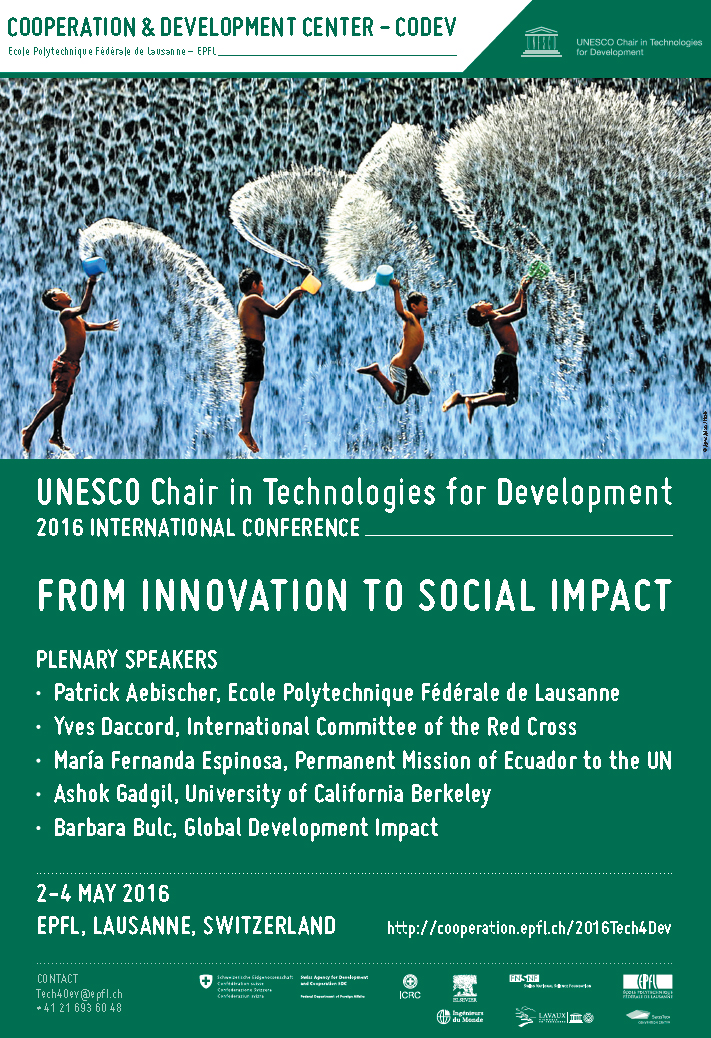
The third UN Educational, Scientific and Cultural Organisation (UNESCO) chair conference on technologies for development hosted by the École Polytechnique Fédérale de Lausanne (EPFL), took place from 4-6 June. The conference discussed access to energy for use of modern technologies, and scaling up and mainstreaming renewable energy technologies.
At the conference, experts presented ongoing projects and papers related to the role of innovative technologies in alleviating poverty, and the key determinants of successful use of these technologies. One of the core underlying themes of the conference was energy.
Philippe Gillet, vice-president of academic affairs at EPFL, said, “We have to test technologies in the local environment of developing countries, which is often characterised by poor infrastructure, unreliable energy supply, bad transport or limited digital access.”
The importance of adequate energy supply for use of technologies was demonstrated in a joint project presented by Guy Ngounou, PHD student at Ecole Nationale Supérieure Polytechnique de Yaoundé, Cameroon, and Michaël Gonin, PHD student at the Université de Lausanne.
The World Health Organization estimates that a third of all medical devices breakdowns occur due to inefficiencies in power supply such as power cuts and voltage dips, said the students. They presented evidence of this in a district hospital in Cameroon, highlighting a number of missing earth connectors and breaks in electrical circuits connecting the hospital’s medical technologies.
One of the main issues, said Gonin, is lack of knowledge about how to maintain electrical supply appliances by the district medical workers running the hospital. Unclear responsibility attribution and accountability also play a role, as often bills are directly sent to ministries, creating a lack of incentive for doctors to undertake extra responsibilities to maintain energy appliances.
Organisational change and training are needed, the students said. They also indicated a possible market opportunity for external consultations and engineering support, which could supply several hospitals.
“The technical solution is expensive but on the long term it pays off,” they said, as medical devices will not have to be replaced at the rate at which they are now.
GIZ: Benefitting from Sustained Energy Supply
Lucius Mayer-Tasch, advisor on international energy policy issues at the German Federal Enterprise for International Cooperation (GIZ), presented the importance of productive use of energy (PUE) to ensure sustainability of energy access programs. PUE includes “agricultural, commercial and industrial activities involving electricity services as a direct input to the production of goods or provision of services.”
He said that access to energy has focused on household use, but sustainability of these programs relies on productive use of energy from which businesses can generate revenue and create employment locally. This contributes to socio-economic development of communities, but also leads to sustained supply of energy where the supplier’s return on investment is ensured by continued use and payment for their services.
Promotion of PUE should be integrated into access programs, said Mayer-Tasch. One existing approach is for energy providers to supply complimentary services, which could help receivers identify how to upgrade their business activities in a way which would most benefit from modern energy supply, and provide training and demonstrations.
GIZ participated in the publication of a manual [pdf] on how PUE can be designed and implemented.
Lorenzo Mattarolo, from the Department of Energy of Politecnico di Milano, presented an ongoing project to develop “comprehensive and people-oriented” monitoring and evaluation tools that measure not only achievement of objectives of energy technology-related projects, but assess “livelihoods changes at a local level” and long-term community improvements and successes.
He also explained the necessity and challenges of developing a shared evaluation framework that would allow comparison of project success to be able to identify the most efficient and impactful initiatives.
Rémi Deveaux, social business development manager for Schneider Electric (France), presented a programme to bring “access to reliable, clean and affordable energy” to people living in off-the-grid villages.
Reflecting on past programs, he said most solar installations in African villages fail because of the need to replace batteries and pay for maintenance, which the villages cannot afford. This is a “disaster” for the villages after having adapted to steady flow of energy to suddenly be cut off. “You cannot scale up without a sustainable business model first,” he said.
Deveaux presented a case study of a village off the grid, whereby it was concluded that it would be too costly to connect all houses to an energy supplier, requiring installation of cabling, safety appliances etc.
However, the community could benefit instead from a central-powered community building, from which villagers could rent batteries for overnight use. The community building could also use its supply to generate revenue through launching new services such as cinema sessions, which could then be used to maintain the energy infrastructure.
Deveaux admitted this is a fragile business model, as services must be sustained and revenue used appropriately, and often requires supplementary income from NGOs, which makes it difficult to scale up. However, he said, market segmentation and the development of different models, such as those focusing on micro-financing, fuel saving or pre-payment methods, could help identify sustainable and adapt sustainable models for different markets.
Replicable Village Energy in India
Sudhir Singhal, former director at the Indian Institute of Petroleum and advisor on biofuels including for NGOs, presented a case study of a “replicable” sustainable village energy security project. Here, vegetable oil operated technologies were optimized for use to provide electric power to a village in India previously without power, using crops grown locally and without replacing agricultural land, and providing the type of energy for local activities.
“The success of the project lies entirely in the interactions that took place with the villagers both before and after the installation” of the technology, said Singhal.
This includes awareness generation around the project, assessment of energy demands and existing means to meet demands; selection of technology optimised for using locally grown crops input; procurement of best quality crop samplings; and village demonstration trials and training for plantation, oil extraction, maintenance and safety, he said.
The technology has not once broken down in over 40 months and is entirely managed and distributed in a financially sustainable way through the Village Energy Committee formed of villagers who are in charge of collecting revenue and managing the finances.
The selection of appropriate technology for the locality, extended consultations and community participation and training are essential lessons learned for implementation of sustainable technology projects, said Singhal.