Original news and analysis on international IP policy
WHO Director Chan Stresses Polio, Inequity, Climate, Junk Food, Supremacy Of Health Over Economic Interests
World Health Organization Director General Margaret Chan opened the annual World Health Assembly today with strong calls to address a wide range of top health concerns across the world. This included a call for the global health community to work to assert the primacy of health concerns over economic interests.
World Health Organization Director General Margaret Chan opened the annual World Health Assembly today with strong calls to address a wide range of top health concerns across the world. This included a call for the global health community to work to assert the primacy of health concerns over economic interests where necessary.
“International trade has many consequences for health, both positive and negative,” Chan said in her opening remarks. “One particularly disturbing trend is the use of foreign investment agreements to handcuff governments and restrict their policy space.”
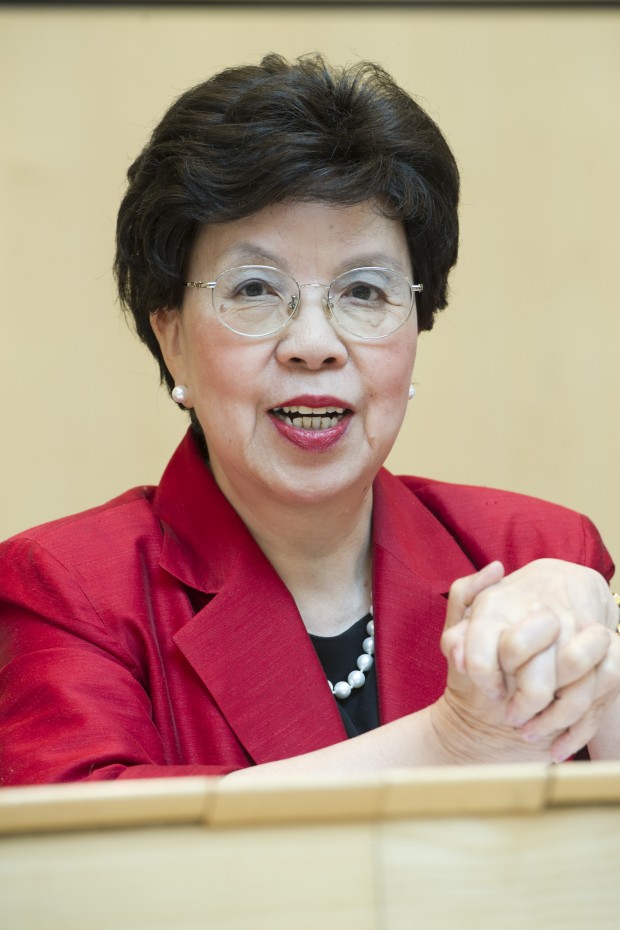
Margaret Chan, WHO Director General Credit: WHO/Pierre Albouy
For example, she said, “tobacco companies are suing governments for compensation for lost profits following the introduction, for valid health reasons, of innovative cigarette packaging.” This is a reference to the attacks Australia (and soon other countries) is facing for introducing a policy of plain packaging for tobacco products as a way to discourage their use.
“In my view, something is fundamentally wrong in this world when a corporation can challenge government policies introduced to protect the public from a product that kills,” said Chan.
In addition, she said that “some member states have expressed concern that trade agreements currently under negotiation could significantly reduce access to affordable generic medicines.”
“If these agreement open trade yet close access to affordable medicines, we have to ask: Is this really progress at all, especially with the costs of care soaring everywhere?”
Chan called for this century to focus on prevention of preventable, non-communicable diseases, at least as much as cure.
“Thirty years ago, who could have imagined that health could take such a firm stand against such an economically and politically powerful industry?” as tobacco, she asked.
“Given the importance of prevention, we will need to argue for the supremacy of health concerns over economic interests with other industries,” she said. “This will not be easy. As recent experience shows, even the very best scientific evidence can have less persuasive power than corporate lobbies.”
Inequity
Broadly speaking, there a number of dangers for health worldwide that are “shaped by some universal and ominous trends,” she said. For instance, in the past few months, social inequities have gained attention, as having a disruptive social and economic effect.
Chan and other speakers at the opening plenary also highlighted climate change and environmental issues having an increasingly critical effect on health. For instance, she said air pollution killed around 7 million people worldwide in 2012, making it “the world’s largest single environmental health risk.”
“Changes in the way humanity inhabits the planet have given the volatile microbial world multiple new opportunities to exploit,” Chan said.
NCDs: Now the World’s Biggest Killer
She also highlighted non-communicable diseases such as related to lack of nutrition. She pointed to the extremes of undernutrition and obesity, saying “parts of the world are quite literally eating themselves to death [while] others starve.”
“Highly processed foods and beverages loaded with sugar are ubiquitous, convenient, and cheap,” she said. “Childhood obesity is a growing problem with especially high costs.”
Another issue she mentioned is cancer, noting that developing countries now account for some 70 percent of all cancer deaths. Cancer cost the world an estimated nearly $1.2 trillion in 2010, she said, adding, “No country anywhere, no matter how rich, can treat its way out of the cancer crisis.”
Other NCDs she mentioned were heart disease, diabetes and chronic respiratory diseases, noting for instance that in some middle-income countries, diabetes treatment alone is now absorbing nearly half of the entire health budget.
How to Handle Poor in Middle-Income Countries?
The shift in the global poverty map, in which around 70 percent of the world’s poor live in middle-income countries and are left vulnerable as countries graduate to middle-income status, rendering them ineligible for support from the Global Fund for AIDS, Tuberculosis and Malaria and GAVI. This shift raises questions about whether countries’ economic growth will also bring an increase in domestic health budgets, and policies ensuring benefits are shared, she said.
“If the answers to these are no, the world will see a growing number of rich countries full of poor people,” Chan said.
[Update:] Some 220 nongovernmental groups from around the world have signed a letter calling for the proposed Blue-Ribbon Task Force to develop a global framework on tiered pricing, led by the Global Fund, to be abandoned out of concern for the poor in middle-income countries. The civil society letter is here [pdf]. Global Fund Director Mark Dybul sent a reply assuring NGOs that the group has stepped away from the tiered pricing approach. The reply included an updated text of the “equitable access initiative.”
Further areas of emphasis for Chan included the “obligatory place” that health has in any post-2015 development agenda, the setting of “highly ambitious” new goals for the Global Vaccine Action Plan on reducing child mortality.
She made a broad reference to research and development for neglected diseases and partnerships, calling it a “legacy of lessons, best practices, and innovative instruments for securing funds, purchasing life-saving interventions, and developing new products for diseases of the poor.”
“The Global Fund, GAVI, UNITAID, multiple partnerships for product development, and the International Partnerships Plus are part of this legacy,” she said, and mentioned the lesson that “markets cannot sell something to people who cannot pay.” She made a pitch for donors to back GAVI in its replenishment.
She did not make a direct reference to WHO’s reform process or recent past financial woes, nor to intellectual property rights or counterfeit/substandard medicines issues.
Chan cited free vaccines for childhood immunization programmes, free distribution of bednets against malaria, and the fact that “the bottom billion receive medicines for neglected tropical diseases at no cost.”
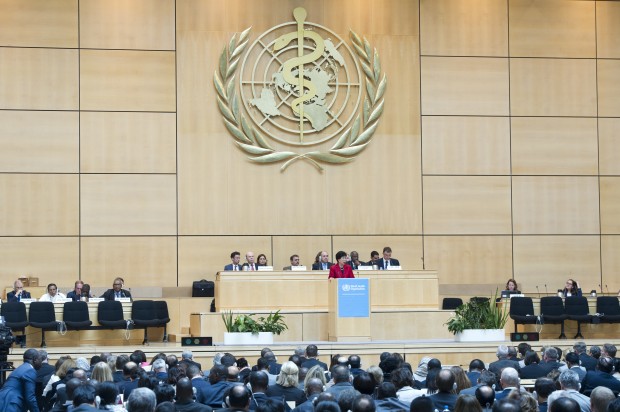
67th World Health Assembly Credit: WHO/Pierre Albouy
The World Needs WHO
She also made a pitch for “how much the world needs an organisation like WHO,” because within the framework of its leadership priorities, “WHO is shaping the health agenda as needs evolve, and using multiple mechanisms and partnerships to meet these needs.”
“If anything,” she said, “the relevance of this organisation has increased.” She noted the leadership role given to WHO by the 2011 UN political declaration on NCDs, and its role in shaping policies in general, referencing a “growing commitment” to universal health coverage.
WHO’s work helps drives down prices and makes medical products more available, she said. “WHO negotiates with industry for concessional prices. For drugs of diseases of the poor, WHO negotiations have cut prices by as much as 90 percent.”
“For the neglected tropical diseases, WHO negotiates and manages very large drug donations from multiple industry partners, amounting to 900 million doses last year,” Chan said. “This is a huge undertaking with huge benefits.”
Chan opened by highlighting her 5 May declaration that the international spread of wild poliovirus has become a public health emergency of international concern. Two years ago, the spread of polio had nearly ceased and “was on its knees,” she said, but it is on the rise due to conflict, unrest, migrant populations, and weak borders.
Another issue she stressed as “one of the most alarming crises,” is the rise of antimicrobial resistance.
And she made a push for greater attention to regulatory capacity, saying countries must have well-functioning regulatory authorities to protect their populations, “whether from unsafe medical products, tobacco, drunk driving, air pollution, notifiable infectious diseases, or the marketing of unhealthy foods and beverages to children.” In particular, she emphasised a “tobacco end-game” to rid the world of tobacco products.
Other “end-games already on the table,” she said, are ending the tuberculosis epidemic, and ending preventable maternal, neonatal, and childhood deaths.
WHA Opening Session: Climate High on Agenda
The 67th WHA opened with speeches from Michael Møller, acting director-general of the United Nations Office in Geneva, and Swiss Health Minister Alain Berset, both of whom focussed on the health-related impacts of climate change.
Without decisive action, said Møller, climate change could turn into one of the greatest health challenges of today, arising from water scarcity and extreme heat. Møller emphasised the need for the inclusion of climate change across different programmes such as health, and a more integrated approach for global public health in the post-2015 development agenda that would incorporate economic growth, social inclusion and climate change.
Berset emphasised the health effects of air pollution and malnutrition from drops in agricultural production. He reiterated the need to stop “looking at issues in isolation” and to address the social, economic and environmental aspects of health.
Speeches were followed by the election of this year’s Assembly President Roberto Tomas Morales Ojeda, Cuba’s minister of health.
In his presidential address, Morales said, “We must face the problems of crises and major inequality” to fulfil the post-Millennium Development Goals. He also pointed to the huge waste of resources that goes into modern warfare that causes thousands of deaths.
“One supersonic fighter aircraft,” he said, “is equal to the cost of implementing 40,000 doctor’s offices.” Morales highlighted the control of non-communicable diseases, mother and child health, and healthy ageing as key areas of discussion for this assembly.
[…] Speaking to journalists at the UN alongside Gates, Chris Elias, president of the Global Development Program at the Gates Foundation, answered a question about Chan’s comment (IPW, WHO, 19 May 2014). […]
[…] Last month World Health Organization Director General Margaret Chan blasted junk food in her opening speech of the World Health Assembly (IPW, WHO, 19 May 2014). […]
[…] The fight against NCDs was a prominent issue discussed at the World Health Assembly in May (IPW, WHO, 19 May 2014). […]


[…] Speaking to journalists at the UN alongside Gates, Chris Elias, president of the Global Development Program at the Gates Foundation, answered a question about Chan’s comment (IPW, WHO, 19 May 2014). […]
[…] Last month World Health Organization Director General Margaret Chan blasted junk food in her opening speech of the World Health Assembly (IPW, WHO, 19 May 2014). […]
[…] The fight against NCDs was a prominent issue discussed at the World Health Assembly in May (IPW, WHO, 19 May 2014). […]