
A presentation of the Tunis Model Law this week at a World Intellectual Property Organization side event addressed how it could be updated and used as a tool to help developing countries implement new developments in international copyright-related law.
In addition, the model law could also be used to assess and experiment with some of the issues and options under discussion at WIPO for a treaty on limitations and exceptions for libraries and archive and educational and research institutions, presenters said.
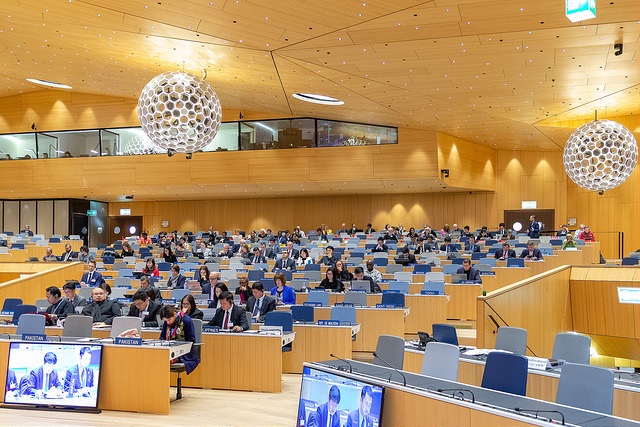
Knowledge Ecology International (KEI) convened the side event to the WIPO Standing Committee on Copyright and Related Rights (SCCR) on 29 April, entitled, “The Tunis Model Law on Copyright for Developing Countries: Is it Time for an Update?”
The SCCR is meeting from 28 April to 2 May.
The Tunis Model Law, developed by the UN Educational, Scientific and Cultural Organisation (UNESCO) and WIPO in 1976, offered developing countries a template for implementing the Berne Convention for the Protection of Literary and Artistic Works, while having regard to domestic legislation and particular interests.
It was “designed to be like a complete copyright act,” said KEI President James Love, touching upon issues relating to protection of folklore, exceptions and limitations to rights, fair use, and the right of translation to reproduction.
The SCCR this week is considering “different pathways to develop appropriate legal instruments for both libraries and archives and educational and research institutions,” said Thiru Balasubramaniam, Geneva representative of KEI.
Love said, “There are some issues that are quite difficult to imagine consensus internationally for a treaty,” adding that there may be benefits in using soft law instruments “in the meantime.”
Soft law as a non-binding instrument can address some of the more controversial issues, and allows for experimentation, for example with the options provided for under the text for a broadcasting treaty currently being discussed at the SCCR, said Love.
KEI is asking WIPO to “ascertain the feasibility of producing an update” of the Tunis model adapted for the digital environment, and study where it could be useful in addressing some of the issues currently being discussed by the SCCR.
Gudibende Ramarao Raghavender, the registrar of copyrights in India, said the Tunis model “respects the typical balance of rights,” but needs to be revised following TRIPS, “TRIPS-plus” agreements, and WIPO’s copyright-related treaties. Although there has been harmonisation in national law in the implementation of these treaties, Raghavender said “there is divergence in this convergence.”
Teresa Hackett, programme manager at Electronic Information for Libraries (EIFL), said WIPO studies and EIFL’s work with libraries in developing countries revealed that developing countries are not using some of the flexibilities available to them, such as scope of protection, duration, and limitations and exceptions.
In 2009, EIFL made their own draft model law on copyright linking which applied to the digital environment, and included provisions for backup copying, orphan works and others. However, Hackett said that this was a “quick fix” solution to help implementation, but that it is necessary to update it and expand on it, and WIPO and UNESCO could play a role in updating the Tunis model to be used as a guide.
Viviana Munoz Tellez, manager of the Innovation and Access to Knowledge Programme at the intergovernmental South Centre, emphasised that model laws should be development-oriented, ensure a balance of the interests of right holders and public interests, and not be imposed on countries but used as guides.
Tellez agreed with other speakers that the Tunis model would need updating, and should be publicly available to expand discussion among other stakeholders other than WIPO member states.


[…] [4] ‘The Tunis Model Law on Copyright for Developing Countries: Is it Time for an Update?’ http://www.ip-watch.org/2014/05/01/at-wipo-soft-law-presented-as-a-solut… […]