Original news and analysis on international IP policy
NTIA Seeks “Solid Proposal” On IANA Transition To Reassure US Stakeholders
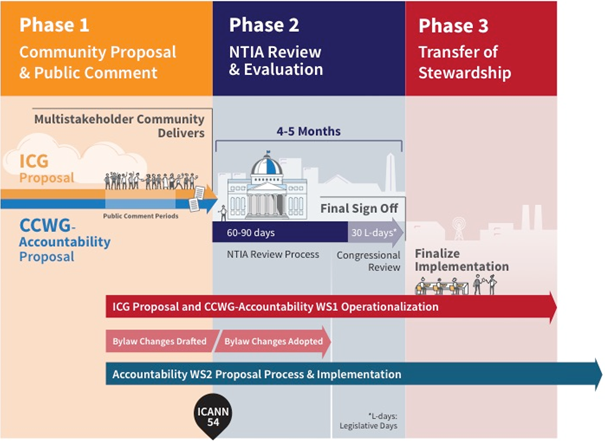
Lawrence Strickling, the United States assistant secretary of Commerce, today called on the internet community to come up with a “solid proposal” for the transition of the Internet Assigned Numbers Authority (IANA), from the US to a new multi-stakeholder oversight model. IANA is responsible for changes made to the internet domain name system.
Lawrence Strickling, the United States assistant secretary of Commerce, today called on the internet community to come up with a “solid proposal” for the transition of the Internet Assigned Numbers Authority (IANA), from the US to a new multi-stakeholder oversight model. IANA is responsible for changes made to the internet domain name system.
Speaking at a daylong conference in Singapore of the Non-Commercial User Constituency on “ICANN and Global Internet Governance: The Road to Sao Paulo, and Beyond,” Strickling said that concerns in the US about his agency, the National Telecommunications and Information Administration (NTIA) “abandoning” the internet would be best laid to rest with a proposal that could “reassure policymakers that there is a sense of responsibility to re-ensure essential values including freedom of expression.”
NTIA has been pushed to reaffirm the conditions for a transition in a new posting to its website. Strickling expressed the hope the community “can step up and demonstrate that this multi-stakeholder model works.”
Strickling’s remarks came on the eve of the next meeting of the Internet Corporation for Assigned Names and Numbers (ICANN), which has technical oversight of the domain name system, including IANA. ICANN is a multi-stakeholder body, including governments.
Concerns expressed during today’s meeting are related to attempts by governments to get into the front seat, something the NTIA declared a no-go in its announcement, but also a centralisation of tasks and possibly power if ICANN just takes over IANA.
IANA is a bundle of core internet infrastructure functions, including managing changes to the legacy root zone of the domain name system. Currently this and the IP address and protocol parameter assignment functions of IANA are performed by ICANN which has now been asked to convene a broad international consultation on the future model.
Strickling underlined in the talk that engagement is much broader with the developing world over internet governance, which is a topic for the April NETMundial conference in Brazil.
Several proposals about how to “route” governments to existing institutions tackling different internet governance issues and establish working processes where gaps for coordinating Internet policies exist were touched upon during the NCUC conference.
Ideas ranged from strengthening the existing UN Internet Governance Forum, perhaps by using the “rough-consensus” and working group model in place at the Internet Engineering Task Force, to various ideas for an international clearinghouse for internet governance from the BestBits NGO Coalition, or the Indian Internet Democracy Project.
During its upcoming 49th meeting in Singapore (officially opening Monday, pre-meetings over the weekend), ICANN has scheduled several discussions focussing on ICANN’s globalisation that are expected to address the IANA transition.
[…] the flurry of analysis, Commerce has issued additional statements emphasizing the need for a “solid proposal” before the U.S. relinquishes control. In Singapore, Commerce Assistant Secretary Larry […]
[…] Consultant Richard Hill writes: The WSIS+10 High Level Event (HLE) last week unanimously adopted two documents (a Statement and a Vision), consisting of some 37 pages of text. What can be learned from this event regarding the evolution of the Internet and its governance? Some of what can be learned confirms what was learned from Netmundial. This short note covers only such items (that is, those that overlap Netmundial), and it may not cover all such items. The HLE output contains many items that were not covered by Netmundial, and Netmundial covered some items that were not covered by the HLE (in particular mass surveillance and the transition of the IANA function). […]



[…] the flurry of analysis, Commerce has issued additional statements emphasizing the need for a “solid proposal” before the U.S. relinquishes control. In Singapore, Commerce Assistant Secretary Larry […]
[…] Consultant Richard Hill writes: The WSIS+10 High Level Event (HLE) last week unanimously adopted two documents (a Statement and a Vision), consisting of some 37 pages of text. What can be learned from this event regarding the evolution of the Internet and its governance? Some of what can be learned confirms what was learned from Netmundial. This short note covers only such items (that is, those that overlap Netmundial), and it may not cover all such items. The HLE output contains many items that were not covered by Netmundial, and Netmundial covered some items that were not covered by the HLE (in particular mass surveillance and the transition of the IANA function). […]