Original news and analysis on international IP policy
South-South Cooperation Rising; WIPO Pushed To Persevere In Its Efforts
The importance of cooperation among developing and least-developed countries in the field of intellectual property is rising, and is a key vector of technology-sharing, according to speakers at a conference on the subject at the World Intellectual Property Organization. Developing countries are strongly in favour of further work in this area, while WIPO will soon launch a dedicated webpage on South-South cooperation.
The importance of cooperation among developing and least-developed countries in the field of intellectual property is rising, and is a key vector of technology-sharing, according to speakers at a conference on the subject at the World Intellectual Property Organization. Developing countries are strongly in favour of further work in this area, while WIPO will soon launch a dedicated webpage on South-South cooperation.
The second annual WIPO Conference on South-South Cooperation on Intellectual Property and Development was held on 22 November, after the 12th session of the Committee on Development and Intellectual Property (CDIP) (IPW, WIPO, 22 November).
The conference presented results from the second WIPO Inter-Regional Meeting on South-South Cooperation on Patents, Trademarks, Geographical Indications, Industrial Designs and Enforcement, which took place from 6-8 May in Cairo, Egypt.
The Cairo meeting followed the first WIPO Inter-Regional Meeting on South-South Cooperation on Intellectual Property Governance; Genetic Resources, Traditional Knowledge and Folklore; and Copyright and Related Rights, held on 8-10 August 2012 in Brasilia, Brazil. The meeting was followed by the first WIPO conference on South-South Cooperation held on 28 September 2012.
Both inter-regional meetings were part of a project adopted at the 7th session of the CDIP, and the conference last week was the last activity under the project. The conference was expected to look at the way forward.
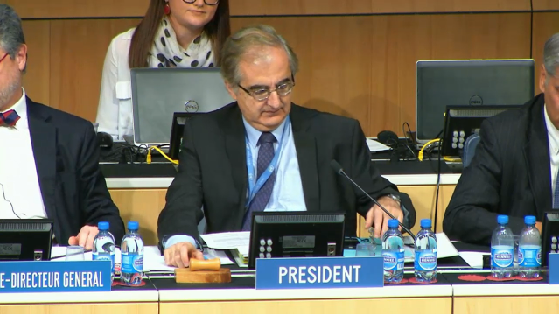
Djibouti Ambassador Mohamed Siad Doualeh, chair of the CDIP, presided over the conference. He said there is a growing recognition that IP is not an end in itself but a tool that can be used by developing countries and least-developed countries to promote development, in a balanced manner. South-South cooperation is recognised as a key means of effective technical cooperation and a vector for knowledge and technology sharing, he said.
The Cairo inter-regional meeting gathered mostly developing countries and least-developed countries, said WIPO Assistant Director General Geoffrey Oneyama, who is responsible for development. The meeting allowed exchanges of experience and lessons learned, he said.
South-South cooperation is running in parallel to North-South cooperation and has impacted development throughout the world, he said, and is a widely recognised key development agenda for the countries of the South, he added. Inter-regional meeting documents and a video of the meeting are available on the WIPO website.
Alejandro Roca Campaña, senior director, Access to Information and Knowledge Division, Global Infrastructure Sector at WIPO, presented a report on the Cairo meeting.
Proposals from the Cairo Inter-regional
Mohamed Gad, counselor at the Minister’s Office, Ministry of Foreign Affairs of Egypt, and former Geneva delegate, said the CDIP project was initially proposed by Egypt in 2010, then presented by the African Group.
According to Gad, after the first inter-regional meeting in Brasilia, Brazil reported that some participants “had expressed dissatisfaction that the meeting had not had a concrete outcome, in particular no concrete recommendations,” and had required that the second inter-regional meeting identify “key areas where cooperation could be further strengthened and turned into concrete projects,” he said.
Two sets of issues were identified at the Cairo inter-regional meeting, he explained: One set of issues to be addressed by WIPO, the other set to be addressed by both WIPO and developing countries and LDCs themselves.
Among the actions identified to be addressed by WIPO, were; finance of South-South cooperation activities and initiatives as part of the next WIPO program and budget for 2014-2015; ensure that WIPO activities in the area of cooperation for development are informed and guided by good practices and lessons learned in the South, including the full and effective utilisation of the flexibilities inherent in multilateral treaties, and the Development Agenda Recommendations; and continue to organise WIPO annual and inter-regional thematic meetings to review the progress made and advance South-South cooperation in the area of intellectual property and development, according to Gad.
Also on the same list was: ensure efficient coordination in WIPO between the focal point for South-South cooperation, the regional bureaus and the patent division in the provision of legal assistance, training and capacity-building, in particular in the area of implementation of the World Trade Organization so-called paragraph 6, and of flexibilities, he said.
Paragraph 6 refers to an August 2003 decision of WTO members to temporarily waive rules under the Agreement on Trade-Related Aspects of Intellectual Property Rights (TRIPS) rules that require predominately all medicines produced under compulsory licence to be for the domestic market of the country producing them. The waiver was intended to allow countries without any manufacturing capability to receive medicines under compulsory licence from another country. This mechanism has been used only once.
Finally, WIPO should support the use of official languages of countries in the South in international intellectual property systems to facilitate their access and use by IP offices and users in developing countries and LDCs, he said.
To be addressed both by LDCs and WIPO: prepare case studies on successful South-South cooperation models in the area covered by the inter-regional meeting; ensure that assistance provided in formulation and implementation of national intellectual property strategies and policies is guided by each country’s national development plans and goals, and public policy objectives; and increase awareness in developing countries and LDCs on utility models and the contribution of this kind of IP protection to innovation and creativity, Gad detailed.
Gad also said in his evaluation of the inter-regional meeting that there was a need to launch a second phase of the South-South cooperation project, and future inter-regional meetings should be linked to actionable elements, such as sub-projects.
WIPO’s South-South Cooperation Digital Platform
Bajoe Wibowo, project manager, Special Projects Division, Department for Africa and Special Projects, Development Sector at WIPO, presented a test environment of a soon-to-be-launched WIPO web page dedicated to South-South cooperation.
The page, he said, will provide information on South-South technical assistance in the field of IP, with several functionalities, and a roster of consultants from developing countries and LDCs. It will also seek to further assist matchmaking needs of developing countries and LDCs and help identify possible South-South partnerships, he said.
The webpage will also include a technical assistance database with WIPO-supported technical assistance activities taking place in developing and LDCs, and an IP case studies section. Nathalie Montillot, assistant project officer, Access to Information and Knowledge Division, Global Infrastructure Sector at WIPO, said.
WIPO, she said, is also working with the United Nations Office for South-South Cooperation (UNOSSC), which she said was the highest level commission on South-South cooperation. WIPO participated in the 17th session of the high-level Committee on South-South Cooperation in May 2012, and the Global South-South Development Expo (GSSD) in 2012 and 2013. WIPO will continue to work closely with UNOSSC, she said.
Brazil Supportive, African Group Calls for 2nd Phase
The Brazilian delegate said Brazil attaches “great importance” to the project on South-South cooperation. He said the country signed a Memorandum of Understanding with WIPO in 2012 that established a Funds-in-Trust (FIT) “dedicated to the promotion of triangular technical cooperation with a view to increasing the capacity of developing countries to use intellectual property tools.”
This was the first FIT “exclusively dedicated to the South-South Cooperation established by WIPO, the delegate said, and the Brazilian government will commit more than US$1 million to this FIT from 2012 to 2016. Three South-South cooperation initiatives have been supported by the FIT since 2012, he said.
The FIT appears in a document [pdf] on the WIPO strategy on external offices presented at the last WIPO Program and Budget Committee in September. Brazil hosts a WIPO external office. Another FIT was established between the WIPO Brazilian office and the Brazilian government on promoting the use of the IP system and the development of competencies on IP protection and commercialisation.
“Strengthening South-South cooperation should be a priority for WIPO,” the delegate said, and there is room for improvement, he added. “Good ideas must be translated into concrete actions,” he said. “The process should be essentially member-driven and developing countries should take primary responsibility,” he said. Members, he concluded, should ensure that WIPO “allocates adequate human and financial resources to the promotion of South-South cooperation.”
Egypt, on behalf of the African Group, also underlined the importance of South-South cooperation, and said a second phase of the project should be considered. The delegate proposed that a clear roadmap be established for South-South Cooperation in WIPO.
Peru offered to hold a potential third inter-regional meeting in 2014.