

BERLIN — Germany’s controversial hate speech legislation is working well, a representative of the German Ministry of Justice said during a panel on 27 November at the German national Internet Governance Forum in Berlin.
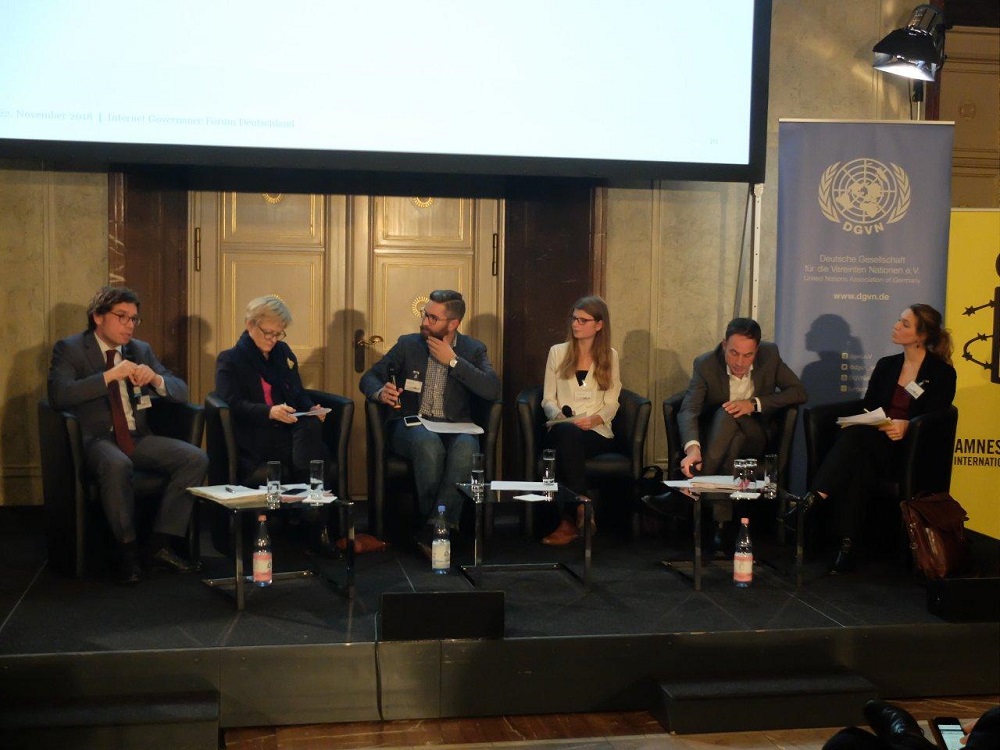
Big social media providers have adapted the reporting mechanisms and hired considerable staff to deal with the complaints. Former Minister of Consumer Protection Food and Agriculture and Green Party Member Renate Kuenast, herself a victim of hate speech, promoted advancing the legislation to include games and said she favours a bigger package.
“Games were part of the original draft and should not have been taken out,” she argued, pointing to illegal speech in the chats running alongside the games.
The so-called Network Enforcement Act (NetzDG) also should be seen more as a part of a package that also dealt with fake news, obliged to make social bots transparent and stepped up media literacy programs, the Green Party member demanded.
Arnd Haller, legal director, North and Central Europe at Google, reported that 50 percent of the 215,000 complaints received by Google in the first six months after the legislation came into effect were bogus complaints.
“This is a result when you make reporting very easy,” he said. Some 27 percent of the posts reported were deleted.
Other social media platforms reported similarly high figures. Twitter has received 264,000 complaints (deleted 10 percent) and Facebook received 1,704 (deleted 20 percent).
Haller said there is a tendency for over-blocking, but declined to give figures. Google differentiates between locally illegal content and content contradicting Google’s community guidelines, as the latter will be blocked globally.
The EU currently relies on self-regulation of hate speech content, but is looking at a tighter content regulation for “terrorist content”.
Meanwhile, several German courts are working on cases in which users have fought back to bring their content online again after having been deleted. The Higher District Court of Munich recently decided Facebook had no right to delete content according to its own standards. A member of the ultra-right Alternative for Germany Party had filed a complaint over a takedown of hate speech content by a party member.
Image Credits: Monika Ermert
[…] Source link […]