

The digital revolution has transformed the way trade is taking place. The share of goods like CDs, books and newspaper is dropping in terms of global trade volume, pushed down by digital goods. In that context, intellectual property rights are also increasingly traded, in particular IP licences, in what a World Trade Organization official defined as a major phenomenon. While the United States is the leader in the digital market, China took pole position in video games in 2017.
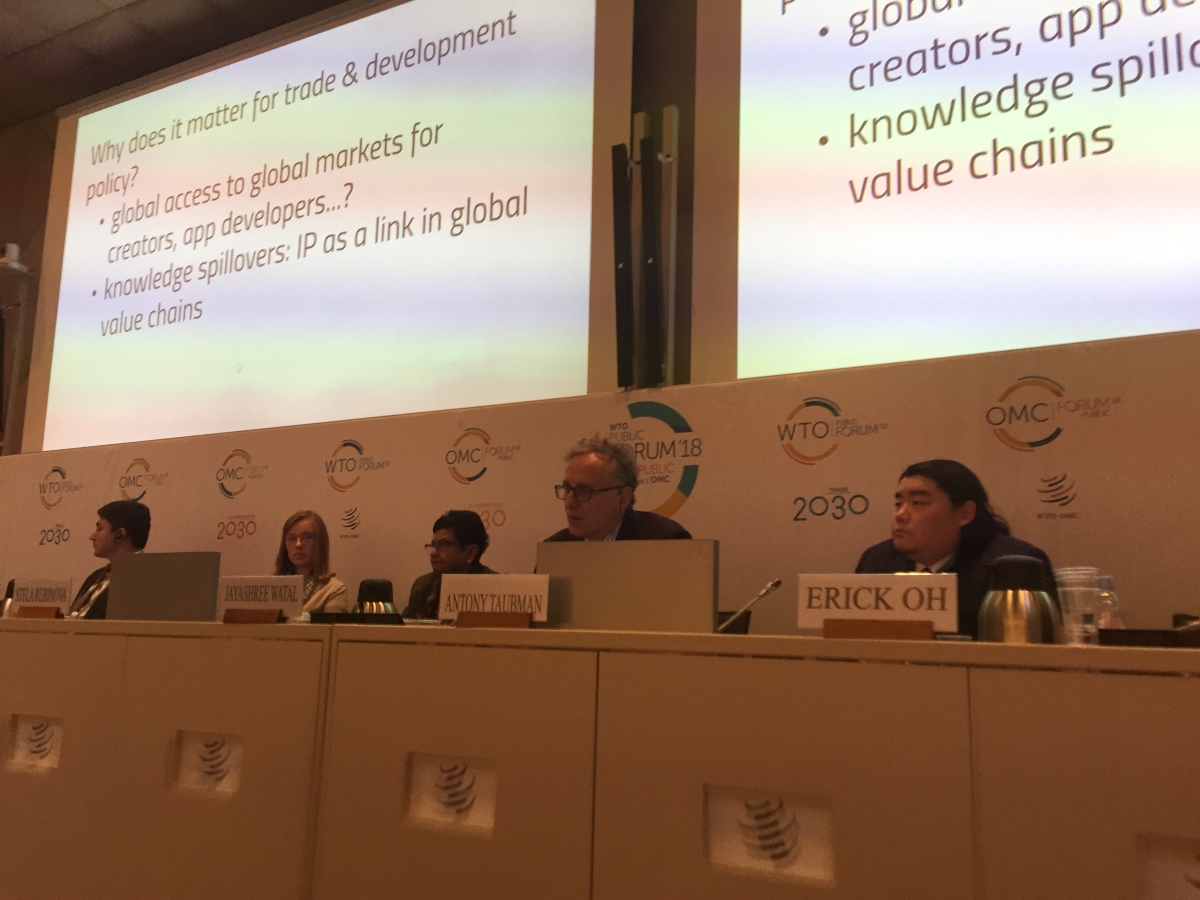 The 2018 WTO Public Forum took place from 2-4 October and hosted over 100 different sessions on the theme “Trade2030.”
One of the sessions, entitled “Trade in knowledge and intellectual property,” organised by the WTO, looked at the impact of the rapid evolution of technology, and in particular its impact on international trade law, including the WTO Agreement on Trade-Related Aspects of Intellectual Property Rights (TRIPS).
Moderating the session, Jayashree Watal, counsellor, WTO Intellectual Property, Government Procurement & Competition Division, mentioned the newly released World Trade Report [pdf], which notes a sharp decline of digitalisable goods such as CDs, books and newspapers.
In 2000, according to Watal, those goods represented 2.7 percent of total goods trade, and in 2016 the number had fallen to 0.8 percent.
According to the report, “the wide adoption of digital technologies changes the composition of trade in services and goods, and redefines intellectual property rights in trade.”
“Trade in information technology products has tripled in the past two decades, reaching US$ 1.6 trillion in 2016,” it says. The evolution of digital technologies radically transformed the linkages between IP and international trade, the report says, “as the increased availability of digital technologies has significantly lowered the costs to create, copy and distribute creative works on a global scale.”
The WTO is putting together a book on the economic, legal, and policy aspects of trade and knowledge, Watal said. The book should be published soon, and should provide a clear mapping out of the contemporary economic, legal and policy trends that are shaping trade and knowledge, she added.
The book is hoped to serve as a resource for technical assistance and capacity building for governments seeking to engage with the knowledge economy for development, she said. The WTO is holding its first capacity building programme in November, aimed at IP and trade officials from developing countries, and based on the draft chapters of the book already received.
Licencing of IP Rights a Major Phenomenon
Trade is nothing like what the TRIPS negotiators had in mind in the 1980s, when most of the trade was carried by goods, said Antony Taubman, director of the WTO IP Department. IP is increasingly traded, he said, in particular IP licences.
Licencing of IP rights has become an “enormous market,” and a “major phenomenon,” Taubman said. It is not just between businesses, but billions of consumers are also involved, he added. “If you read the terms and conditions from Apple and Google, what you are purchasing is a licence, the content is licenced, not sold to you,” he explained.
The United States is a dominant player in the licencing market, he said, as the US export of IP licences “insofar that they can be counted,” was US$128 billion in 2017. A joint US Patent and Trademark Office and the US Economics & Statistics Administration publication [pdf] (Intellectual Property and the U.S. Economy: 2016 update) found that the revenue specific to the licencing of IP rights totalled US$115.2 billion in 2018 with 28 industries deriving revenues from licencing.
This a significant area of growth and diversification, according to Taubman, who noted the growing interest of emerging economies. Hong Kong and Singapore are seeking to become a trading hub of IP as such, he said, and BRICS (Brazil, Russia, India, China, South Africa) countries are increasing their share of IP licence fees.
The current situation is a much more complex and diverse international legal structure, with the emergence of some 200 bilateral and regional agreements dealing with IP in different ways, he said. Those agreements cover the digital area, with “enormous” implications on how to deal with IP as such, he added.
The World Trade Report noted that “Alongside the burgeoning trade in intellectual property licences, trade in the ownership of intellectual property rights is growing in diversity.”
US Leader in Digital Content, China for Video Games
Erick Oh, international trade analyst for the US International Trade Commission, said the US is leader in digital content, and in particular on video on demand, with YouTube and Netflix.
The rapid expansion of broadband networks and the ubiquity of smartphones and hand-held devices as they became less expensive, the development of cloud infrastructure enhancing storage, growing computer compatibility, and the “immense” popularity of social media platforms such as Facebook allowing to better link content creators and audiences, all contributed to the growth of the digital market, according to Oh.
Video games have the lion’s share in digital content revenue. China overtook the US in 2017 for the first time, to become the global leader in digital video games revenue, he said, adding that China has over 400 million online gamers.
Image Credits: Catherine Saez