Original news and analysis on international IP policy
New Report Calls For Copyright For Public Benefit In Digital Era
The International Centre for Trade and Sustainable Development (ICTSD) has released a new report calling for a redesign of global copyright norms to preserve the public interest in the face of emerging technologies.
The International Centre for Trade and Sustainable Development (ICTSD) has released a new report calling for a redesign of global copyright norms to preserve the public interest in the face of emerging technologies.
The report suggests that the rise of emerging technologies such as “big data, robotics, machine learning, and artificial intelligence (AI)” calls for “a more radical conception of global copyright norms” in order to “preserve, and even advance, public benefit in an era of digital trade.”
Challenges to Copyright
In the report, the author identifies three main challenges to the current design of global copyright rules:
The onset of AI-generated knowledge goods will complicate “the authorship focus of copyright law and its related originality doctrine,” as these goods may in some cases meet the minimum standard of creativity and originality required by copyright law. This will relatedly require a reassessment of the incentive structure of copyright, as “[a]lgorithmically driven creative works hardly need (much less require) the same incentives as human-authored works.”
The shift toward licensing copies of digital goods, rather than transferring ownership, erodes “the first sale or ‘exhaustion’ doctrine for knowledge goods and its consequences for digital trade,” reducing potential benefit from a secondary market. “Exhaustion — the principle that a rights holder is not entitled to control downstream resales of IP-protected materials – has long facilitated the free exchange of goods worldwide.”
Digital trade strengthens technical and legal mechanisms “that make fair use less available as a legal defence for end users to assert—such as legal restrictions on the circumvention of technological protection measures, or extralegal copyright policing by online platforms.” These mechanisms threaten the fair use doctrine, from which “[m]any of the permission-less innovations for which the digital age is known emerged.”
Redesigning Copyright
The author then offers three observations on the “needed shifts in the extant regulatory model of international copyright law,” to address the “deficiencies in national and international copyright systems” underscored by emerging technologies:
Rather than a simple “codification of authors’ rights,” copyright law and “information policy should be reconfigured as a set of core principles that regulate unfair conduct, promote flexibility in national economic planning, and foster norms that facilitate the production of knowledge goods and access to the global marketplace on competitive, rather than monopolistic, terms.”
“Should freedom of commerce, competition, liberty, freedom of expression, and other values of personhood become agreed-upon policy priorities, such considerations impel a pivot away from traditional harmonisation efforts, and towards the progressive disharmonisation of copyright regimes.” This will enable a shift of focus from the “human author” toward “a meaningful commitment to improve the capacity of national governments to facilitate welfare gains among consumers.”
“The International Telecommunication Union (ITU) is the specialised agency of the United Nations responsible for information and communication technologies (ICTs). Although the World Intellectual Property Organization (WIPO) is singularly responsible for international copyright norm-setting, the role of the ITU is significant in the design of the global regulatory framework for the digital economy.” Increased coordination between the ITU and WIPO could “elicit greater alignment between information policy and copyright law.”
Equity in the Fourth Industrial Revolution
The report notes that international copyright law was strengthened under the World Trade Organization Agreement on Trade-Related Aspects of Intellectual Property Rights (TRIPS), which “reconfigured the terms of access to knowledge goods in ways that increased the technological gap between the global south and the global north and resulted in wealth transfers to net exporters of technology.”
The author speculates about whether the “technologies of the Fourth Industrial Revolution may produce the same outcomes, despite how revolutionary and beneficial those technologies are expected to be to the creative process.”
“In the end,” the report concludes, “technological advances that drive digital trade will be judged not only by increased levels of production, but also in light of norms that support and facilitate inclusive innovation and human development.”
David Branigan is a contributing writer at Intellectual Property Watch and Health Policy Watch. He graduated in May 2018 from the Studley Graduate Program in International Affairs at The New School. His research is focused at the intersection of technology, public policy and human rights.

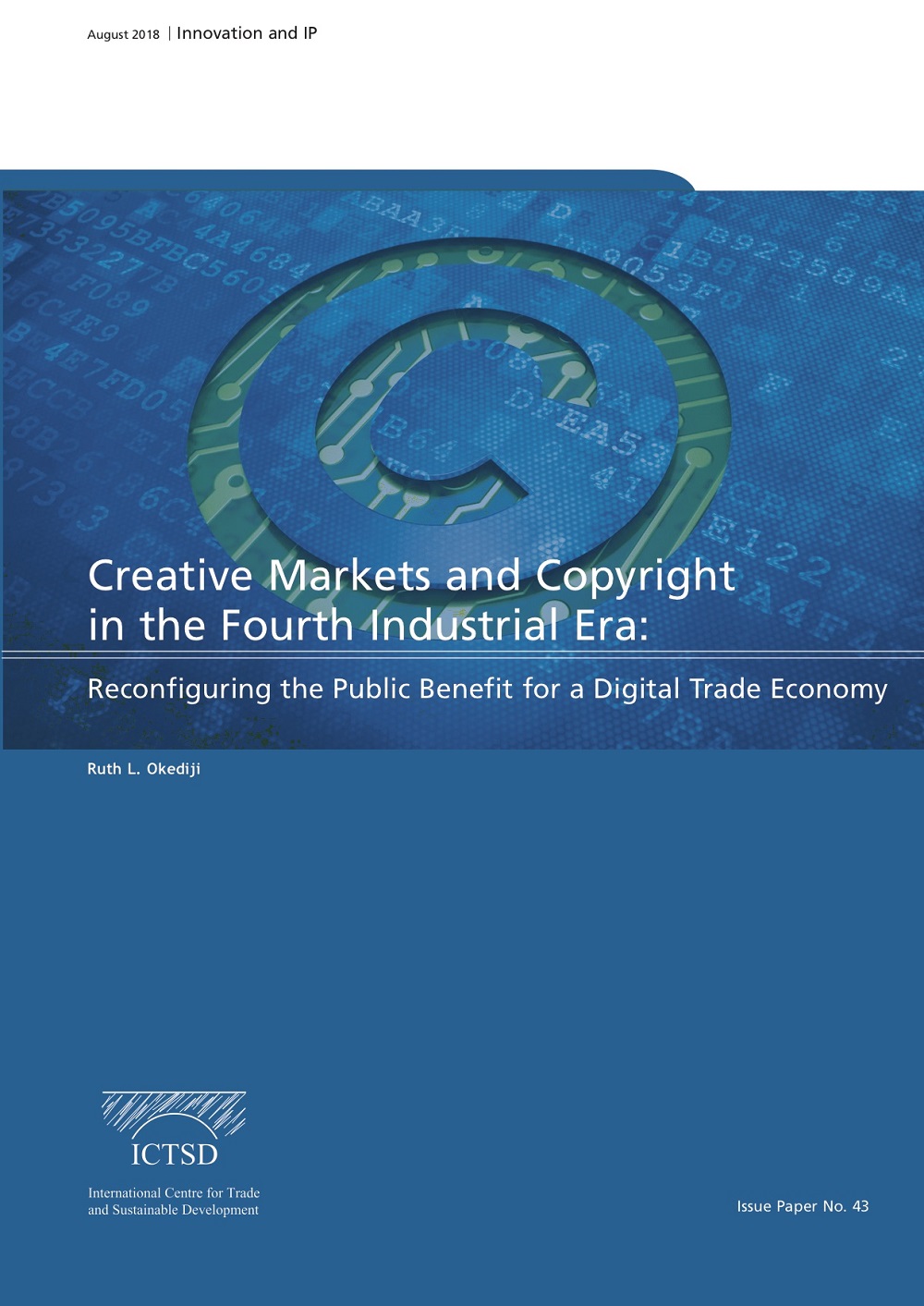 The report, “Creative Markets and Copyright in the Fourth Industrial Era: Reconfiguring the Public Benefit for a Digital Trade Economy,” was authored by Prof. Ruth L. Okediji, the Jeremiah Smith, Jr. professor of law at Harvard Law School.
[…] New Report Calls For Copyright For Public Benefit In Digital Era Intellectual Property Watch […]