Original news and analysis on international IP policy
US Patent System Remains 1st In The World, Despite Errors In Chamber Rankings
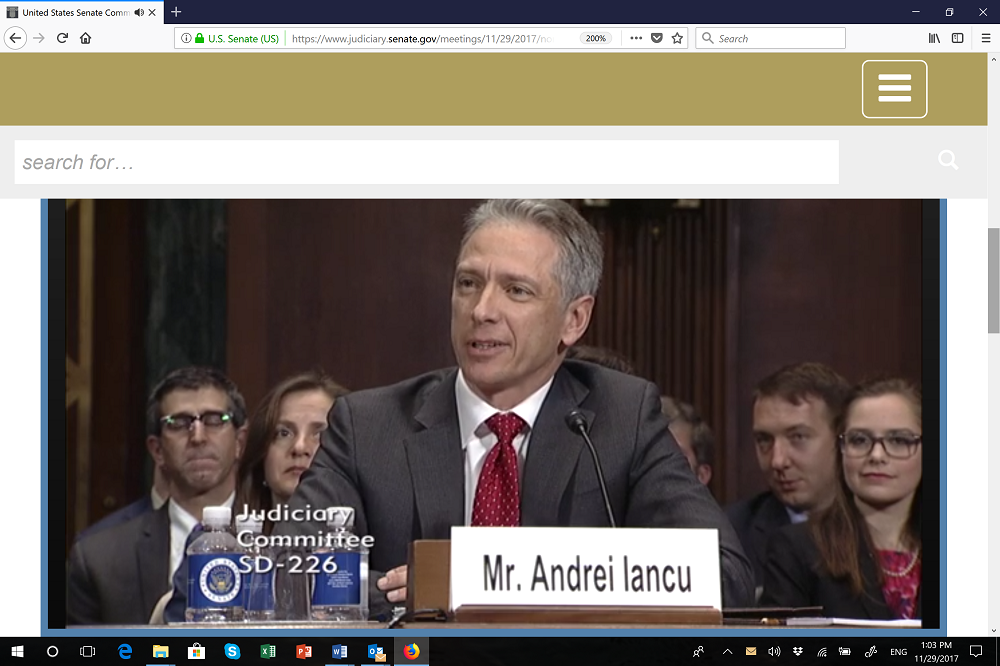
Over the past few months, US officials ranging from PTO Director Andrei Iancu to a number of Congressional members, most recently Rep. Kelly (Illinois-2), have cited to the Chamber of Commerce’s ranking of intellectual property systems, which has dropped the US patent system from 1st in the world to 12th. They cite the rankings as evidence that the US patent system is in urgent need of review.
Unfortunately, the rankings are based on misinterpretations and falsehoods. These are worth noting ahead of a House Judiciary hearing Tuesday with Iancu testifying.
Over the past few months, US officials ranging from PTO Director Andrei Iancu to a number of Congressional members, most recently Rep. Kelly (Illinois-2), have cited to the Chamber of Commerce’s ranking of intellectual property systems, which has dropped the US patent system from 1st in the world to 12th. They cite the rankings as evidence that the US patent system is in urgent need of review.
Unfortunately, the rankings are based on misinterpretations and falsehoods. These are worth noting ahead of a House Judiciary hearing Tuesday with Iancu testifying.
US Patent and Trademark Office headquarters, Alexandria, Virginia
The primary falsehood is that “only about 5–15% of cases end with all claims being considered patentable.” The Chamber bases that statement on an unnamed, uncited third party study. But the PTO’s own study shows that 58% of all challenged patents remain unchanged after challenge. Other third party studies, including my own, agree with the PTO’s numbers. In reality, the PTO is as likely to decide that a patent is so clearly valid that it doesn’t even need to be reviewed as they are to decide that even one claim in the patent is invalid.
That alone should be enough to question the Chamber’s ranking. But that’s far from the only problem.
For example, the Chamber’s ranking claims that life sciences patents experience a disproportionately high number of trials. But biological and pharmaceutical patents represent only 10% of all challenges—which is slightly lower, proportionally, than the percentage of patent applications that relate to biological and pharmaceutical technologies. And when the PTO looks at drug patents, not only is the number of trials requested lower than would be expected by proportion, but the rate at which the PTO agrees to review those patents is slightly lower than average.
And when the PTO does review drug patents, they are significantly less likely to find them invalid. In other words, the statements in the Chamber’s ranking are completely at odds with the reality when it comes to life sciences patents.
Finally, the Chamber’s ranking relies on speculative harms that simply haven’t proven out in practice. The ranking cites the risk of “bad faith actors” and the “injection of a great deal of cost for patent owners.” However, bad faith actors are no more of a risk in the US post-grant system than they are in the similar European Patent Office (EPO) system—both allow “any person” to oppose the patent. In fact, bad faith challenges are less of a risk in the US because, unlike the USPTO, the EPO allows anonymous third parties to participate in (although not originate) challenges to patents. And, rather than injecting cost for patent owners, the post-grant system has likely saved them over $1 billion in legal fees by determining that their patents shouldn’t have been granted without going through the expense of a court case.
Based on these factual errors and misstatements, the Chamber’s ranking subtracts 0.5 points from the US patent system’s score. That doesn’t sound like much—but in reality, that 0.5 point difference is enough to drop the United States from 1st to 12th in the patent system ranking.
If not for the errors in the Chamber’s ranking, the US patent system would be ranked exactly where it truly is—in 1st place.
Josh Landau is the Patent Counsel at the Computer & Communications Industry Association (CCIA), where he represents and advises the association regarding patent issues.




[…] Source link […]