

NAIROBI, Kenya — With high vulnerability to adverse effects of climate change, African countries are keen to develop, acquire and disseminate technologies for mitigation and adaptation.
 As a result, they are involved in initiatives aimed at technology development, acquisition and diffusion. This is in a bid to implement the 2015 Paris Agreement, an accord within the United Nations Framework Convention on Climate Change (UNFCCC) dealing with greenhouse gas emissions mitigation, adaptation and finance issues.
According to the Technology Needs Assessment project implemented by the UN Environment Programme (UNEP) and the Technical University of Denmark (DTU), developing countries – many of them from Africa – have developed more than 250 technology action plans to tackle climate change challenges.
The UNEP-DTU technology needs assessment project, which is supported by the Danish Ministry of Foreign Affairs, also aids nations in implementing other adaptation initiatives such as Nationally Determined Contributions (voluntary national climate targets for mitigation and adaptation) and National Adaptation Plans.
The role of appropriate technology cannot be overemphasized. Countries are as a result undertaking technology needs assessments (TNAs) to determine their technology needs for prioritising their deployment in order to fight negative effects of climate change. Under the Paris agreement, a new technology framework was envisaged whereby results of the technology needs assessment will see enhanced technical and financial support.
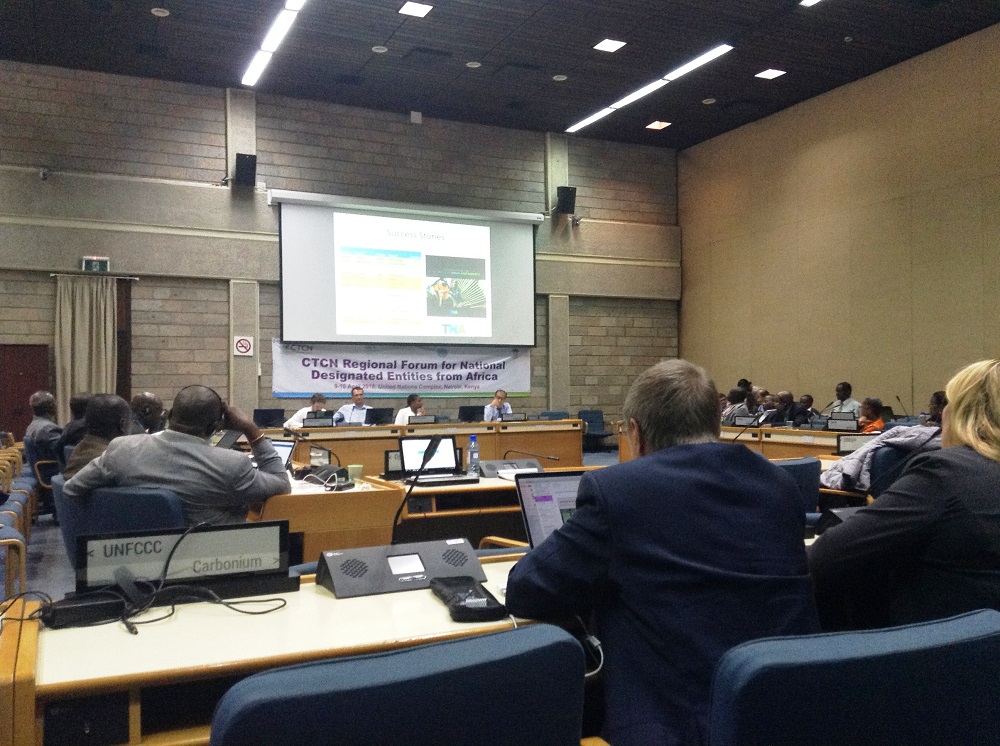
It is no wonder that in a meeting held in Nairobi, Kenya from 9-10 April to explore climate change technologies for adaptation and mitigation calls for closer collaboration among intergovernmental bodies, national government, research institutions and the private sector for development of technologies came out loud.
The delegates representing governments, private sector, finance and research institutions participating in the meeting called enhancement of capacities of African nations to deal with climate change challenges. The meeting was organised by the Climate Technology Centre and Network (CTCN), an implementation arm of the technology mechanism of the UNFCCC in collaboration with World Agroforestry Centre.
Jorge Rogat, senior economist, Cleaner Energy Development at the UNEP-DTU partnership, said to Intellectual Property Watch and as a panellist at an event that intellectual property rights are a barrier to technology transfer. “It is an impediment to access, transfer and diffusion of green technologies highly needed by poor nations in Africa and elsewhere across the globe,” he told Intellectual Property Watch. He called for a negotiation that can result in freer movement of technology and knowledge.
It is a conversation that has been ongoing for close to three decades. In 2008, during the Bangkok Climate talks [pdf] aware of the need for technology and impediments linked to IPRs in their endeavour to acquire it, developing nations pitched for various interventions (for reference, see here, page 39).
They sought concessional and preferential terms for technology transfer as well as special patent regime for climate change technologies, but without much success.
Rogat said that although there are other barriers that affect technology transfer such as financial, institutional or even cultural, IPRs have a huge impact. He revealed that African countries spend some 4.5 percent of their gross domestic product (GDP) annually on paying for licences to obtain technologies and other innovations. “A country can’t just pick a technology no matter how desperately it requires it. There are cost implications and this is a huge constraint to these nations most of them poor,” he observed.
He added that it is unfair that poor nations are compelled to pay to obtain technologies for cleaning the environment, an exercise that also benefits their richer counterparts who are reluctant to offer the technology at affordable rates.
Rogat called for negotiations that could result into agreements with innovators providing for complete exceptions or cheap licences for easy access to their innovations to poor countries that are in huge need of them.
Surprisingly, he said North-South transfer of technologies usually face more barriers than is the case with South-South exchanges. He suggests that developing countries enhance IP protection to catalyse local innovations in green technologies. “New technologies are capital intensive, this undermines abilities of innovators to develop them, hence the need for protection so that all innovators be they in rich or poor nations are at par,” he said.
Additionally, he noted, African nations should support innovators in commercialization of green technologies and engage the private sector more for their adoption.
Sara Trærup, researcher in the Climate Resilient Development Programme at the UNEP-DTU partnership, elaborated that many developing countries have been in their technology needs assessments, prioritising technologies that can be termed ‘traditional ‘ and prioritising less technologies which are highly advanced. In that respect, she observed, IPR issues are sidestepped as a key barrier.
But still the issue cannot be trivialized. “However, we have seen a shift that involves moving from ‘traditional’ technologies towards more advanced technologies,” she said, adding that a radical shift toward the very advanced technologies is set to make IPRs a big issue in terms of impeding transfer of technology.
Charles Mutai, the director of Climate Change in Kenya’s Ministry of Environment, pitched for establishment of a continental climate change funding mechanism to shield countries from the weight of footing huge climate mitigation and adaptation costs.
He said the fund will accelerate the development, deployment and transfer of locally relevant climate and clean energy technologies in the continent. “With the increasing frequency and intensity of droughts and floods, the continent requires technology cooperation to help reduce the cost of tackling climate change while stimulating opportunities for sustainable development,” he explained.
According to Mehmood Hassan, head of capacity building, World Agroforestry Centre, African countries are heavily dependent on climate-sensitive sectors. The negative effects of climate change are affecting the continent’s GDP by some 1.4 percent annually with the costs arising from adaptation estimated to reach three percent of its GDP by 2030.