

The music community is ramping up its efforts to have significant new copyright legislation approved by United States Congress in 2018, amid key changes in the legislative apparatus, with the elevation of Rep. Jerold Nadler (D-New York) as the Ranking Member of the House Judiciary Committee, a pivotal role that puts him at the heart of the US legislative system, and the retirement of the Committee’s current Chairman, Bob Goodlatte (R-Virginia), at the end of the year.
On 8 January, a coalition of 22 organisations representing the interests of the music sector at large – music publishers, record labels, songwriters, composers, artists and performance rights organisations (PROs) – presented a united front in support of key pieces of pending music legislation, waiting for the votes of members of Congress.
The trade groups officially endorsed the following pieces of legislation: the Music Modernisation Act of 2017, fixing licensing issues; the Compensating Legacy Artists for their Songs, Service, & Important Contributions to Society Act (CLASSICS Act), dealing with pre-1972 recordings that are currently out of copyright; the Allocation for Music Producers Act (AMP Act), allocating royalty payments to producers, mixers, or sound engineers for the digital use of works; a market-based rate standard for artists from satellite radio; and a terrestrial performance right for sound recordings.
For music community leaders, time has come to work collectively to push for legislative reforms. “We are all coming together to support each other’s efforts to modernise and bring fairness to how music creators are paid,” David Israelite, president & CEO of the National Music Publishers’ Association (NMPA), said in a statement. “Right now, there is unprecedented momentum behind efforts to fix outdated laws that prevent music creators from earning what they deserve, and I am thrilled to say that publishers, songwriters, composers, labels, artists and PROs stand together to fix them.”
A “Champion” of Creators’ Rights
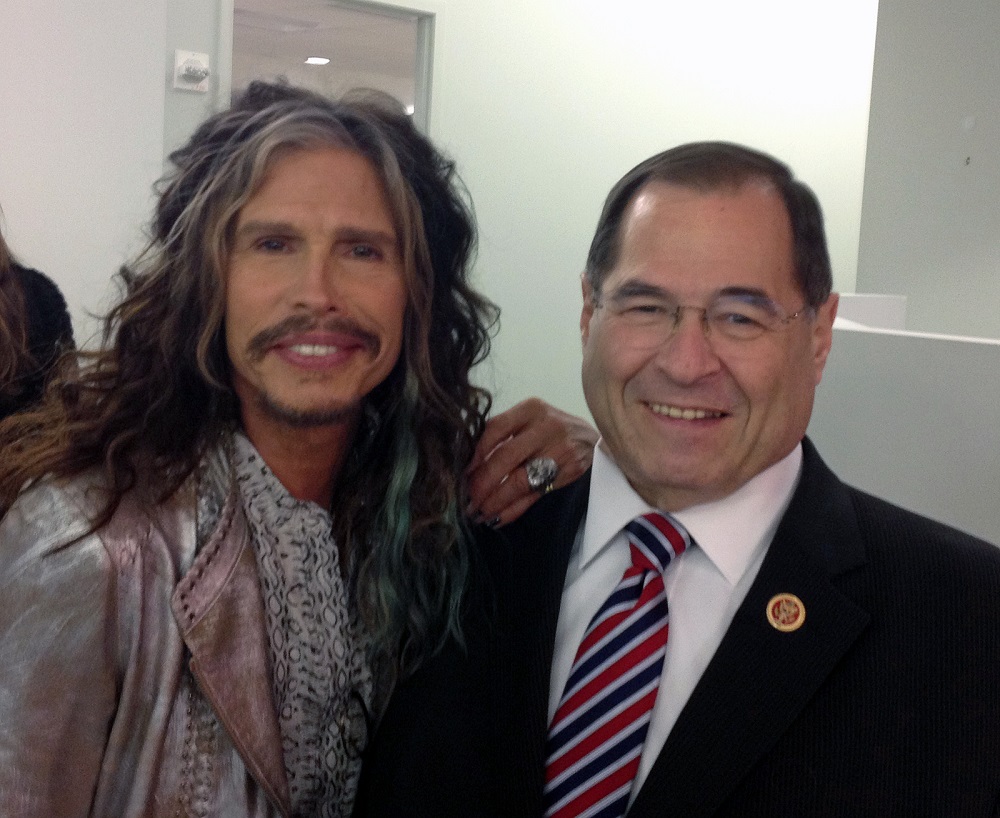
One of the key allies in Congress for the music community is congressman Nadler, who was elected Ranking Member (the highest ranking committee member on the minority party side) in December by his Democrat peers in a 118-72 vote against Rep. Zoe Lofgren (D-Calif.). Nadler succeeds Rep. John Conyers, who resigned following sexual harassment allegations. Nadler is considered by the creative community as a supporter of creators’ rights and his election was warmly welcomed by the sector.
Nadler has been the sponsor or co-sponsor of several proposed bills, such as the Fair Play Fair Pay Act, which calls for performance royalties for sound recordings for their use in radio broadcasts. The Content Creators Coalition (c3) labelled Nadler “a champion for artists” who has “taken on some of the most powerful special interests in Washington as he has fought to ensure working artists are paid fairly.”
Nadler’s elevation is one of the positive signs that the copyright-led industries consider when looking at the copyright agenda for 2018. “Ranking Member Nadler has always been a champion for music creators. He’s a smart, thoughtful leader who knows how to roll up his sleeves and get things done,” Michele Ballantyne, EVP of public policy & industry relations at record labels’ trade body the Recording Industry Association of America, told Intellectual Property Watch.
The key question is how much can be achieved in the current legislature, considering that no significant legislation in the field was passed in the past four years. In a blogpost, Terry Hart, VP, legal policy and copyright counsel for Washington, DC-based creators’ advocacy group Copyright Alliance, noted that as 2018 is an election year, bills that aren’t passed by the end of the session will expire, and the closer members of Congress will be from election day, the less time they will spend in DC on legislative matters.
The entire House of Representatives is up for renewal and one-third of the Senate too. But Hart is confident that 2018 will see action on the Hill on copyright issues, not least because outgoing Judiciary Chairman Goodlatte has been conducting a wide review on copyright law over the past two years and a half and will pass the baton of chair with the legislature. Much talk in DC among creative circles was whether Goodlatte would leave a significant legacy in copyright law or not.

“This is the last year of Goodlatte’s tenure as House Judiciary Committee chair, and over his six-year term, he’s engaged in a comprehensive review of copyright law, so we expect those efforts to come to a head in 2018 and for legislation to pass,” Hart told Intellectual Property Watch.
This view is shared by RIAA’s Ballantyne. “Music licensing has been long-studied by Congress with various hearings over the course of over two-and-a-half years. The time is ripe for advancement of legislation that will help music creators get paid fairly. In addition, you have a retiring House Judiciary Chairman who has made it his mission to get something done in this arena,” said Ballantyne.
Fixing the US Music Licensing System
On top of the industry’s agenda are the bills supported by the coalition, as well as a bill establishing a voluntary tribunal within the Copyright Office for copyright claims under $30,000 in total damages (the Copyright Alternative in Small-Claim Enforcement Act or H.R. 3945), and the Register of Copyrights Selection and Accountability Act (HR 1695), which proposes to make the Register of Copyright a Presidential appointee, rather than being named by the Librarian of Congress, as it is the case currently. The bill was voted by the House by stalled in Senate.
“Other than HR 1695, that could mean we see something on the music licensing front and small claims,” surmised Hart. On the music licensing front, the pièce de résistance is the Music Modernization Act of 2017 (HR 4706), co-sponsored by US Reps. Doug Collins (R-Georgia) and Hakeem Jeffries (D-New York) and introduced just before Christmas. The bill addresses the touchy issue of the licensing of mechanical rights to digital services as well as the rate-setting mechanism for mechanical royalties.
The bill reforms sections 114 and 115 of the Copyright Act with the creation of a new collective management organisation in charge of licensing, collecting and distributing mechanical reproduction rights. This new CMO would provide digital services with a blanket licence for mechanical rights, reducing the risks of litigation, as is currently the case. The new rights society would be governed by a 10-member board consisting of eight music publishers and two self-published songwriters. The proposed rate-setting mechanism, applicable also to performance rights societies, would be based on willing-buyer, willing-seller standards and could result in higher rates for songwriters and music publishers.

Under the current system, streaming services are required to have licences for sound recordings (acquired via direct deals with labels or through rights body SoundExchange) and for compositions – performance rights (via established societies such as ASCAP, BMI, SESAC or GMR) and mechanical rights (either in a direct deal with publishers or through agency HFA, now owned by SESAC). In case rights holders are not identified, services are required to send a notice of intent (NoI) to the US Copyright Office to ensure that they are covered for the use of tracks.
The current system has created a lot of friction between digital services and rights holders, with several class action suits hitting services such as Pandora or Spotify. Just before the New Year, music publisher Wixen slapped Spotify with a lawsuit for failing to get proper mechanical licences for its catalogue, claiming as much as $1.6 billion in damages (or $150,000 per song infringed).
Providing a “Win-Win” Situation
The bill is supported by a wide range of organisations, including DiMA, the trade organisation regrouping most of the USA’s digital services. “DiMA’s top legislative priority in 2018 is reforming Section 115,” DiMA CEO Chris Harrison confirmed to Intellectual Property Watch. We are encouraged by the support the Music Modernisation Act has generated and are working hard to keep that momentum going. Moving copyright reform legislation is always challenging, but we are optimistic that 2018 will be the year in which everyone comes together and we pass the MMA.”
Harrison called the legislation “a real win-win-win.” He elaborated: “It benefits digital music providers by providing an efficient blanket license to clear mechanical rights. It benefits songwriters by reducing licensing friction and improving transparency, increasing the speed and accuracy of royalty payments. And it benefits consumers by encouraging digital music providers to continue to invest and innovate compelling listening experiences.”
However, the National Association of Broadcasters, which represents the majority of US commercial radio stations, expressed via its spokesperson Dennis Wharton “serious concerns about unrelated provisions in the bill that may unjustifiably increase costs for many music licensees, including local radio and TV broadcasters, who otherwise receive no benefit from the legislation.”
One dissenting voice came from Rick Carnes, president of the Songwriters’ Guild of America, who in an open letter to to Rep. Collins published in Artist Rights Watch, applauded Collins’ “sincere efforts and the efforts of the many members of Congress” to solve licensing issues, and welcomed “many good points” about the draft legislation, but indicated that there were “a number of very serious problems that will need to be addressed before SGA and thousands of its music creator colleagues can support the bill.”
For Carnes, one of the key issues with the bill, is that it would be “for the first time or the very first time in history that any Government has acted to sanction the creation of a music copyright licensing and royalty collective over which creators themselves would not share at least equally in governance. That is a concept that we cannot support.”
The Music Modernisation Act will have to go through the House Judiciary Committee for a review and will eventually be brought to the House and Senate floors for a vote. If passed, the bill would take effect on the 1st of January, two years after passage (if passed in 2018, the bill would become enforceable on 1 Jan. 2020).
This year could also see some changes on the issue of “safe harbour” provisions contained in Title 17 of the Digital Millennium Copyright Act (DMCA) of 1998, which provides protection for digital service providers when infringing content is identified on their networks, providing they take down the infringing content when notified by rights holders.
Starting in 2015, the US Copyright Office ran a series of public roundtables as well as two rounds of public comment on the issue and its report on the impact and effectiveness of the safe harbour provisions is due in the first quarter of 2018. The Copyright Alliance’s Hart noted that this was the first attempt to review the safe harbour provisions since they were introduced two decades ago. The content of the report remains unknown, but the USCO could take this opportunity to propose legislative changes.
“During the written comments and public hearings, the USCO heard a lot from copyright owners that the law was not achieving the balance Congress intended,” said Hart, “but not many specifics on what legislative changes might address that lack of balance. They may end up addressing those issues by recommending that voluntary initiatives between copyright owners and various stakeholders in the digital ecosystem is the best initial approach.”
For the RIAA’s Ballantyne, the report “will likely be a mixed bag.” The music industry, in particular the RIAA, has been calling for a reform of safe harbours that, in the words of Ballantyne, can be used by platforms such as Google to “hide behind these provisions” and “claim immunity from illegal posts or uploads on their network,” or, in the case of YouTube, “as an excuse not to pay music creators fairly.” But she argued that the provisions “were never intended for that purpose.” She concluded: “So something’s gotta give, whether that’s now or next month or next year, who knows. But the issue is not going to go away.”
List of industry organisations supporting new copyright legislation:
National Music Publishers’ Association (NMPA)
Recording Industry Association of America (RIAA)
American Association of Independent Music (A2IM)
Recording Academy
Nashville Songwriters Association International (NSAI)
Songwriters of North America (SONA)
American Society of Composers, Authors, and Publishers (ASCAP)
Broadcast Music Inc. (BMI)
Production Music Association (PMA)
Church Music Publishers Association (CMPA)
Music Publishers Association (MPA)
Council of Music Creators (CMC)
Society of Composers and Lyricists (SCL)
MusicAnswers
American Federation of Musicians (AFM)
SAG-AFTRA
Association of Independent Music Publishers (AIMP)
SoundExchange
SX Works
Administrators of Gospel Music (AGM)
Content Creators Coalition
Music Managers Forum U.S.
Comments from music industry executives regarding the Music Modernisation Act:
NMPA President & CEO David Israelite: “Today is truly a new day for songwriters and artists. We are all coming together to support each other’s efforts to modernise and bring fairness to how music creators are paid. Music has value – and that value is not reflected in the way songwriters and artists are treated under century-old laws that have not kept pace with technology. Right now, there is unprecedented momentum behind efforts to fix outdated laws that prevent music creators from earning what they deserve, and I am thrilled to say that publishers, songwriters, composers, labels, artists and PROs stand together to fix them.”
RIAA President Mitch Glazier: “2018 is the year for Congress to enact many long-studied proposals that will make our country’s music licensing system fairer for artists, songwriters and their label and publisher partners. A unified music community is essential if we are to take advantage of this once-in-a-generation opportunity. We encourage the Judiciary Committees to begin advancing these common-sense provisions that modernize the music licensing system, and provide fair, market-based compensation to all music creators for their property and work.”
Recording Academy CEO Neil Portnow: “For years, our creator membership has sought a holistic approach to update music licensing. Artists, songwriters, producers and engineers have each advocated for their fellow creators because we’re all in this together. Today, our industry unites in the same manner to support a comprehensive slate of legislative issues that will improve the environment for music makers, music services, and music fans. As we prepare to celebrate music at the GRAMMYs, we can celebrate this important milestone as well.”
A2IM CEO Richard James Burgess: “The recorded music industry speaks with one voice in support of the Music Modernisation Act and to further rationalise copyright law. This legislation brings us one step closer to our goal of creators and copyright owners being compensated fairly for all uses of their work. We applaud Mr. Collins and Mr. Jeffries for introducing this bill, Mr. Issa and Mr. Nadler for the CLASSICS Act, and Mr. Rooney and Mr. Crowley for the AMP Act. We urge Congress to move forward on these important reforms, to seek market rates for all music streaming, and to demand that American artists be paid for terrestrial radio performances.”
Nashville Songwriters Association International (NSAI) Executive Director Bart Herbison: “Songs are written and songs are sung. Music industry trade groups who represent songwriters and artists coming together to fully support bills to benefit all music creators is monumental. Congress will soon consider a variety of measures to significantly advance fair market compensation for creators. Our show of unity should encourage them to pass the most significant copyright reforms in more than a generation.”
Songwriters of North America (SONA) Executive Director Michelle Lewis: “These historic pieces of legislation constitute an exciting first step towards unifying songwriters, artists, producers, labels, and publishers with the digital platforms that deliver music to consumers. On behalf of our community of songwriters and composers, SONA is happy to support the shift towards fair compensation for all music creators.”
ASCAP CEO Elizabeth Matthews: “Music is the essential ingredient in the success of companies that deliver music to listeners. The songwriters, composers and artists who make that music deserve to be treated fairly under our copyright laws. The Music Modernisation Act, the Classics Act and the AMP Act are all reasonable and sensible reforms that bring our nation’s outdated laws into the modern world. We stand together as a community to advocate for the music creators and artists who enrich our lives everyday with their incredible talent and hard work.”
BMI President & CEO Michael O’Neill: “BMI supports strengthening Copyright protections for all American music creators. We are proud to be a part of this unique coalition of music creators, music advocates, and music users, in support of this legislation which brings 21st-century protections to all.”
SoundExchange President & CEO Michael Huppe: “SoundExchange is pleased to join other industry voices banding together on behalf of all music creators to advocate for meaningful change to the laws driving how music is valued. All creators of music deserve to be fairly paid for the use of their work, regardless of the platform or their place in the creative process. Working together, across the industry and across the aisle, on a shared agenda of legislative solutions is the best way forward to fix our system.”
SAG-AFTRA National Executive Director David White: “SAG-AFTRA represents the sound recording performers – including royalty artists and session vocalists, whose creative work brings American music to life. An update to the music licensing landscape to reflect the new digital age of music consumption, and recognition of the immeasurable value of our cherished pre-1972 sound recording performers, are both long overdue. We join with our industry colleagues in thanking representatives Nadler, Collins, Jeffries, Issa, Rooney and Crowley for their foresight and their leadership. These legislative initiatives better serve the artists at the heart of the creative works that provide so much cultural and economic value to this country. We look forward to seeing this legislation move forward, and we look forward to continuing our fight for fair compensation for sound recording artists on all music platforms, including terrestrial radio.”
AFM International President Ray Hair: “We stand with all music creators seeking fairness, and urge Congress to act in 2018 to remedy the full range of inequities that harm creators under current law. Musicians welcome the support of the entire music community in urging Congress to enact a terrestrial performance right. It is time for Congress to end the loophole that deprives performers of fair pay for the use of their work on AM/FM radio.”
Image Credits: Rep. Jerrold Nadler, Copyright Alliance, RIAA