

The 12th Internet Governance Forum has closed its doors and sent home the last of the more than 2,000 die-hard internet governance adepts from 142 countries who stayed until a mere three days before Christmas in the halls of the United Nations in Geneva. Asking the adepts and the critics about what has changed in the forum that started because governments just could not agree on how critical internet infrastructures should be managed during the 2005 UN World Summit on Information Society, the first answer always is just “big”.
With originally 3,000 registered, it is the biggest international internet politics conference. But “big” is not only the size of the meeting, it is also the number of workshops, panels, best practice forums and bi-, pluri- and (nearly) multi-lateral meetings taking place over the five days. So this year Intellectual Property Watch, having participated substantively all week, decided to make an encyclopaedic endeavour to bring you the first IGF dictionary (or to make a dictionary about that encyclopaedic endeavour) in an effort to give credit to the richness of the forum, but highlight some problems, too.
A-F: The Hot Topics of the IGF 2017
A (as in Artificial Intelligence)
Artificial intelligence was one of the hot topics during the IGF 2017 (IPW, ITU/ICANN, 22 December 2017). Descriptions of “social credit scores” system in place in eight pilot cities in China given by Malavika Jayaram, executive director of Digital Hub Asia, illustrated that datafication and the use of more or less smart, but nearly always non-transparent, algorithms is no future topic really. Jayaram’s own friend benefited, she said, as with a good social score he could get an apartment in one of the cities. But those interested in benefitting will refrain from exchanging their opinion freely as this gives them a bad score.
“Data science today directly conflicts with privacy rights due to violating the principle of purpose,” said Philippe Cudré-Mauroux, professor in charge of the Xascale Infolab at the University of Fribourg, Switzerland, during an AI session organised by the Council of Europe (CoE). Learning algorithms just go over and over data sets to come up with models and prediction, so the purpose for which they will be used when collected. Parliamentarians of the 57 member states of the CoE passed a recommendation on how to address the trend, but they are already late, according to Cudré-Mauroux, who said: “We need transparency yesterday.”
B (as in Blockchain bubble)
The use of blockchain technologies did not get too many distinct panel sessions at this year’s IGF, by far not enough as AI. Still blockchain technologies might be in for being the biggest bubble. A blockchain for tracking the movements of refugees (who might lose their papers), a blockchain for the good old critical internet infrastructure part, the domain name system (DNS), and even a blockchain for the accumulated wisdom of the IGF. Anything, it seems, can be done with the blockchain, if you believe some of the enthusiasts gathered at the cramped meeting of the Dynamic Coalition on Blockchain technologies.
With such reach – and such a value, check out Bitcoin’s (and some eager copycats’) crazy climb on the stock exchange and in the headlines – there comes the question, is there a need for governance. “Do we need an ICANN-like governance institution for all the blockchains?” the Dynamic Coalition pondered. “Not in my opinion,” said Benedikt Schuppli from Lykke, a company that wants to create a free exchange point for cryptocurrencies. What is urgently necessary, Schuppli told Intellectual Property Watch, is some governance for cryptocurrencies, in order to protect the investments of those buying into the bubble. A proposal for what such regulation could look like has been presented on the website of the coalition.
C (as in Cybersecurity)
While no newcomer, cybersecurity was all over the IGF 2017 program. Yet, cybersecurity discussions have evolved, as Lynn St. Amour, chair of the Membership Advisory Committee of the IGF – the program committee, you might say – noted during the closing plenary. “Today’s discussions on cybersecurity are very different from the discussions of ten years ago. These issues are complex, often very nuanced, they clearly involve many different viewpoints whether that’s from different stakeholder groups or national or regional differences,” she said. Not one, but at least two sets of cyber security guidelines were put on the table. St. Amour in her closing speech referenced the Commission on the Stability of Cyberspace’s “norm on protecting the core of the public internet as a first building block”
Highly ambitious also is the initiative for a “Digital Geneva Convention,” this one promoted fervently by Microsoft (IPW, ITU/ICANN, 19 December 2017). While the IGF, St. Amour said, is “not a place for binding decisions, it [the core norm] does very clearly inform actions that are taken back to the national and local level.” Not everybody, though, is satisfied with the way these multi-stakeholder outputs are dealt with by the IGF by the way, see O below. And some participants took note on the call of the Liu Zhenmin, UN Undersecretary Economic and Social Affairs, to better regulate the internet for security.
D (as cross-border Data flows, Data protection and Digital trade)
Soon after Edward Snowden’s revelations on pervasive surveillance, the topic of cross border data flows flew into the IGF. Concerned US politicians and some trade lobbyists were the first to bring the topic. In IGF 2017 it was a centrepiece of attraction in several ways. One is the dilemma of privacy and the by design borderless nature of the net. Experts like Vint Cerf, Google Evangelist (see V), called on the panel on cross border data flows “to make sure we don’t destroy the internet in the process of trying to introduce these ideas.” Privacy, Cerf argued, should rather be dealt with by encryption.
But that, even for Jeremy Malcolm, Electronic Frontier Foundation activist and the chair of the newly formed Dynamic Coalition on Trade, is not good enough. While the EFF is campaigning for end-to-end encryption, a minimum set of data protection rules would be highly reasonable, he said. This is a position promoted by the European Parliament, too, as Marietje Schaake, member of a group of European parliamentarians, never tired of reiterating in the various trade panels on which she spoke.
Some data localization makes sense, offered Raul Echeberria, vice-president of the Internet Society (ISOC), during that discussion. “There are cases where data is kept local for good reasons,” he said, quality of service and keeping local sensor networks tightly knit. It is not without a reason that ISOC helps in setting up local Internet Exchange points, for example.
“If you have a very strict idea of data protection, you could end up with you iPhone not working”, said Bill Drake, author of numerous books and papers on the issue and a lecturer at the University of Zurich. Maximum privacy, said Drake, should be strived for, while at the same time state obligations to keep data local while engaging in overall surveillance has to be dismantled as purely rhetorical. Drake is a co-initiator of another platform to discuss digital trade, one sponsored by the World Economic Forum (WEF). On who should be eligible to talk about digital trade, go on to E.
E (as in E-Commerce)
There are a growing number of aspirants for taking on e-commerce/digital trade talks. With the e-commerce negotiations at the World Trade Organization not being promoted to “working party”-level and a group of 71 members going off for a plurilateral negotiation, there was broad consensus at the IGF 2017 that such a “club” was the worst option. Both an initiative by the World Economic Forum talking digital trade, and the new IGF Dynamic Coalition on Digital Trade, called for multi-stakeholder formats to at least bring the trade and digital expert communities together. The dynamic coalition in their inaugural session agreed on a resolution calling for more transparency in trade talks (IPW, ITU/ICANN, 19 December 2017).
One organisation which offered to help during the UNCTAD Panel, the UN Conference on Trade and Development, whose Director General Tjorbörn Frederiksson presented the new UNCTAD Information Economy Report 2017 illustrating the large gaps in digital trade between North and South. Without action, the divide could deepen through digitalisaton, the report found. “In the Philippines up to 90 percent of the jobs are at risk,” Frederiksson reported, due to automation in the textile market. His organisation is prepared to offer a platform for talks on e-commerce for all.
F (as in Fake News)
The shooting star of IFG2017 topics clearly was “Fake News”. Not even a coined phrase at the last IGF, Fake News was the topic in at least half a dozen full panels and one of the main sessions coming up with special messages addressing it. Revelations of Russian paid ads on Facebook during the US election campaign presented during hearings in the US have further fuelled the fake news hype. A whole session at the IGF was dedicated to potential countermeasures, yet the idea of a “constant stream of truth” sent out somehow sounded frightening and commitments to good journalism come cheap as nobody pays for that, as the practitioners know. The main session thankfully delivered a rather balanced message, recommended a distinction between “disinformation” and “misinformation” and called on governments “to abstain from content regulation and censorship.” The call nevertheless comes too late for a number of governments. During IGF week, Brazil’s Special Electoral Council passed its resolution to take strict measures on fake news in the pre-election phase 2018 Latin American NGOs during the closing session rang the alarm bell over the trend that would shrink the space for free speech and benefit large media and platform providers. It was not Latin America that the UN Special Rapporteur on Freedom of Expression, David Kaye, focused on during the IGF 2017. Rather Kaye pointed to numerous legislation in Europe which obliges intermediaries to judge and execute against what they think is fake news, hate speech or terrorist recruitment.
Fight, Fight, Fight for the IGF:
G (for Geneva Messages)
A whole set of “messages” – short papers on key points discussed and broadly agreed upon during the large thematic high-level and public main sessions – were put out. In essence, this is an effort to give participants something tangible to take home, said Thomas Schneider, vice-president of the Swiss Federal Office of Communication. The lack of official “IGF recommendations” has been criticised over the years by many, so the Swiss hosts decided to attach what rough consensus could be reached on:
Shaping our future digital global governance
The impact of digitisation on politics, public trust, and democracy
Dynamic Coalitions: Contribute to the Digital Future
NRIs Perspectives: Digital Rights Online
Empowering global cooperation on cybersecurity for sustainable development and peace
Gender Inclusion and the Future of the Internet
Digital Transformation: How Do We Shape its Socio-Economic and Labor Impacts for Good?
While many of the messages are of a general nature, it is interesting to see the broad affirmation of a number of basic principles, including, for example, a restraint to censure speech by fake news regulation, a commitment to report vulnerabilities or a much broader use of stakeholder participation in the development of policies for the digital world. The messages bind nobody, but they allow, to some extent, taking the pulse of a digital community.
H (like in Hosts)
Switzerland has been one of the most ardent supporters of the IGF, and a donor in its first two phases. Being in its third phase, this time with a 10-year mandate until 2025, the IGF still struggles somewhat organisationally, as the UN so far has been rather tight-fisted. The IGF secretariat in Geneva still is tiny considering the scope of the conference, even if it has grown to four members. Money remains an issue and interestingly it is the so-called “I*” organisations (ISOC, RIRs and the IETF) who stepped up in the third phase as biggest donors and jointly put in over €600,000 euros.
Switzerland had to step up as host for this year on last-minute notice, hence the rather unusual date. During the closing session, the Membership Advisory Council Chair St. Amour had to disappoint participants. The host for 2018 has not yet been selected. “We have a number of very strong candidates,” she said, “and we’re very hopeful we’ll be able to announce that in January.” One observer told Intellectual Property Watch that there are in fact four applicants for 2018, but none has completed their bid and the IGF could be expected to accept the one from the winner of the race. Hong Kong had been a secret tip some pointed to. But nothing is agreed until everything is agreed.
The host for 2019 is Germany and the country is already in the midst of advancing its preparations, according to a number of German participants, with some bumps, but still a lot of time at their hands to straighten these out. For 2020 and 2021, the situation also looks bright, promised St. Amour, as the secretariat has “very, very strong commitments from a number of countries.”
I (as in Inclusivity)
Inclusiveness remains an issue of the IGF. A mere 10.7 percent of participants come from African countries, compared to 45.8 percent from Western Europe. “Central Africa in particular is sorely underrepresented,” said one participant from the Democratic Republic of Congo. A civil society representative from Iraq deplored the lack of Arab participation.
The number of initiatives that sponsor participation in the IGF from developing countries, for example, are on the decline, noted Vladimir Radunovic, director of the e-diplomacy and cyber security programs at the Diplo Foundation. “In recent years, apart from a couple of ‘I-star’ institutions, we did not see that much commitment to bring especially young people from developing countries,” he said. “The ISOC youth ambassadors are here. A program co-funded by the German Ministry of Economic Cooperation and Development, the IGF Academy is here. A program by the Asia-Pacific School of Internet Governance is here. The IGF itself also sponsors some fellows, making the countries and regions send a list of candidates.”
And, as often in international conferences, visas were an issue. A representative civil society representative from Iraq pointed to his colleague whose visa had been denied. Matthias Spielkamp, co-organiser of the IGF Academy complained that of the Academy fellows, more than a dozen had not received a visa, “despite providing a complete application.”
J (as in Jurisdiction)
This is the million-dollar question: can the US government oblige Microsoft to hand over data from servers in Ireland? Can the European Union ask the Internet Corporation for Assigned Names and Numbers (ICANN), based in the US, to comply with its General Data Protection Regulation? Or, can Brazil’s courts freeze over $11 million of Facebook’ funds due to the company not handing in data of its WhatsApp service users?
“The fundamental problem is the tension between the cross-border nature and the territoriality of the international system,” said Bertrand de la Chapelle, founder of the Internet and Jurisdiction Policy Network. The project is gearing up for its second dedicated conference on jurisdiction in Ottawa in February. Three policy options that will be addressed there are “access to e-evidence” in the cloud, the handling of cross-border cases related to illegal content (illegal perhaps only in one jurisdiction), and the handling of cross-border domain name cases.
“Nothing that the Internet and Jurisdiction Project is doing is likely to stop the efforts by international administrations to create case law on internet-related topics,” said Paul Mitchell from Microsoft. Yet lots of input on potential cooperative measures was helpful. “Without that, speaking from the perspective of a global cloud provider, we have chaos in terms of how we operate our services,” he said.
According to a representative from the UNESCO (the UN Educational, Scientific and Cultural Organisation), judges in trainings on internet cases are asking about jurisdiction in the first place. Faster cross-border access to e-evidence – apart from the mutual legal assistance treaties (MLAT), are currently being explored by the Council of Europe and a bilateral initiative of the UK and US government.
K (as in Knowledge)
The knowledge society and access to knowledge have been topics in earlier IGFs, but are overshadowed by security talk. Media literacy and education have been bemoaned as important to stop the fake news tide. But copyright limitations and exceptions receive little attention. Defender of the knowledge society issues at the IGF remains the Dynamic Coalition on Public Access, which announced it would try to build on the “principles on public access” agreed upon in 2015.
L (as in Luxury)
Meeting for five days at the United Nations discussing freedom of expression, internet openness, identifiers, artificial intelligence and so on is a luxury many cannot afford. As was noted in main sessions and workshops, about half of the citizens worldwide are not connected (see ITU stats), and 1.3 billion have no electricity. One participant from Haiti reminded the conference that while it was nice to talk about wifi in buses in Geneva, this is a luxury problem from the perspective of Haitians who have no electric power in many places. “We have a generation talking about technology in summits,” he said, “but the majority of people do not understand this at all. Cyber security, smart cities, artificial intelligence are the worlds of experts, but not useful for people in Haiti.”
One workshop at least talked on the two networks that will shape the future – power and communication. The workshop reminded participants that over 60 percent of the developing world is still without household electricity.
M (as in Multi-stakeholder)
No dictionary about the IGF is complete without talking about the multi-stakeholder model. Coined by the ICANN in the first place and adopted by the UN Working Group on Internet Governance (WGIG) during the World Summit of the Information Society, and being the organisational principle for the IGF, it is now very politically correct to call your organisation, event, policy or process multi-stakeholder. Swiss Confederation President Doris Leuthard in the opening session called for more multi-stakeholderism.
But Kathy Brown, outgoing president of the Internet Society, challenged the conference during the first main session. While multi-stakeholderism is claimed by many to be “their model”, in the real world, “we don’t see that,” she said. Governments still go off to their rooms and decide, she warned. For Brown “multi-stakeholder engagement must go beyond consultations to collaborative decision-making”, but for the IGF decision-making is off-limits, so there is a problem (see S).
N (for National and Regional IGFs – doubled [see picture NRIs])
The number of National and Regional IGF initiatives (NRIs) has risen from 60 to 97, with another 10 getting started, according to Marilyn Cade, a former AT&T employee, now Board member of the Women’s Alliance for Virtual Engagement (WAVE). There are large regional IGFs, like the EuroDIG, Africa or the Arab region, and numerous countries.
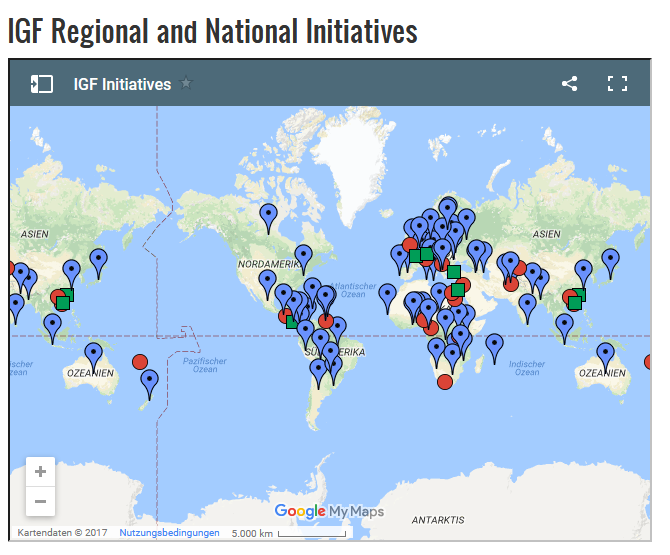 Talk globally and act locally, Cade said, is the way to change public policy. The NRI community organised a series of NRI sessions on the hot topics like fake news (see F) and also met during a short main session. The NRIs work not without problems. One participant from Iraq for example complained that the Iraq civil society in the region battered by shutdowns and government enforcement actions, in his opinion, had not been consulted at all on the Arab IGF.
O (as in Open internet)
Everybody wants it, or at least says so. The open internet is the holy grail of the internet governance discussion. But the open internet order, the US Federal Communication Commission’s net neutrality guarantee, has been rolled back, a step that might have international effects, the UN Special Rapporteur on Freedom of Information said at a press conference during the IGF meeting.
Russia, as journalism and tech lecturer Walid Saqaf reported, is gearing up its “own” or “backup” domain name system. China is on the path to socially score its citizens and clamp down on the use of unlicensed virtual private networks. A man in Guanxi Pignan County was sentenced to 5 years in jail and half a million renminbi for offering VPN services without a licence.
While the Global Commission on the Stability of Cyberspace called for the protection of the public core of the internet, one might ask, is the core still public, when private platforms like Facebook or Google start to build their own transport networks – from the undersea cables to the server inside the premises of the companies?
P (like in Panels)
The sheer number of panels is terrifying. According to the official statistic of the IGF, there was a total of 231 sessions. On top of the 4 host country and 8 large main sessions, there were 99 workshops, 45 open forums, 4 best practice forums, 18 meetings of dynamic coalitions, 8 sessions of national and regional IGFs, and 14 “other” sessions. The number and programming received considerable criticism – too much, too many sessions covering the same topics (sometimes at the same time), and lack interactivity between speakers and participants.
“Sometimes the IGF workshop process focuses so much on diversity that we have panels that have many accents, we have all of the stakeholders represented, they come from different places, and they all say the same thing,” said Mike Nelson of Cloudflare, dialling in remotely to the main open mic session. “This year I heard panels where seven people all said the same thing and then, the next day, the same topic, four other people said the opposite thing. We did not mix the panels to enough,” he observed.
Q (like in Q&A)
Sixty to 90-minute panels with up to 10 speakers are no rarity at the IGF. The format often falls short of allowing for proper discussion. Q&A at best is crammed into a few minutes at the end. It is not what many participants came for. Thomas Schneider, vice-chair of the Swiss Federal Office of Communication (OFCOM), in his concluding remarks called for session organisers to rethink this. “This is not really using the potential of the people in the room to have, like, a crowd intelligence discussion and outcome.” At the Swiss IGF, the rule was now that “there are no panellists.” Instead, two provoking statements and moderators who engaged the audience had been working well. “And you don’t always have the same people speaking and the same people listening.”
Whither IGF? Observations
R (as in Regulation)
Regulation came up on many fronts during IGF 2017. Should there be blockchain governance and cryptocurrency regulation? Should there be regulation for cybersecurity? Shall fake news be regulated, hate or Nazi speech? More regulation on cybersecurity was called for by Liu Zhenmin in his opening statement, as well some ministers. At the same time several initiatives from the technical and the private sector to come up with their versions of rules or even “Digital Geneva Declarations” (see C). So how much need is there for rules. Brushing rules aside carried a special risk, warned Marietje Schaake, Member of the European Parliament and author of the European Parliament’s digital trade strategy. Schaake warned against calls “make the internet the domain of the fittest who are going to be principleless, and sweep aside every right, whether it’s a human right or digital right”. Rules, she finds, can protect the net.
S (as in Stakeholders)
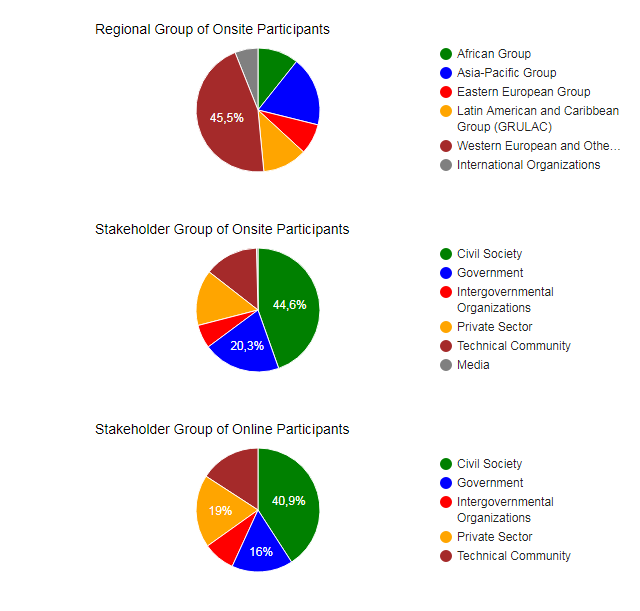 Fewer governments participate in the IGF. Less companies come. Civil society is the dominant player. On the quiet, this is what many participants said during IGF 2017. One reason for the big elephants to stay away is the fact that the IGF cannot take decisions, which has been hammered into its mandate: it is a multi-stakeholder dialogue. One reason for this was that the US (and its allies) were afraid of the potential after-WSIS fallout with regard to the management of critical infrastructure management. At the same time “equal footing” between government delegations and the civil society crowd seemed really weird to some governments.
The call by some governments and many civil society actors gets louder every year that the IGF should make “recommendations”, see the blog of the Electronic Frontier Foundation’s Jeremy Malcolm on the crisis of multi-stakeholderism during IGF 2017. Other governments underlined that allowing for formal results would make negotiations necessary, and would change the stature of the IGFs – possibly meaning civil society and business would not be welcome to the table?
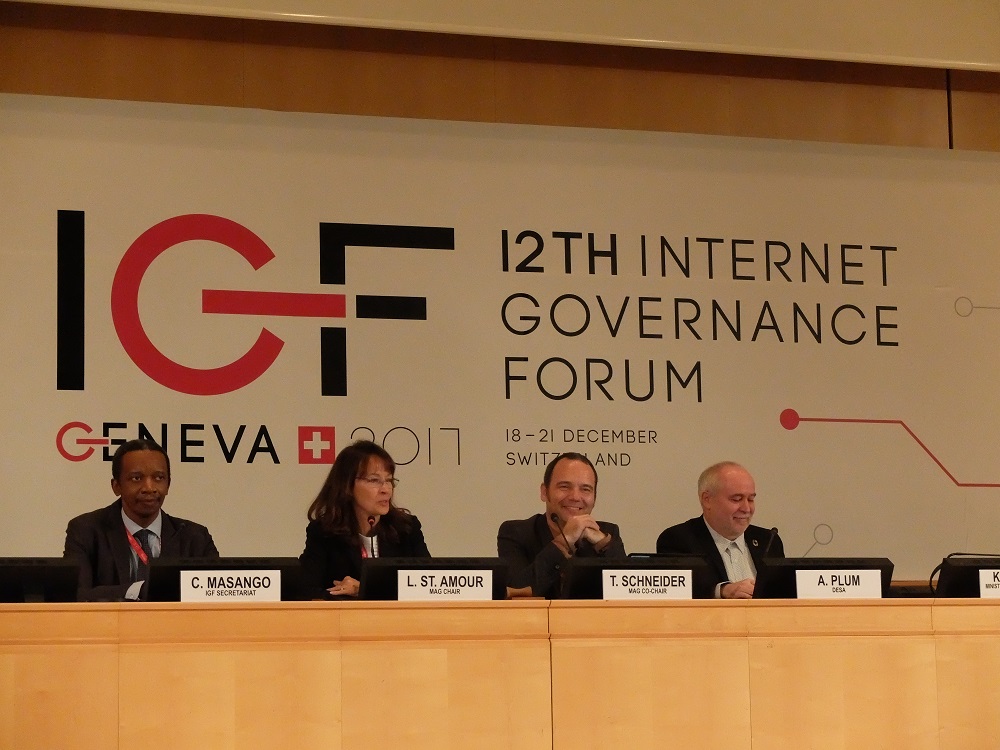
One cannot have it both ways, said a critical Thomas Schneider, of Switzerland’s OFCOM. He said that governments who want to keep the IGF a dialogue forum could not then stay away for that very reason. “If we ranked success of a conference in the numbers of ministers and presidents and CEOs that participate, then the IGF will never be a success, because this is not what it’s about,” he said. The IGF was the most open platform for the emergence of new ideas. Instead, Schneider said, “what we experience is that governments from developing and developed countries spend millions and millions to organise and businesses spend millions to sponsor non-inclusive, invitation-based conferences on IG issues all over the world where they invite 100, 200, 500 people, and pay hugely for security and other things. And then they have no money to fund the IGF secretariat.” For Schneider, this does not make sense.
T (as in Transparency)
Transparency is medicine number one. Prescription for it was made in many places at IGF 2017. From artificial intelligence to data collection, from trade negotiations (see A, B, C, D, E, F) to the work of the IGF Membership Advisory Committee – transparency was seen as necessary.
U (as in USA)
The US has been a steadfast supporter of the IGF since its inception, regularly bringing large and also high-level delegations to the Forum. Not the least the US must have seen the forum as the lesser evil when governments from many continents pounded the desks during the WSIS conference in Tunis over the US special role in overseeing the Internet Corporation for Assigned Names and Numbers (ICANN) and thereby the heart of the domain name system, the root zone. IGF 2017 saw a dramatic change in that regard.
The official US delegation included a mere half-dozen members, dwarfed by, for instance, the official delegation of the small Netherlands which sent 40 people (10 from Ministries). For the US, no high-level speeches, no press conferences, no intention to become the largest funder.
For more on this topic, see here (IPW, ITU/ICANN, 23 December 2017).
V (as in Vinton G. Cerf)
Yes, the “father of the internet” deserves a graph of his own in here. Cerf did it all, he became his own avatar during the meeting, often popping up in different sessions during just one slot, always trying to hold on to the open internet, the good internet and the secure internet. Cerf‘s stature nevertheless also highlights an internet trend itself. The co-father of the internet is now an “evangelist” for Google, the much-loved, much-hated former search engine provider that has turned into a google-over-everything (or everything over google) machine touching nearly everything on the net. While some point to other shooting stars on the net that are long gone and say the next, post-Google thing might be around the corner, there certainly are those that think that anti-competition has work to do and digital trade rules on fair competition might, if crafted well, help to tame the beast. Antitrust, says Annette Esterhuysen from the Association for Progressive Communication, IGF-watcher from day one, may be the next big topic at the IGF.
W (is for Women)
While it is a shame this has to get a special paragraph – let aside a special, and highly visible thread – at the IGF 2017, sorry guys, it still seems inevitable. The IGF looked not bad gender-wise, in fact better than in earlier years. There was the opening by the host country, with the Swiss President Doris Leuthard asking for more multi-stakeholder participation (link to our story). The IGF is the champion of diversity, diversity is written in its new mandate and over all its documents. Gender-balance and otherwise diverse panels sometimes result in panels that do not fit the stage (see P)

Projects to bridge the still existing gender divide in ICT, when it comes to access as well as it when it comes to designers. One of the projects presented in the IGF was TechWomen Afghanistan and TechWomen Asia, the latter launching a portal that shall create networks for women from over 60 countries to join into the internet governance space. The network wants to “develop leadership and enhance employability of women in technology in Asia and the Pacific, create the next generation of women technology entrepreneurs in that region also help the wider women community through digital literacy programs improving their lives and livelihoods,” according to Omar Mansoor Ansari, chairman of the National ICT Alliance in Afghanistan.
But beside the still-uneven numbers of participation there are the reports in IGF panels like the one on “online gender-based abuse and violence.”
X (like in WebEx)
WebEx, a remote participation and conferencing tool by Cisco, has been used for several years to allow remote participation including remote presentation, and worked well for the sessions broadcast, reported Mike Nelson of Cloudflare, calling into the open mic session on day four of the IGF. The number of remote participants – 1,661 – was nearly as high as the 1,900 who travelled to Geneva, for Nelson a reason to recommend considering a virtual-only IGF. The Internet Society has done it before with its Intercommunity event, a virtual worldwide 27-hour meeting, during which the ISOC chapters and regions organised an hour each, Nelson said. Holding a pure online IGF would at least remove the challenge of finding a host.
Online conferencing tools for such an experiment still might need tweaking. More work certainly was necessary for people with disabilities, Andrea Saks, chair of the Dynamic Coalition on Accessibility and Disability, said during the open mic session. “WebEx does not work for blind people,” Saks said. The ITU, which has stepped up as a facilitator for the dynamic coalition is “testing other tools and we will make the information available,” Saks announced, while recommending to give “a really healthy nudge to Cisco to say redesign, do something.” While Cisco was donating the licence, other open source also came at no cost, she said, and hosts should be made aware of the options. The dynamic coalition during the IGF 2017 looked into the effects of IoT (internet of things) for disabled people.
The largest number of online participants came from the following countries: United States, Switzerland, Nigeria, China, India, Brazil, France, United Kingdom and Mexico.
The charts below illustrate the breakdowns of onsite participants and estimates for online participants by stakeholder group, region and gender.
Y (as in Youth)
“Youth is no longer in the shadows,” Jianne Soriano, journalism student at the Hong Kong Baptist University, said during the open mic session. But the extensive Youth track of the IGF sometimes feels like a separate world, set apart from the “grown up” sessions. Several Youth@IGF participants therefore complained during the open mic session that they felt kept away from the mic or not listened to in workshops and main sessions. Soriano spoke of a certain exhaustion and the need to see results. Young people should “fight, fight, fight” for the IGF, asked Nigel Hickson, vice chair from ICANN during that session, but they should also fight outside of the UN building and with their local governments.
Z (as in Zero day)
The IGF is a four-day meeting – but wait you can‘t fit all these panels into a four-day meeting, therefore there is the “Zero Day”. Not arriving on the Zero Day sets you at a disadvantage. Some of the hot topics make the first splash on day zero. The World Economic Forum started to tout its digital trade multi-stakeholder platform initiative, for example. The Global Internet Governance Academic Network (Giga.net) has its annual meeting, delivering a set of interesting papers and working on projects to map the internet governance landscape, for example with this effort to facilitate access to research in the field in a special online library. The first announcements and calls are put on the table, this year the call to protect the public core of the internet.
The author of this miniature IGF 2017 encyclopaedia did not attend the Zero Day, but knows full well, that any description of an IGF must fail anyway in attempting a high-resolution picture. Everybody should know that when he or she says that some topic has not been covered, it might just have been, right around the corner.
So we bet you, dear reader – tell us (info (at) ip-watch.ch) the internet governance-related topic not covered during IGF 2017. If we cannot present you with evidence that it has come up, you win a six-month subscription to Intellectual Property Watch.
And with this, we wish you a good post-IGF holidays and a Happy New Year.
Image Credits: Monika Ermert
[…] Most of the latter’s reporting is password-protected, but there is an unusually informative “encyclopaedia” of terms accompanied with insightful analysis of the full cacophony of this IGF. We encourage […]
[…] Son espacios de de intercambio entre actores especializados, incluida la sociedad civil sobre los desafíos de la sociedad digitalizada. Han efectivamente contribuido a disminuir la brecha tecnológica. Pero […]