

Governments and the private sector must work more closely together in the area of technology and innovation to make the United Nations Sustainable Development Goals (SDGs) a reality by 2030, government and major tech company officials said at today’s UN high-level event in New York. Today’s development problems won’t be solved with yesterday’s solutions but by all stakeholders – governments, civil society, youth, businesses and academia – working together, said General Assembly President Miroslav Lajčák. Everyone must have “fair access to technologies and innovations” and to training, he said.
 Lajčák and others called for the creation of innovation hubs around the world. The UN SDG goals are optimistic and achievable, but they require innovation on a global scale, said LinkedIn Founder Reid Hoffman. Achieving the goals requires networks which allow entrepreneurs to find the right innovations and business models, and to enable them to transact business safely and reliably, he said. The UN can help to establish such networks among member states, universities, inventors and others, he said.
Entrepreneurship is also key, because innovators are the individuals and team who build the organisations that provide the new products and services, Reid said. We will never achieve the more equitable world the SDGs envision by relying solely on venture capitalists, he warned.
We are entering the “fourth industrial revolution,” with exciting new technologies that are dramatically changing the world, said Salesforce CEO Marc Benioff. Many of the SDGs, such as food and access to jobs, can be boosted by artificial intelligence (AI), drones, robots and so on, he said. The SDGs should be rethought to determine how new technologies could advance them, he said.
But Benioff said he’s also “deeply, deeply worried” about the dark side of the new technologies such as autonomous warships and planes and driverless vehicles. AI will disrupt the entire employment landscape of the world and destroy millions of jobs, and people are right to be concerned, he said.
“Crisis of Inequality” Coming
AI isn’t equally available to everyone everywhere, creating a “crisis of inequality,” said Benioff. The advent of advanced technologies could create a wide new divide, he said.
People will be expected to relearn, but it’s not clear what jobs will be out there, said Ashish Thakkar, founder of the Mara Group and chair of the UN Foundation’s Global Entrepreneurs Council. Both men agreed that AI should be a basic human right, whether as SDG number 18 (there are currently 17) or as an embedded part of the other 17 goals.
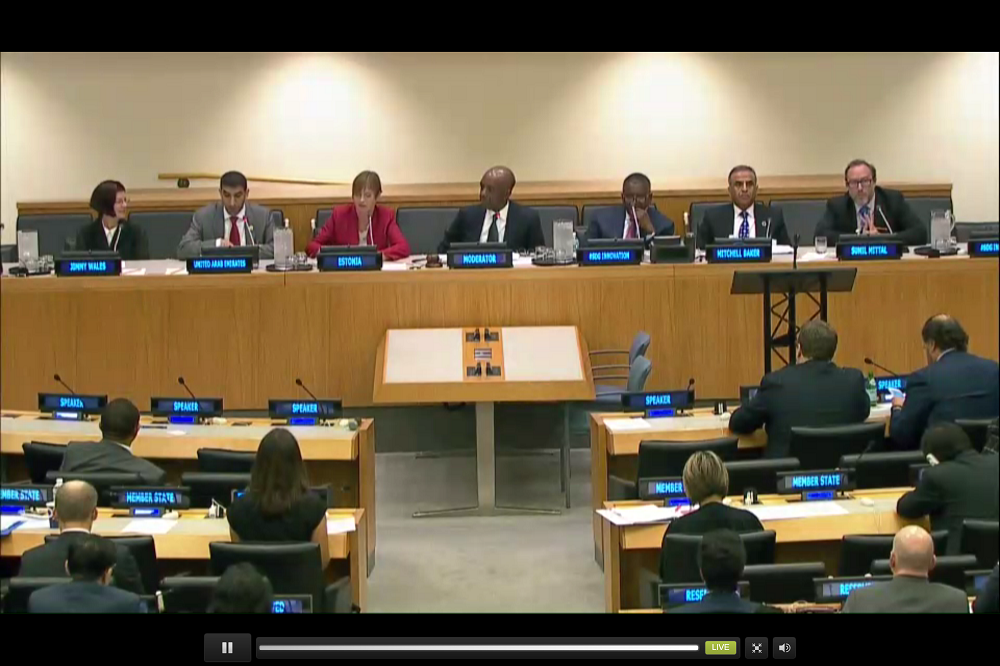
One panel mulled how governments and innovators can partner to solve the most pressing global issues. An example of such a partnership is Estonia, the only country in the world which offers government services to all citizens 24/7 online, offering significant environmental savings, said Estonian President Kersti Kaljulaid. After independence, Estonia had the will to offer service but not the means, she said. In 2002, the private and public sectors created a digital signature platform which allows actors from both sectors to offer an infinite number of services, she said.
One lesson Estonia learned is that any kind of social disruption cannot be achieved by the government or private sector alone, Kaljulaid said.
Technology companies are not as quick to shy away from collaboration with governments as they used to be, said Wikipedia Founder Jimmy Wales. Administrations are often a step behind technologists but the two groups are beginning to understand each other better now, he said.
Technology is starting to realise that it cannot avoid government, said Mozilla Executive Chair Mitchell Baker. But there is a disconnect between old regulations and new innovations, and there must be a push for greater understanding by both communities, she said.
One goal for the meeting was to try to build commitments for government officials and the private sector to work together, said moderator James Manyika, chairman of the McKinsey Global Institute.
Asked what government leaders can do, Bharti Enterprises Chair Sunil Bharti Mittal said they can commit to light-touch regulation and avoid going after low-hanging fruit, particularly telecom providers, through spectrum auction fees and excessive taxes. Governments can drive inclusiveness in the digital world, which means market for private companies, said Estonia’s Kaljulaid.
Getting basic technologies into the hands of all citizens makes a difference, she said: Washing machines changed society, not traveling to the moon.
Education was key to enabling Finland to become a global tech state and it now supports information technology hubs in Africa and stresses the need to get more girls involved, said the country’s Minister for Affairs and Trade Development. Many companies want to advance development goals but have problems measuring them, said Planet CEO Will Marshall. His and other businesses can help by, for example, using satellites to image the earth every day and provide data on agriculture, reservoirs and environmental issues such as tracking ice caps, he said.
Many panellists have or have had ties to Silicon Valley, one audience member said, arguing that the situation must change, because the US tech centre has the answers to some but not all of the questions. The faster everyone connects to and enables global innovation hubs, the sooner they can address the issues, he said. The hubs must be platforms where all stakeholders can voice their needs and arrive at solutions, he added.
Many answers will not come from Silicon Valley but from local entrepreneurs, said Wales. Ultimately, it falls to governments to solve SDG problems, said Kaljulaid.
The annual UN General Assembly is taking place from 19-25 September.
Image Credits: United Nations