

The Program and Budget Committee of the World Intellectual Property Organization this week is meeting for the second time this year. It is expected to consider the budget for the 2018/2019 biennium before the annual WIPO General Assembly next month. Delegates flew through the agenda today and had little to remark on audit and oversight reports, but the next days might give way to more discussions, in particular on the diplomatically thorny issue of which countries should host a WIPO external office. On a separate issue, the United States tabled a paper presenting an alternative methodology for allocating funds to WIPO-managed systems, reducing revenue reliance on a single global patent agreement.
The 27th session of the Program and Budget Committee (PBC) is taking place from 11-15 September. The agenda is here [pdf]. The General Assembly takes place from 1-12 October.
Financially Sound, Gurry Says
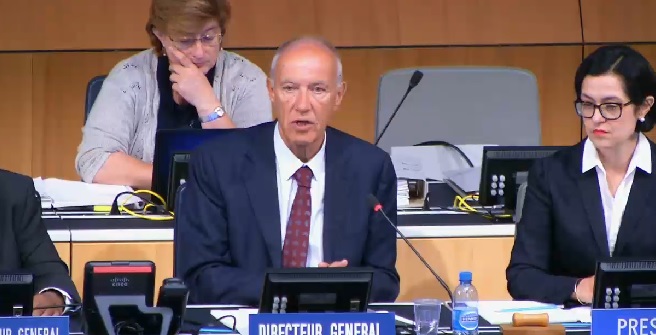
WIPO Director General Francis Gurry opened the meeting by commenting on the good financial results of the organisation, underlining the fact that the fees derived from the Patent Cooperation Treaty (PCT) contribute to about 75 percent of WIPO’s revenue. The Madrid System (Madrid Agreement Concerning the International Registration of Marks) accounts for another 16 percent of the overall revenue, while the Hague System (Hague Agreement Concerning the International Registration of Industrial Designs) provides a further 1.3 percent of the revenue.
According to projections by the WIPO Chief Economist, the organisation’s total revenue for the biennium is expected to grow in the next biennium 2018-2019 and go beyond CHF 800 million. The expected revenue is estimated at CHF 826 million (US$ 866 million), a 10.4 percent increase compared to the current biennium 2016-2017. Expenditures in 2018-2019 are expected to raise by 2.7 percent, to reach CHF 725 million (US$ 760 million).
A decision by the International Civil Service Commission (ICSC) to ask for a decrease in the amount high-level staff get as a post adjustment to compensate the high cost of living in Geneva spurred some discussions at the last session of the PBC in July as some member states asked why this decrease was not reflected in the draft program and budget 2018/2019 (IPW, WIPO, 20 July 2017).
Today Gurry said the ICSC now foresees a transition period until February 2018, and the WIPO secretariat is unable at this stage to have a precise estimate of the impact on the budget of the ICSC decision.
The PBC examines the budgetary and financial aspects of the organisation. It also reviews reports from the external and internal audits before they go to the WIPO Annual General Assembly.
WIPO’s operations and activities are evaluated by three separate bodies: the WIPO Independent Advisory Oversight Committee (IAOC), whose members serve in their personal capacity; the External Auditor, who reviews WIPO’s financial statements and their compliance with financial regulations and rules.; and the Internal Oversight Division (IOD), which carries out audits, evaluations and investigations, and makes recommendations to improve program implementation and operations.
Today, the PBC examined the reports of those three bodies. The committee recommended that the WIPO General Assembly takes note of the IAOC report [pdf], and the report by the External Auditor [pdf], and noted the IOD report [pdf].
Recommendations of the External Auditor on Hague
In this report, the External Auditor, Shashi Kant Sharma, Comptroller and Auditor General of India, provided a number of recommendations, some of which concern the Hague System.
In particular, the External Auditor recommended a more targeted strategy for the expansion of the Hague System to developing countries and least-developed countries. He also suggested that WIPO set more realistic targets, taking into account factors outside its control to avoid a number of targets in performance indicators not being reached.
The external auditor also recommended that WIPO consider drawing a specific biennial capacity building action plan, as his report states that “there had been no activity for certain capacity building initiatives pertaining to the Hague system.”
The report further remarked that the processing of regular applications in 2015 has taken more time as compared to the previous year and thus recommended that WIPO consider establishing a timeline for examination and processing of applications, as well as “realistic enforcement of provisions for abandonment of applications, to introduce more accountability and promptness in the system.”
The Hague System fee structure has not been revised for over 20 years, the external auditor remarked in his report, and recommended that WIPO consider “framing an actionable strategy early for making the Hague System self-sufficient and may also consider placing a proposal in the Hague Union Assembly to revisit existing fee structure periodically.”
China took the floor to point to what it said are shortcomings in the external auditor’s recommendations. For example, the Chinese delegate said China is actively considering joining the Hague System and beyond publicising the system, other measures should be considered, such as including all six United Nations languages in the system.
The Chinese delegate also underlined capacity building activities conducted collaboratively with WIPO and the Chinese intellectual property office in 2015, and said WIPO holds many thematic seminars in Geneva, in particular during committee meetings.
Revisiting the fee structure of the Hague System to reach self-sufficiency may discourage new membership, and would be short-sighted, China said, adding that it hopes that WIPO will increase investment in the Hague System, to improve its attractiveness.
UN Joint Inspection Unit Recommendations
Also examined by the PBC today was the WIPO Secretariat Progress Report [pdf] on the Implementation of the Joint Inspection Unit Recommendations.
The report provides an overview of the status of implementation of outstanding recommendations addressed to WIPO, resulting from the reviews of the Joint Inspection Unit (JIU) of the United Nations System during the period 2010-2017. The JIU is an independent external oversight body of the United Nations system mandated to conduct evaluations, inspections and investigations system-wide, according to its website.
According to the report, at mid-July 2017, 82 percent of all the 261 JIU recommendations made since 2010 and relevant to WIPO had been implemented, 10 percent were either not relevant or not accepted, and 7 percent in progress of implementation, 1 percent remaining under consideration.
The report notes that WIPO had been ranked number one along with the International Civil Aviation Organization among evaluated UN agencies for its follow up processes, in the latest JIU report, soon to be released.
An example of recommendations not considered by WIPO as being relevant is one on dissemination and exchange of information concerning donor assessments among member states.
One of the recommendations still in progress refers to contract management and administration.
The PBC took note of the report and called on WIPO to propose assessments for the open recommendations made by the JIU.
Also adopted today was a decision approving the WIPO Annual Financial Report and Financial Statements 2016 [pdf]. The PBC also took note of the status of the payment of contributions [pdf] as of 30 June 2017. The WIPO Secretariat provided a list of payment received since June from the following countries (Belgium, Benin, Burkina Faso, Ecuador, Gabon, Greece, Guatemala, Italy, Malawi, Mali, Mexico, Niger, Paraguay, Senegal and Spain).
US Wants a New Allocation Methodology for Unions
In their opening statement, the US said it is concerned that WIPO is disproportionately funded by the PCT fees, and that the over-reliance on the strength of the PCT is masking weaknesses in other areas.
The US tabled a discussion paper [pdf] on funding alternatives for WIPO. According to the paper, the PCT strength is masking weaknesses in the Madrid, Hague and Lisbon systems (Lisbon Agreement for the Protection of Appellations of Origin and their International Registration). None of these systems “currently cover a proportional share of the overall cost of WIPO’s programs, and thus are all subsidized by the PCT.”
Furthermore, the paper says that the assessed government contributions to WIPO, “which make up less than 5 percent of WIPO’s budget, do not fund the growing expenses they were meant to cover because of the over-dependence on PCT income.” Any further reduction, as is proposed in the proposed program and budget for the 2018/2019 biennium, “would increase the burden on the PCT system…,” the paper adds (IPW, WIPO, 20 July 2017).
The paper proposed using a proportional allocation methodology based on each union’s share of direct expenses.
External Offices
Scheduled to be discussed later in the week, the issue of WIPO field offices remains a difficult item, according to sources.
The PBC is expected to discuss which country will host the remaining unallocated external office for the 2016-2017 biennium, and which three countries will host the external offices of the 2018-2019 biennium.
Costa Rica, on behalf of the Group of Latin American and Caribbean countries (GRULAC) said it is a priority issue for the group. The Costa Rican delegate said the group designated Colombia as a consensus candidate for the biennium 2016-2017.
There is a list [pdf] of candidates for the 2016-2017 biennium, and a list [pdf] for the 2018-2019 biennium, which some countries being on both lists.
Image Credits: WIPO
[…] a discussion paper [pdf] during the last session of the Program and Budget Committee in September, (IPW; WIPO, 11 September 2017), and non-conclusive efforts by France and the US to propose common language [pdf] on a new […]