

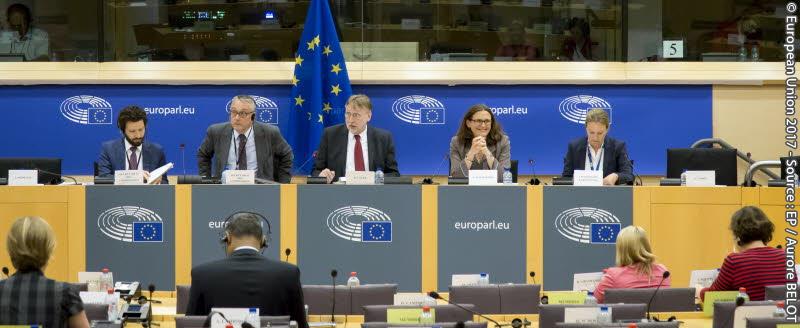
European Union trade politicians and their counterparts from the United States need more time to consider next steps in their trade relations, EU trade Commissioner Cecilia Malmstroem said during a session with the trade committee of the European Parliament this week. At the same time, she reported that Trans-Pacific Partnership (TPP) and Trade in Services Agreement (TISA) negotiating partners have been turning to Europe to make headway. Meanwhile, former EU Justice Commissioner and member of the European Parliament, Viviane Reding, called for a counter-offensive to rising protectionism.
On 30 May, Malmstroem outlined a full agenda of her cabinet on continued and new trade negotiations, on work to better include development and human rights aspects in trade politics and on ongoing work to implement the recent EU Court of Justice decision over competencies in negotiating
TTIP in the Fridge, TPP Partners Turning to Europe
Asked several times about the future of the Transatlantic Trade and Investment Partnership (TTIP) and future transatlantic trade relations, Malmstroem said: “TTIP and the trade talks with the US still make a lot of sense,” Malmstroem said, “but at the moment it is paused, or in the fridge or on the cupboard or wherever you want to put it.”
DG Trade is engaging with the US over how to establish positive transatlantic trade relationships. She is aware of protectionist measures in public procurement, the maritime sector and the “Buy America” initiative. A restart of TTIP, in the same or a limited form, would be dependent on how the conditions would look like, she said.
The new US position on the other hand has resulted in a shift in trade negotiating activities. Malmstroem reported: “Some of the events in Washington, namely President Trump’s decision to withdraw from the (12-country) TPP had the effect that the 11 other countries were very disappointed. They turned to us, almost all of them, asking if we can speed up negotiations that were ongoing, or take next steps together.”
The EU now plans to finalise negotiations with Japan, the Mercosur countries (Argentina, Brazil, Paraguay, Uruguay and Venezuela) and Mexico. New negotiation mandates are sought by DG Trade for Chile, Australia, New Zealand, three countries that have been parties to the US-abandoned TPP. Further negotiations are also ongoing with Indonesia, Tunisia, the Philippines, and Myanmar are prepared to start with Malaysia. The plans for an investment treaty with China are on the agenda at a EU-China summit later this week in Brussels.
Malmstroem said she also noticed a change in the mood of the Council of EU member states, in the sense that the EU now has to stand for a new way to negotiate trade agreements. “The mood on trade is ambitious,” she said. “We should stop talking about free trade and should instead talk of fair trade,” recommended Reding, member of the European People’s Party. The EU is currently in the process of passing legislation on conflict minerals, dual-use goods and is working on its “Trade for All” strategy.
TISA Partners Should Go Ahead, Even Without US
Reding asked for a “major European initiative” to answer the rise in protectionist policies and called on the Commission to consider going ahead with the Trade in Services Agreement (TISA) negotiations. The negotiations, which have been going on for years, were stalled after the new US administration came to power.
“It might be worthwhile,” said Reding, “to make some headway, especially as plurilateralism might be the way to open the door to multilateralism.”
Reding at the same time took a shot at protectionist mechanisms “here and there”, saying that perhaps Europe itself should consider if it is time for a Buy European Act. Her party group, the EPP, just has started an initiative to harmonise control of foreign investment, haunted by big shopping tours of China in the tech industry.
Fact and Fiction in Trade Politics
Despite the big FTA agenda and the promises to go for fair and value-based trade, members of Parliament had questions for the Commissioner.
One result of the recent European Court of Justice decision on the competencies in negotiating FTAs could be that national parliaments would now be excluded from taking a position on most aspects in these agreements, warned Anne-Marie Mineur from the Confederal Group of the European United Left (GUE).
Malmstroem argued that national parliaments still could be consulted by their governments, and that this should be done “from the first day” of negotiations. Yet member states have been the ones to block publication of the negotiating mandates, even after they have been decided upon, and should rather have allowed their national parliaments to be a part of that process, critics think.
Several members also questioned the preparedness of the Commission to hold transparent and participatory trade negotiations. Malmstroem only briefly reacted to questions on how she would remedy the failure to register the “Stop TTIP” citizens’ initiative. The initiative signed by more than 3.2 million EU citizens according to EU law is eligible to have the EU legislature discuss their requests to end both TTIP and CETA (Canada) negotiations. The rejection of the Commission to register the initiative recently was judged illegal by the European Court. Malmstroem said that the ruling “does not say that the initiative was implemented, but it was wrong to register it.”
More criticism on the lack of transparency came from Klaus Buchner (Green Party Group), who criticized a lack of transparency with regard to negotiations started with representatives from Western Sahara to save the EU-Morocco Deep and Comprehensive Trade Agreement (DCTA). The DCTA was stopped by the European Court judgment that held that the deal was not valid for the illegally annexed territory.
Conservative MEP Christopher Fjellner questioned the effective implementation of trade agreements, as rules of origin would prevent companies to use the negotiated terms. For example, in case of the South Korea EU FTA, only 65 percent of companies git rid of barriers.
Image Credits: European Parliament