

With the recent entry into force of the Marrakesh Treaty providing copyright exceptions for persons with visual impairments, a panel convened alongside last week’s World Intellectual Property Organization copyright committee meeting explored ways to transform the treaty’s promises into reality.
The WIPO Standing Committee on Copyright and Related Rights (SCCR) met from 14-18 November. The 15 November side event was organised by the Accessible Books Consortium (ABC), which is hosted by WIPO.
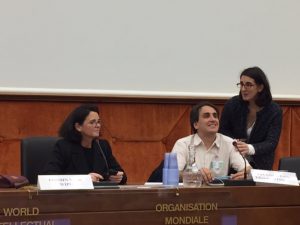
Recently appointed WIPO Deputy Director General for the Copyright and Creative Industries Sector Sylvie Forbin said at the event that 25 countries have now ratified the 2013 Marrakesh Treaty to Facilitate Access to Published Works for Persons Who Are Blind, Visually Impaired or Otherwise Print Disabled, which entered into force on 30 September.
“We hope that in by next year, we will have another 25,” which was the goal set by WIPO Director General Francis Gurry, she said. The ABC supports the objectives of the Marrakesh treaty at the “practical level”, she said, adding that the ABC is a public-private partnership including the World Blind Union, libraries, publishers, authors, and collective management organisation.
ABC acts as a complement to the aims of the treaty through three main activities: the ABC book service, capacity building activities, and inclusive publishing. According to the ABC website, the inclusive publishing project promotes technologies and industry standards which support “born accessible” publishing. Born accessible publishing refers to published works that are accessible from their creation.
The ABC book service (TIGAR – Trusted Intermediary Global Accessible Resources) is hosted at WIPO and, according to the website, makes it easier for participating institutions to search internationally for books in accessible formats, and to exchange them across national borders.
Forbin said the World Blind Union estimates that only one in 10 blind children will get an education to find a job. She underlined the human impact of the lack of educational books on visually impaired children.
She said nominations for the 2017 Accessible Books Consortium International Excellence Award for Accessible Publishing are now open. The award recognises outstanding leadership and achievements in advancing the accessibility of commercial e-books or other digital publications for print disabled people, according to the ABC website. The winners of the 2017 award will be made known during the upcoming London Book Fair in March.
Ratifying Treaty Requires Cooperation by Stakeholders
Karen Keninger, chair of the International Federation of Library Associations and Institutions (IFLA) section for Libraries Serving Persons with Print Disabilities, said the promises of the treaty will be fulfilled when anybody with a legitimate print disability can get and read a book or any published work in accessible format, anywhere in the world.
Access to published work for visually impaired people is fragmented, inconsistent, and often completely unavailable, she said. Some resources are duplicated to make accessible works that are popular while the vast majority of published work remains out of reach, she said.
Eventually, the hope is that every published work will be accessible from its publication, she said. In the meantime, structures such as the ABC will have to be developed, to create a “web of access,” she added. Ratifying the treaty and updating copyright law require the cooperation of all stakeholders, she said. It is important to raise awareness of the issues encountered by visually impaired people at the national level to promote the ratification of the treaty, she added.
She also underlined particular areas of concerns that may arise when implementing the treaty, including prescriptive recordkeeping requirements, and commercial availability clauses.
The availability clause states: Article 4 (National Law Limitations and Exceptions Regarding Accessible Format Copies) of the Marrakesh treaty [pdf] provides that members may confine limitations or exceptions under Article 4 to works which in the particular accessible format, cannot be obtained commercially under reasonable terms for beneficiary persons in that market.
Broad Consideration of Authorised Entities
Pablo Lecuona, executive director of Tiflolibros, the first digital library for the Spanish-speaking blind created in 1999 in Argentina, explained how Tiflolibros came into being. At the end of the 1990s, he said, technology suddenly provided greater access to reading materiel through digitalisation, he said.
Lecuona said they started exchanging digital books between visually impaired friends, which later became a network for visually impaired people.
In Argentina, exceptions to copyright for visually impaired people were incorporated into the national legislation, he said, which ensured that the network was functioning in a legal framework.
Lecuona underlined the fact that in Latin America, organisations that made works accessible are mainly very small civil society organisations, with few resources and no government funding. This situation calls for the need to make the most of every single resource, to work as a network and share experiences.
The authorised entities through which accessible works may be distributed or made available according to the treaty, should be considered from a broad perspective, he said, so countries can easily add new authorised entities, including libraries, school and universities. It is important not to have a complete red tape to authorise an entity.
International exchanges need to be simple, he said, with less bureaucracy. Not one system is better than another but all systems have to fulfil the Marrakesh treaty promises, he added. Different countries will create different structures to organise exchanges but the central element is to ensure that works can circulate across each country, he explained.
Tiflolibros is working with ABC and hopes that in 2017 a large number of educational books will be make accessible and available not only through Tiflolibros but also through ABC, he said.
Increase Reach and Online Library Content in India
Manocha Dipendra, director of the Regional Resource Centre (New Delhi), DAISY for All, said the Daisy Forum of India (DFI) was established in 2007 and hosts India’s largest online library for blind and print-disabled people.
DFI is a network of 132 members including the government, non-governmental organisations, educational institutions, public libraries, and publishers. This network is reaching about 50,000 users, he said, which still misses a large number of people in need in India, he said. According to the World Health Organisations, he said, some 12 million people in India are suffering from visual impairment.
Among the goals for the next three years is to increase the online library content, which is a collection of books accessible in India but also through international partners such as Bookshare, with accessible digital copies of 500,000 books. That would double the number of books currently available, including all school and university textbooks, 100 newspapers and periodicals, and books for all age groups, he said.
Another goal is to increase the number of users to one million, he added, and provide them with a holistic solution that is referred to as: Kit, Content, and Confidence.
Kit is the assisted technology that end users need, content of accessible formats, and confidence for users in the capacity to use the assisted technology and the capacity to produce for organisations.
New WBU Guide to Marrakesh Treaty Published Soon
Chris Friend, representing the World Blind Union, in the audience, presented the World Blind Union Guide to the Marrakesh Treaty: Facilitating Access to Books for Print Disabled Individuals, to be published by Oxford University Press in February.
The guide is intended to provide an analysis of the treaty to multiple audiences including parliamentarians and policymakers who adopt domestic legislation and regulations to give effect to the treaty, judges and administrators who interpret and apply those laws, and to disability rights organisations and other civil society groups who advocate for the treaty’s implementation and effective enforcement, according to the guide executive summary.
[…] Turning Promises Of Marrakesh Treaty For Visually Impaired Into Reality […]