Original news and analysis on international IP policy
IP Should Serve More Actors In New Ways, Keynote Speaker At WIPO Says
The much-advertised World Intellectual Property Organization conference on the digital content market kicked off with a visionary speaker calling for the broadening of intellectual property rights income as a way forward for a sustainable economic ecosystem and reducing inequalities. The WIPO director general meanwhile said digital technology has brought new possibilities and reduced prices but also carries its load of regulatory challenges.
The much-advertised World Intellectual Property Organization conference on the digital content market kicked off with a visionary speaker calling for the broadening of intellectual property rights income as a way forward for a sustainable economic ecosystem and reducing inequalities. The WIPO director general meanwhile said digital technology has brought new possibilities and reduced prices but also carries its load of regulatory challenges.
WIPO Director General Francis Gurry said of the large turnout for the event that such a “strong response is a good indication of the timeliness of an international discussion.”
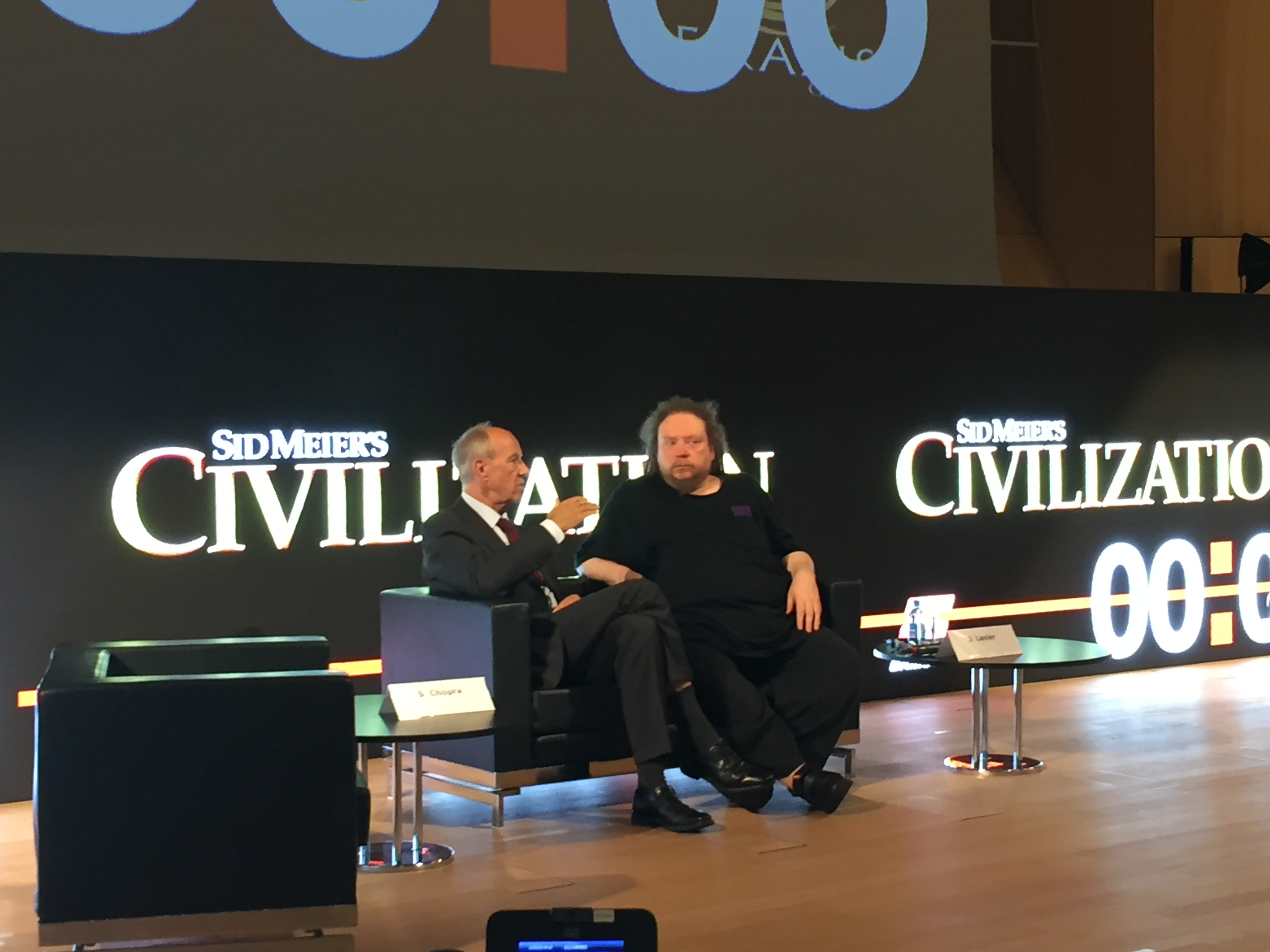
WIPO Director General Francis Gurry and Jaron Lanier, computer scientist, author, and composer, keynote speaker of the conference
Technology, particularly digital technology and the internet, has enabled ease of storage, reproduction and distribution of creative works, he said.
“These features, in turn, have created the possibility of access to unprecedented repertoires of works, the possibility of a worldwide audience and vastly reduced prices for access to creative works.” All of this occurring in a short time span, he said. “Scarcely 20 years ago, in 1995, commercial activity was permitted for the first time on the internet,” he remarked.
However, he said that the same features of technology which have produced enormous benefits for consumers “have also presented multiple challenges for creators and their business associates.”
The conference “seeks to explore both of these sides of the impact of the digital transformation on the creative world, the enormous benefits and opportunities, on the one hand, and the radical challenges and, even, threats, on the other hand,” said Gurry.
The impact on creators and performers of the new value chains, and whether the balance originally built into the copyright system is being preserved in the new environment, are questions that are being raised in the context of the global digital content market, he said.
Countering the Current Risk Distribution Model
Opening keynote speaker Jaron Lanier, computer scientist, author, and composer from San Francisco, delivered a talk that came as a surprise to many, according to several sources, by suggesting an expansion of intellectual property rights to all and everything, but in a quite innovative way.
By his own admission, Lanier supported the early “everything should be free on the internet” movement, but “my ideology was challenged by real world events,” he said, adding, “That’s called empiricism.”
Around the turn of the century, he noticed a pattern emerging, he said. “I have nothing against wealth, and people who are doing well,” as in any free society distribution of wealth is uneven. But if distribution is too concentration, it leads to a dangerous situation, he said.
Musicians are like canaries in coal mines, they are the early sign of what could happen to the whole society, he said.
According to Lanier, as machines appeared and relieved people of some work, there was a belief that people would go out of a job but “this was proven wrong again and again,” he said. Machines created new kinds of work for people, requiring more educated workers, and that still holds true in terms of fundamentals, he said.
However something changed. What changed was the notion that software should be free, and everything should be free online, he said.
But automation does not exist, he said, remarking, “It is a lie!” It is just a way of channelling human effort in a new fashion, he said. “What changed lately is not that machines are putting people out of work, but we have decided that they are so we don’t pay people anymore.”
He illustrated his point by mentioning automated translation services, which are competing with translators. Computer scientists spent many years trying to get language translation to work, he said, and it was very difficult because “we don’t have a scientific description of language,” he said. In order to have language translators, in the 1990s scientists had the idea of gathering a large body of actual translations, and their initial database was from the United Nations, as it was available for free.
“We are constantly stealing” from the real translators, “mash[ing] up their stuff and it is presented as automation,” he said. “But it is not, there is no such thing as artificial intelligence.”
Also, the desire to pretend that artificial intelligence is real is very strong, said Lanier, adding that for some people with a technical culture it takes a “religious quality.” “If we pretend that people are not needed,” he said, “obviously we create a distortion in the economy and obviously we create an unsustainable pattern.”
“I have tremendous sympathy for people who say” they do not have to pay for music or movies, he said, because “we have broken the social contract with them,” he said. Going to the period before internet, people used to pay for music or movies but the production of either of them created employment and wealth in the society so it was a two-way street, he said. That is no longer the case.
A critical point that has to be understood is the method by which wealth is concentrated today, he said. The concentration of welfare is unsustainable. The wealth is not concentrated by people gaining monopolies in the old fashioned way but by creating a new risk distribution model, he said.
He illustrated this with the Uber model. Uber never takes any risks, he said, the driver actually takes all the risks. Facebook and big hedge funds use the same big computer model in which, at the centre, no risk is taken. Users take all the risks, he said. That is the radiation of risk away from the big computer that is the problem, he said.
Two Options for Way Forward
The way forward can be imagined in two directions, he said. One way is that people are no longer first-class economic players but supported by society through a basic income model for example.
In the other, the idea of intellectual property is broadened to become fine grained and distributed enough to apply to all kind of work it has not before. In the latter model, people from whom data is mined would be remunerated. For example, somebody playing the game of “Go”, whose moves are taken to feed an algorithm which would create an automated Go programme, would be compensated with micro-payments. “We can imagine a future where people are constantly getting many little tiny streams of income all the time,” he said.
Algorithms are becoming the new societal control, he said. Algorithms from Facebook can not only causally get people to vote for a certain candidate without those people being aware that that has happened, he said, but it can also change people’s mood without people knowing it is happening, he said. Who has the control over the central computer potentially has a control over society, he said. “It is a form of direct manipulation.”
Answering the moderator about why Lanier is not a social media user, he said, “I am not on social media because I believe it’s a fake.”
“I have advice for young people,” he said, suggesting that for the sake of understanding, “as painful as it might be, to quit those services” and see what happens to their lives. “Quit Facebook, quit using Google, for a period of time,” he said. “You might be surprised by the result … that is freedom.”
Not Less IP rights, a Broader System Needed
Not advocating less IP rights, Lanier talked about “a vastly expanded notion of IP” as there is a need for a social contract which allows spending and receiving money from the internet. IP needs to be more fine-grained and much more accessible. “Broaden it [IP] and save the middle-class, that’s my talk,” he said.
Asked by the moderator about the technical possibility of such a system of micro-payments, he said the technical framework for such a system would be “extremely easy” to set up.
On the ability of technology to be actually a job creator, Lanier said two technologies have to be lauded as job creators, one is the phone and messaging services in the developing world, and the other, before the internet, personal computers, which were a great help for small companies. However, “people owned their own data,” he said.
As soon as internet was captured by the Googles, the Facebooks, the Amazons, the Ubers, you enter into a new kind of command economy where algorithms tell people what to do, “you are no longer participating in the marketplace,” he said.
There has to be a new regulatory concept that is both rigorous and easy to use. “One of the problems of the internet is that we have made freedom too difficult to be imaginable, and that is absolutely unacceptable,” he said.
“What we need is a much more sophisticated idea of intellectual property,” he said. “Before it was a sort of bulky thing…. The new IP is something that you sell millions of times a day.”
Asked by Intellectual Property Watch if his views only applied to copyright, he answered “no, everything, everything will be digital.”
[…] The highlights, although picking up the main points of the presentation, left the most contentious parts out, such as the advice to quit Facebook and using Google, or his remarks about the capture of the internet by “the Googles, the Facebooks, the Amazons, the Ubers” by which “you enter into a new kind of command economy where algorithms tell people what to do” (IPW, WIPO, 21 April 2016). […]
[…] This alternative economic system was presented by Jaron Lanier, computer scientist, and speaking at the World Intellectual Property Organization last year (IPW, WIPO, 21 April 2016). […]


[…] The highlights, although picking up the main points of the presentation, left the most contentious parts out, such as the advice to quit Facebook and using Google, or his remarks about the capture of the internet by “the Googles, the Facebooks, the Amazons, the Ubers” by which “you enter into a new kind of command economy where algorithms tell people what to do” (IPW, WIPO, 21 April 2016). […]
[…] This alternative economic system was presented by Jaron Lanier, computer scientist, and speaking at the World Intellectual Property Organization last year (IPW, WIPO, 21 April 2016). […]