

“The Ebola outbreak shook this organization to its core,” World Health Organization Director General Margaret Chan said in opening the WHO’s annual assembly today. And the need to better construct the world’s emergency response systems has the biggest economies on the podium, with German Chancellor Angela Merkel speaking as chair of the Group of 7.
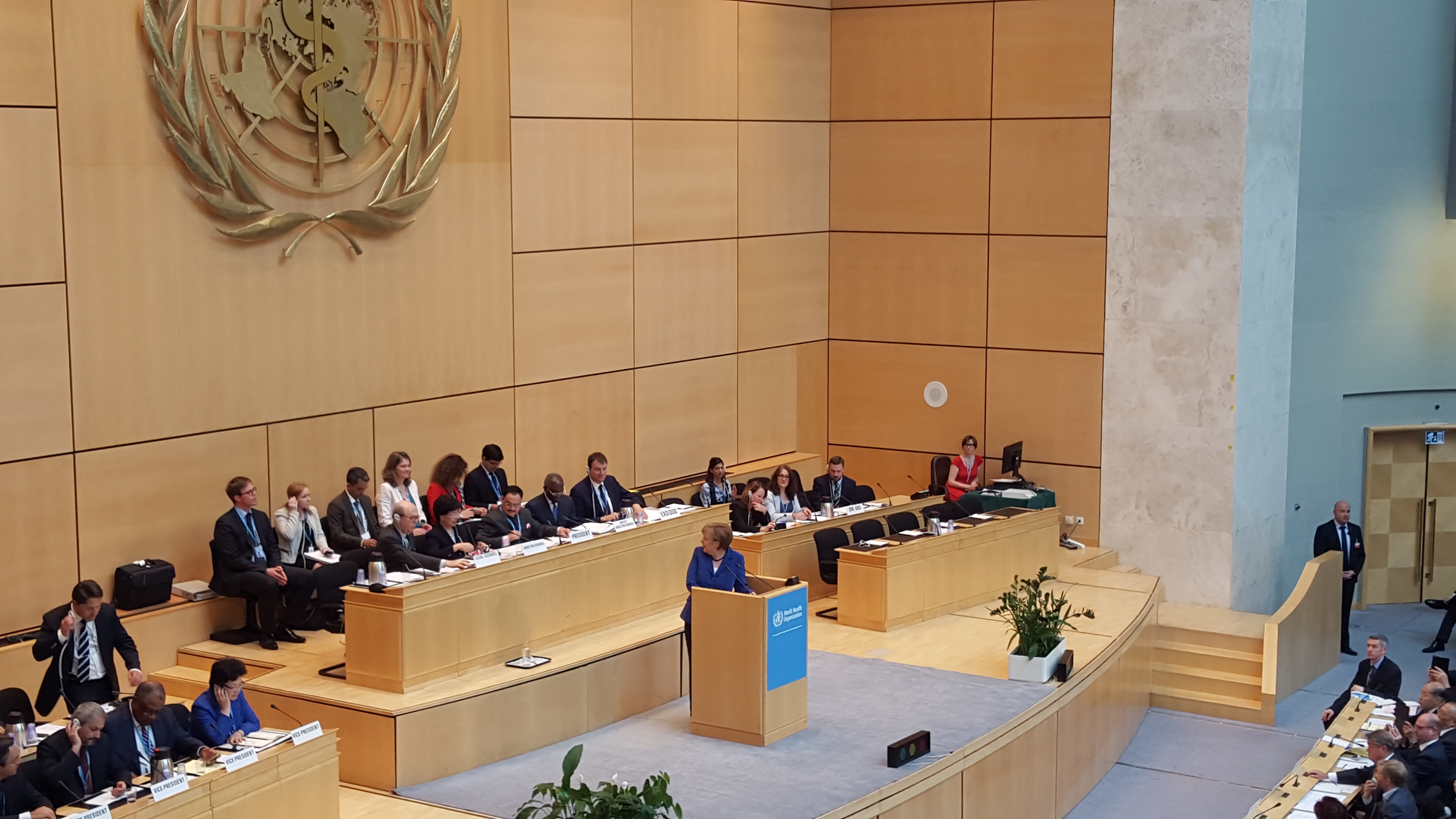
The World Health Assembly is meeting from 18-26 May. At the top of the agenda is learning from Ebola, addressing antimicrobial resistance, and tackling research and development for neglected diseases.
The Ebola crisis “was a defining moment for the work of WHO and an historic political moment for world leaders to give WHO new relevance and empower it to lead in global health,” she said.
“The demands on WHO were more than ten times greater than ever experienced in the almost 70-year history of this organization,” said Chan. “The Ebola outbreak has pushed the process of WHO reform into high gear, giving top priority to changes in WHO emergency operations.”
Merkel focussed on building better health systems after Ebola, antimicrobial resistance, and neglected tropical diseases. On Ebola, she said the fight is really only won when the world is prepared for the next outbreak, and said it “ought to have acted far earlier” on Ebola.
Looking at what could have been done, she said the role of the WHO is critical, adding, “The WHO is the only international organization that has universal political legitimacy on global health issues.” But she mentioned other partners, including the World Bank.
On neglected tropical diseases, Merkel said the term “neglected” should not be taken literally, as some 1.4 billion people are affected by such diseases, which predominantly afflict poor populations (70 percent of which are in emerging economies it was said today). She called for a build-up of health systems and other steps to be able to act fast and have clear crisis management.
Also on the opening day, Shri Jagat Prakash Nadda of India was named the new president of the WHA. He later announced several donations by India, including to the demonstration projects of the WHO Consultative Expert Working Group on Research and Development: Financing and Coordination (CEWG), and to the WHO efforts to address concerns about substandard and fake medicines.
The latter issue is known at WHO as “substandard/spurious/falsely labelled/falsified/counterfeit, although it appears that WHO has quietly removed the reference to “substandard” on its website: http://www.who.int/medicines/services/counterfeit/en/
Program for Health Emergencies
Chan outlined a programme for addressing emergencies, highlighting five changes:
– a unified WHO programme for health emergencies, accountable to her.
– establishing clear performance metrics for the programme, built on partnerships with other responders.
– establishing a global health emergency workforce, and strengthening WHO’s core and surge capacity of trained emergency response staff.
– developing new business processes to facilitate a rapid and effective response.
– proposing options for a new $100 million contingency fund.
“I do not ever again want to see this Organization faced with a situation it is not prepared, staffed, funded, or administratively set up to manage,” she said. “We will move forward on an urgent footing. I plan to complete these changes by the end of the year.”
One of the key lessons was that vaccines and treatments can be developed far faster than was thought.
“Many appreciated the way WHO moved to unite scientists, the R&D community, and the pharmaceutical industry to develop vaccines, medicines, therapies, and rapid diagnostic tests with record-breaking speed,” Chan said.
She referred to the high-level Ebola R&D forum held last week, which she said “translated experiences with Ebola into a new model for the accelerated development, testing, and approval of medical products during emergencies caused by any emerging or re-emerging infectious disease.”
“This is a ground-breaking achievement,” Chan said. “Ebola is not the only epidemic-prone disease that has no vaccines or treatment. Nor has the world seen its last new human pathogen.”
Hunger and Obesity
Separately, Chan took a jab at the junk food industry. “Hunger persisted, but the world as a whole got fat,” she said. “The globalized marketing of unhealthy products opened wide the entry point for the rise of lifestyle-related diseases.”
Overall, non-communicable diseases (such as obesity, cancer, misuse of tobacco and alcohol) overtook infectious diseases as the principal driver of global mortality, changing the very foundations of how public health operates, she said.
IP-Watch Researcher Eimear Murphy contributed to this report.
[…] For IP-Watch reporting on the non-state actor issue at WHA 68, see here. […]
[…] World Health Assembly Opens: Time Of Change At WHO; G-7 Involved […]