

This year is an auspicious moment for the World Trade Organization and the multilateral trading system, WTO Director General Roberto Azevêdo told journalists today. In particular, he said, the WTO, after a hiatus last year, is implementing the results of the 2013 Bali agreement on trade facilitation and finalising work on the work programme to conclude the Doha Round of trade liberalisation negotiations.
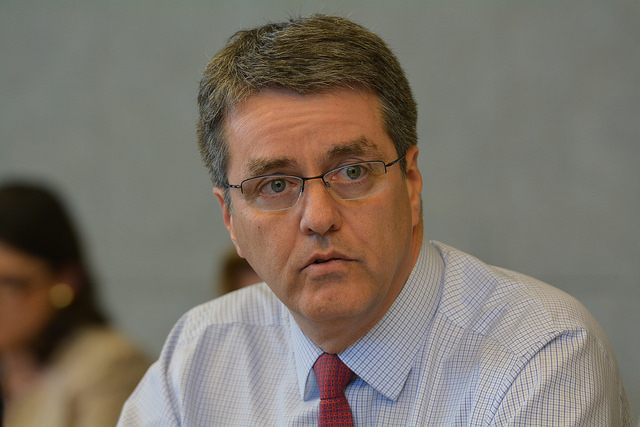
In an overview of 2015 at the WTO, Azevêdo described a busy year, highlighting negotiations to conclude the Doha Round, WTO’s 20th anniversary, and overload of the dispute settlement system.
The next WTO ministerial conference set to take place in Nairobi, Kenya, in December, will be the first time has Africa hosted such event, he said.
The year 2015 also marks the 20th anniversary of the WTO, founded in 1995, and the year will be peppered with events and celebrations, he announced.
“We have a big year ahead of us,” he said.
Doha Round: New Approaches Being Tested
The 2001 Doha Round negotiations have taken a turn for the better this year, according to Azevêdo. Up until the end of last year, members were merely restating old positions, but “that clearly has changed,” he said.
A number of delegations are exploring new approaches, and proposals are being put on the table. They are moving from a situation of identification of problems, differences and gaps, to a situation where they are trying to find solutions to overcome differences.
But there is not yet convergence, and options are still being tested, he said. How much can be achieved is yet to be determined, he said, adding that his hope is that “we can make as much progress as possible until the ministerial conference.”
On the intellectual property issues, they remain the same as in 2008, Azevêdo said. “Nothing has been taken off the agenda,” and everything is back on the table. Discussions are still ongoing on the establishment of an international register for geographical indications, he noted. Some members are also talking about biodiversity and how that can be part of the IP conversation, he added.
The Council for the Trade-Related Aspects of Intellectual Property Rights (TRIPS) is discussing a proposal by some members to amend the TRIPS Agreement so that patent applicants would have to disclose the source of the genetic resources and related traditional knowledge used in their invention. According to the WTO, some members are suggesting that this issue be included in the Post-Bali work programme. No progress has been made in the Council on this issue yet, or on the international register for geographical indications, or on whether the United Nations Convention on Biological Diversity should brief the Council.
Dispute Settlement System: Victim of its Success
Azevêdo said the WTO is reaching its 500th dispute settlement case, which is proof of the success of the system. Members would not be using it if they felt it was not helping them or that the system was inefficient, he said. “We are very happy with this,” he said.
The downside of this success, is that the WTO is facing “some degree of overloading,” and the system is straining the resources of the secretariat to the limit. This has led to “some delays.” The WTO has hired eight additional lawyers to remedy the situation, he said, but no immediate effect can be expected.
According to Azevêdo, some 90 percent of the dispute settlement cases are fully implemented and resolved.
Other Events in 2015
The fifth Global Review of Aid for Trade is set to take place from 30 June – 2 July in Geneva, Azevêdo said, adding that the WTO is hoping to invite high level officials from international organisations, such as the World Bank, and donor countries as well as beneficiary countries. This event is significant, he said, as technical assistance activities in the WTO are increasing in importance, since the demand is growing from developing countries and least-developed countries.
For the 20th anniversary of the WTO, he said book launches and events are expected to be organised. It will also be the major focus of the upcoming Public Forum in October.
On 14 June, the WTO will open its door to the public, to resume a tradition put on hold for several years due to construction work, he said. The event named “Merci Genève” is meant to thank the local community for hosting the WTO for the last 20 years. The public will be invited to visit the premises, offered tours, and displays.
Image Credits: Flickr – WTO
[…] Busy Year At WTO: 20th Anniversary, Doha Round, Dispute Settlement Overload […]