
By William New
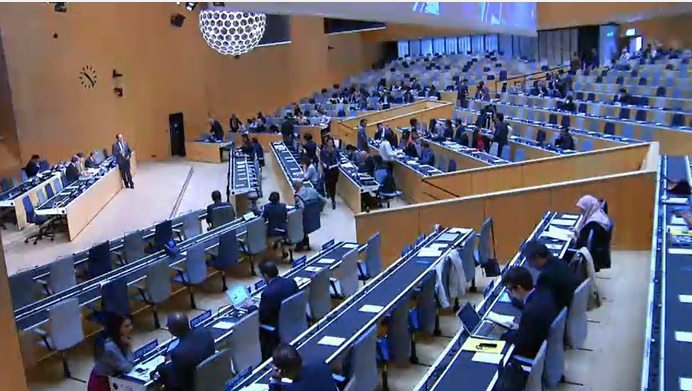
The World Intellectual Property Organization’s newest and potentially highest impact committee – aimed at ensuring all of the organisation’s activities are sufficiently development-friendly to fit its wide-ranging membership – completed its first year with some concrete progress and lots of hints for the future, including many new faces taking over the debate next year.
“Implementation has begun,” Guilherme Patriota of Brazil, a chief architect of the original Development Agenda, said afterward.
While the 7 to 11 July meeting of the Committee on Development and IP (CDIP) did not make any profound changes in the operations of WIPO yet, discussions revealed some of the areas where change may be coming. And while there were moments of tension, the overall spirit of the meeting appeared more agreeable than meetings of the past years.
The chair’s summary of the meeting is available here [pdf]. The annex of 45 recommendations for implementation, which did not change on the final day, is attached to the Thursday draft of the chair’s summary, available here to IP-Watch subscribers.
The committee concluded two weeklong meetings (the first in March) by discussing 19 recommendations that had been deemed as not needing significant new human or financial resources, thereby making it possible to implement them immediately, participants said. The committee also addressed a number of the remaining 26 recommendations, and began consideration of the budget associated with them.
“This is a significant first step toward implementation,” said Patriota. “It captures some content, and sends us forward.” He said the 19 recommendations could start being implemented and the others would go to the WIPO Programme and Budget Committee for 2009 implementation, which was “unavoidable.”
Agreement on the draft chair’s summary required several hours of a closed-door meeting upstairs in WIPO between the chair, regional coordinators and a few interested parties on the final afternoon.
Some participants said compromise was reached by, among other things, including a phrase in paragraph 12.d that said resources would be made available “in a manner consistent with WIPO’s programme and budgetary processes.” Developed countries had sought that assurance. Indonesia tried at the last moment to have it removed but Chairman Trevor Clarke of Barbados said that sometimes it is necessary in diplomacy to “state the obvious,” according to sources.
The other key compromise, one source said, was the change of a statement in paragraph 8 that the committee agreed on budget numbers provided by the WIPO secretariat [pdf] for implementing the Development Agenda, totalling in the millions. The language was changed to say the committee agreed on the “indicative figures” on human and financial resources proposed by the secretariat.
A significant debate surrounded the budgetary issue, as some were concerned that implementation of the recommendations be beholden to standard budgetary processes at WIPO, while others saw potential delay in the fact that the WIPO Program and Budget Committee is not scheduled to meet again until December, well after the September General Assembly.
The 2008-2009 budget does not include full funding for the Development Committee activities as it was passed beforehand. The issue appeared to be somewhat resolved by the expectation of an Extraordinary General Assembly to be held immediately after the Programme and Budget Committee. The extraordinary session also will give a chance for changes in budget under the new director general if he takes over in October.
Another key focus of the committee’s work during the week was establishing how it will carry out its mandate of “monitoring, assessing and reporting” on the implementation of 45 recommendations to “developmentise” WIPO’s work, agreed last year. In particular, this meant questioning representatives of other policy committees and deciding how strong a role – and how much budget – the committee will have vis à vis the others.
An overriding precept of the Development Agenda idea was that WIPO must reflect its United Nations status by fully taking into account the needs of developing countries in everything it does. WIPO is different from other UN agencies in that it is mostly funded by fees for services provided to IP rights holders, the vast majority of which are in developed countries.
Late in the meeting, Indonesia sought to add a specific timeframe in paragraph 10, which says the committee noted a need to discuss necessary mechanisms for coordination with other WIPO bodies in implementing the recommendations, and modalities for monitoring, assessing and reporting on the implementation. Indonesia was concerned because the chair’s summary only said the committee decided to “have a discussion on these issues” at the third session of the committee next year. The chair declined to change it, however, and said it would be understood that the timeframe would be next year.
In paragraph 7, which describes the opening remarks to the committee by WIPO Deputy Director General Francis Gurry, a change was made on request of Brazil. The paragraph had said Gurry was nominated “to become the next Director General of WIPO.” But this was changed to more accurately reflect the decision of the Coordination Committee, which in May decided by one vote to nominate Gurry “as candidate for appointment to the post of” WIPO Director General.
Brazil, whose candidate Jose Graça Aranha lost to Gurry by one vote, has been considering asking for a vote in the September General Assembly. If so, it could possibly lead to reopening the election process, according to sources.
A Fond Farewell
At the end of the week, the United States asked for a change in the chair’s summary reference to the “Development Agenda,” calling it out of date, a thing of the past, and that it is time to move on. Instead it should just say the work programme, they said. Brazil responded by accepting that it could say the Committee on Development and IP work programme, which was agreed.
The Development Agenda first was proposed by Brazil and Argentina in 2004, and was intensively negotiated until agreement on 45 recommendations at the September-October 2007 annual General Assembly. The assembly created the CDIP and gave it a mandate to implement the recommendations, which is still in the process of doing.
This year’s relative normalisation of the Development Committee into the workings of WIPO was capped Friday night by the announcement of the departure of several of the key architects of the WIPO Development Agenda.
Bidding farewell to WIPO and Geneva this month were: Guilherme Patriota of Brazil (heading to New York), Mohinder Grover of India (to Jamaica), Boumédiene Mahi of Algeria (to the capital Algiers), Gilles Barrier of France (to Rio de Janeiro) and David Morfesi of the US (returned to capital earlier this year). Egypt also has a change coming soon, officials said.
After several others had already given their farewell remarks, Patriota took the floor to make one last objection to the US suggestion on removing reference to the Development Agenda, but then said he would leave on a positive note by agreeing to name the full committee in the reference. A little later he took the floor to make give his farewell, and said he was sorry earlier, but that he had been busy trying to keep the United States from “suppressing” the Development Agenda.
William New may be reached at wnew@ip-watch.ch.

[…] Recommendations addressed during the week included: 1, 3, 4, 6 and 7, plus 19, 24 and 27. These were in addition to recommendation activities approved at the last session of the CDIP in July 2008. (IPW, WIPO, 12 July 2008). […]
[…] http://www.ip-watch.org/2008/07/12/wipo-development-committee-ends-first-year-on-mostly-agreeable-no… […]