

By Itaru Nitta, Green Intellectual Property Project, Geneva, Switzerland
Since the current IP framework has been shaped in wealthy societies of the North, accompanied by fertile markets, the North is required to rebuild the framework if they attempt to expand it to the South without substantial markets. The revamped regime, namely the “Green Intellectual Property (Green IP)” scheme or more explicitly the “Patent Insurance” scheme,1-8) would call for maintaining a reliable and sustainable patent system and assuring unimpeded access to socio-ecological needs or “green” technologies while “insuring” strong patent protections and consequently stimulating R&Ds even for unexploited markets.
Today’s global pro-patentism dates back to the Young Report in 1985, a policy recommendation urging strong IPs for the Reagan administration. Since the report, pro-patentists have argued patents allow us to enrich our society through technological progress accelerated by an increase in capital intensity for patentees. However, patents have also spawned fierce disputes when they interfered with access to necessary technologies such as essential medicines (see Box 1). Since the 2001 World Trade Organization Doha Declaration, and the historic signing of the TRIPS [WTO Agreement on Trade-Related Aspects of Intellectual Property Rights] amendment on public health, the worldwide anti-patent protest has successfully justified the flexibility in the patent regime, i.e., a variety of safeguard measures and exemptions for public interests of impoverished nations, who have now begun actually invoking such measures, specifically raising the number of compulsory licenses.
|
||||||||||||||||||||||||||||
These movements indeed are hard-won gains in the short term, but they usher in unfortunate consequences in the long run: the ultimate demise of the IP regime ruling not only patents but also R&D drivers. As developed by the European Patent Office (EPO) in the “Scenarios for the Future,1)” diminishing societal trust and growing criticism of patents would induce their erosions, which would be caused by the enforcement of more frequent and widened safeguard measures. The degradation of reliance on patents would result in the reduced number of applications and resultant fomentation of corporate secrets to avoid invention disclosure. This situation would lead to the vanishing of assistance for generic sources as well as incremental and genuine innovations. In such a world, to make the EPO’s scenario worse, most of the proposed funding (see Box 2) to stimulate incentives over neglected needs might not serve due to the absence of financial resources comparable to the earnings by patent monopolies. In other words, society would likely lose all the promoters of innovations, including not only patents but also the proposed mechanisms alternative to the present patent framework, unless society fundamentally reviews the framework.
The major causes of this nightmare are, as suggested by the Commission on IP Rights Innovation and Public Health (CIPIH) in the World Health Organisation (WHO),2) both that the patent system adversely functions for the developing world where their market has very limited purchasing power and that the system lacks stable and readily admissible flexibilities “flexible enough” for the developing nations.
|
To prevent such possible retrogression to the “IP anarchy” and its resulting disappearance of R&D drivers, we are forced to introduce a reform into the present IP regime in order to strike a new balance between knowledge monopoly and access to it while inciting incentives to socio-ecological needs or “green” technologies. These green technologies encompass sociological technologies, typically including medicines, as well as ecological technologies such as traditional eco-friendly technologies, hydrogen economy and space photovoltaic.
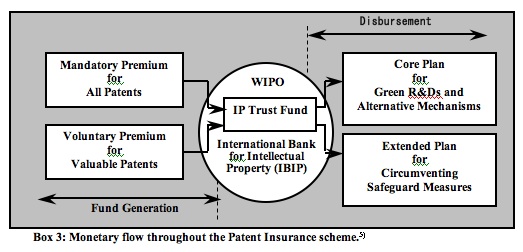
The Green IP scheme is designed to impose the “IP premium” in addition to existing official fees on patent applicants/owners to create the “IP trust fund (see Box 3).” The premium would consist of mandatory and voluntary fees, which would finance the core and extended plans, respectively. The IP trust fund would be operated by the International Bank for Intellectual Property (IBIP), a financing institution that could be an affiliated entity of the World Intellectual Property Organization (WIPO).
- The core plan would cover all patents regardless of their value in return for the mandatory premium. Under this plan, the IP fund would furnish a financial source for a variety of the proposed financial tools to intensify activities not only in green R&Ds but also in neglected necessary technologies, especially including prizes, public-private partnerships and treaties. This financial aid would allow society to recognise the utility of the patent regime as fending off criticism, resulting in upholding the efficient patent system and consequently ensuring patent properties of their owners.
- The extended plan would be offered to more valuable patents, such as drug patents, by paying the voluntary premium. This plan would provide financial assistance to technology users when they have unfavourable or no access to a patented technology due to a lack of capital and such users are condemned to issue safeguard measures. This assistance would compensate the cost of technology transfer, particularly royalty assumption, and subsidise the purchase of patented technology in a bid to deter users from actually invoking safeguard measures. As a result, insured patents would be guaranteed, while assuring unimpeded access to technologies.
Through the core and extended plans, the Green IP scheme would serve as a “green tax” to facilitate market incorporating its failure attributed to the current IP system. At the same time, the scheme would make for reliability and sustainability of the patent system where the patentee would successfully collect early investments and earn reasonable rewards for invented technologies. Furthermore, by means of amalgamating the Green IP scheme and the proposed alternative mechanisms for neglected technologies, inventors would be motivated to develop such technologies even when users do not have sufficient financial means.
| Source | Mandatory premium | Voluntary premium |
| Ratio | 3% of the total cost to obtain a patent right | 1% of the patent market |
| Potential revenue | $240 million | $50 billion |
The Green IP scheme would circumvent undermining of the patent regime and frequent issuing of safeguard measures. At the same time, it would facilitate unimpeded access to technologies and increased incentives for neglected needs and genuine innovations. These mutual benefits for patentees as well as users would convince patent applicants/owners to readily accept the financial burden of contributing to the Green IP scheme. The potential scale of the IP trust fund has been estimated to reach several tens of billions of US dollars annually (see Table),4) but also ecological technologies, e.g., solar power generation.7&8)
The Green IP scheme is today’s innovation that will enable future innovations to build a truly affluent society tomorrow.
The author can be reached at itaru@greenip.org. More information at: www.greenip.org.
1) http://www.epo.org/topics/patent-system/scenarios-for-the-future.html
2) http://www.who.int/intellectualproperty/en/
3) http://www.who.int/gb/phi/pdf/igwg2/PHI_IGWG2_ID4-en.pdf, paragraph 20
4) http://www.who.int/intellectualproperty/submissions/ITARUNITTA.pdf
5) http://www.who.int/phi/public_hearings/second/contributions_section2/Section2_NittaItaru-GreenIntellectualPropertyProject.pdf
6) http://www.who.int/phi/public_hearings/second/contributions_section2/Section2_NittaSummary.pdf
7) http://www.wcl.american.edu/org/sustainabledevelopment/2005/v5_2.pdf?rd=1
8) http://www2.epia.org/documents/NL_0603_015.